

Have you ever typed “vaccum” into a search bar only to see it corrected automatically? You’re not alone. Thousands of people search for vaccum or vacuum every month because the word looks deceptively simple but is surprisingly easy to misspell.
In this guide, you’ll learn which spelling is correct, why the mistake happens so often, how to remember the correct version, and how to use the word confidently in everyday writing. Whether you’re talking about a vacuum cleaner, a scientific vacuum, or simply checking your spelling, this article has you covered.
Vaccum or Vacuum: Which One Is Correct?
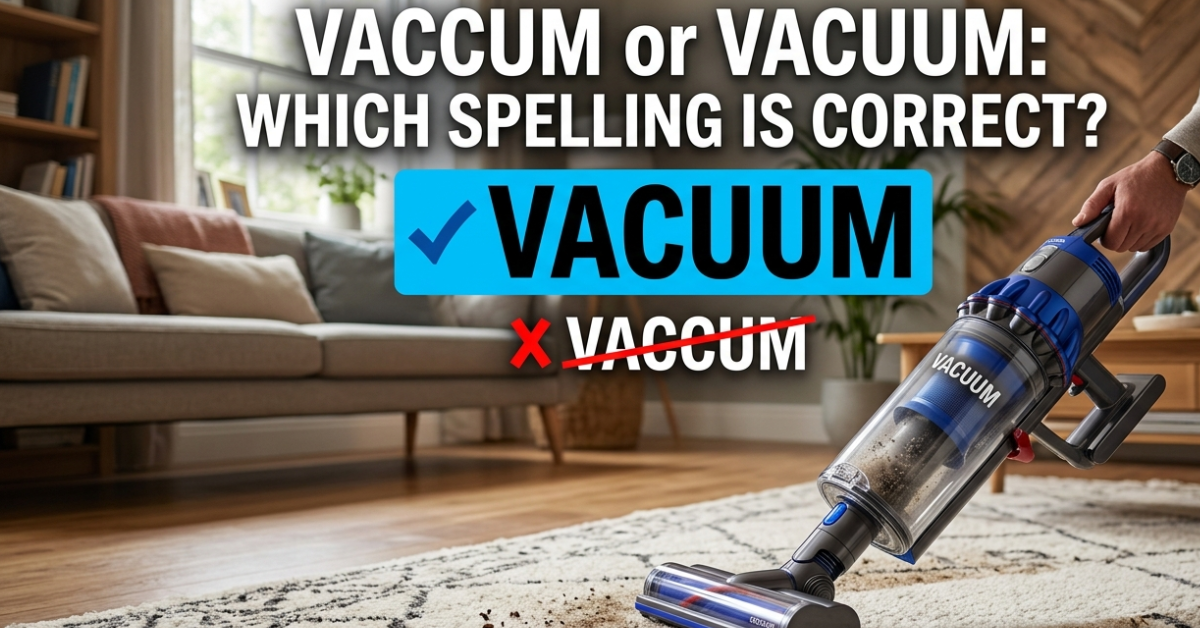
The correct spelling is vacuum.
The spelling vaccum is incorrect and is considered a common misspelling in English.
Correct: Vacuum
Incorrect: Vaccum
The word vacuum always contains two “u” letters placed together.
Examples
- I need to buy a new vacuum cleaner.
- The laboratory created a vacuum inside the chamber.
- Please vacuum the living room before guests arrive.
Incorrect examples:
- I bought a new vaccum.
- Can you vaccum the carpet?
Why Do People Spell It “Vaccum”?
The mistake is understandable because English spelling isn’t always intuitive.
Several factors contribute to this common error:
- People often forget the second u.
- The pronunciation doesn’t strongly emphasize both vowels.
- Many English words don’t contain consecutive u letters.
- Fast typing leads to accidental omissions.
Since “vaccum” closely resembles the correct pronunciation, it’s one of the most frequently misspelled household words.
What Does Vacuum Mean?
The word vacuum has multiple meanings depending on the context.
1. A Vacuum Cleaner
This is the meaning most people use daily.
Example:
She used the vacuum to clean the carpet.
Here, vacuum refers to an electrical appliance that removes dust and dirt.
2. An Empty Space
In science, a vacuum is a space containing very little or no matter.
Example:
Space is often described as being close to a vacuum.
Scientists frequently use this term in physics, astronomy, and engineering.
3. A Lack or Absence
The word can also describe the absence of something important.
Example:
After the manager resigned, there was a leadership vacuum.
In this case, it means a gap created by someone’s absence.
How to Pronounce Vacuum
The standard pronunciation is:
VAK-yoom
Phonetically:
/ˈvæk.juːm/
Although the word sounds like it has only one “u,” the spelling includes two consecutive u’s, making it easy to forget one while writing.
Easy Trick to Remember the Correct Spelling
A simple memory trick is:
A vacuum needs two “U”s because it “sucks up” everything.
Or think of it this way:
Vac + U + U + m
The double u is what makes the spelling complete.
Origin of the Word Vacuum
The word comes from the Latin word vacuus, meaning:
- Empty
- Void
- Unoccupied
English adopted the term in the 16th century, initially in scientific contexts. Over time, it expanded into everyday language through the invention of the vacuum cleaner.
Understanding the word’s origin helps explain why its spelling differs from what many people expect.
Is “Vaccum” Ever Correct?
No.
There are no accepted English dictionaries that recognize vaccum as a correct spelling.
Major dictionaries consistently list only:
- Vacuum
Spell-checkers, grammar tools, and search engines automatically suggest correcting vaccum to vacuum.
Vacuum as a Noun and a Verb
One interesting feature of the word is that it functions as both a noun and a verb.
As a Noun
It refers to a machine or an empty space.
Examples:
- The vacuum is stored in the closet.
- Scientists created a vacuum inside the chamber.
As a Verb
It means to clean using a vacuum cleaner.
Examples:
- I vacuum the house every Saturday.
- She vacuumed the office before leaving.
Common Phrases Using Vacuum
You’ll encounter the word in many everyday expressions.
Vacuum cleaner
The household appliance used for cleaning floors and carpets.
Vacuum seal
Removing air from packaging to preserve food.
Vacuum-packed
Products sealed without air to increase freshness.
Vacuum chamber
A sealed enclosure used in scientific experiments.
Power vacuum
A situation where leadership is missing.
Common Spelling Mistakes Related to Vacuum
Besides vaccum, people also write:
- Vacum
- Vaccuum
- Vacuum
- Vaccuam
The only correct spelling is:
Vacuum
Examples in Everyday Sentences
Here are some examples showing correct usage.
Home Cleaning
- I vacuum the living room every evening.
- Our old vacuum stopped working last week.
Science
- Air is removed to create a vacuum.
- Experiments are performed inside a vacuum chamber.
Business
- The CEO’s resignation created a leadership vacuum.
- Strong management prevented a power vacuum.
Vacuum vs Vacuum Cleaner
People often use these terms interchangeably, but there’s a slight difference.
| Vacuum | Vacuum Cleaner |
| Can refer to empty space or the appliance | Specifically refers to the cleaning machine |
| Broader meaning | Household appliance only |
Example:
- The vacuum cleaner is broken.
- The vacuum of space contains extremely little matter.
Why Correct Spelling Matters
Using the correct spelling improves:
- Professional communication
- Academic writing
- Search engine optimization
- Resume quality
- Email credibility
- Social media captions
- School assignments
Small spelling mistakes can affect how readers perceive your attention to detail.
Tips to Avoid Writing “Vaccum”
Try these practical habits:
- Read the word slowly before typing.
- Remember there are two consecutive “u” letters.
- Enable spell-check in your writing software.
- Practice writing the word several times.
- Associate it with the phrase: “Vacuum uses two U’s.”
With repetition, the correct spelling quickly becomes natural.
Related Words
Learning related vocabulary strengthens your understanding.
- Vacuuming
- Vacuumed
- Vacuum cleaner
- Vacuum seal
- Vacuum chamber
- Vacuum pressure
- Vacuum pump
- Vacuum-packed
- Suction
- Cleaning appliance
When Is Vacuum Used in Science?
In physics, a vacuum refers to an area with extremely low pressure where very few particles exist.
Scientists use vacuum environments in:
- Space research
- Semiconductor manufacturing
- Medical equipment
- Laboratory experiments
- Particle accelerators
While a perfect vacuum is theoretically difficult to achieve, modern technology can create environments that come very close.
Key Takeaways
- Vacuum is the correct spelling.
- Vaccum is always incorrect.
- The word contains two consecutive “u” letters.
- Vacuum can be both a noun and a verb.
- It refers to a cleaning appliance, an empty space, or an absence of something.
- Simple memory tricks can help prevent spelling mistakes.
Frequently Asked Questions
Is vaccum or vacuum correct?
The correct spelling is vacuum. The spelling vaccum is a common mistake and should be avoided in formal and informal writing.
Why is vacuum spelled with two U’s?
The spelling comes from the Latin word vacuus, which influenced the modern English form. Although pronunciation doesn’t emphasize both vowels, the standard spelling always includes two u letters.
Is vacuum a noun or a verb?
It can be both. As a noun, it refers to a cleaning machine or an empty space. As a verb, it means to clean using a vacuum cleaner.
Why do so many people write vaccum?
Most people accidentally omit one u because the pronunciation makes the double vowel easy to overlook. Fast typing and unfamiliar spelling patterns also contribute to the mistake.
Is “vacum” correct?
No. Like vaccum, vacum is an incorrect spelling. The only accepted English spelling is vacuum.
How can I remember the correct spelling of vacuum?
A simple trick is to remember that vacuum has two U’s because it sucks everything up. Visualizing the double u can help reinforce the correct spelling.
Conclusion
If you’ve ever wondered whether vaccum or vacuum is correct, the answer is straightforward: vacuum is the only correct spelling. While the mistake is common, remembering the double u and practicing the word a few times can help you avoid future errors.
Whether you’re writing about household cleaning, scientific concepts, or everyday conversations, using the correct spelling makes your writing clearer and more professional. Keep this guide handy whenever you need a quick reminder, and continue exploring common English spelling questions to strengthen your language skills.