

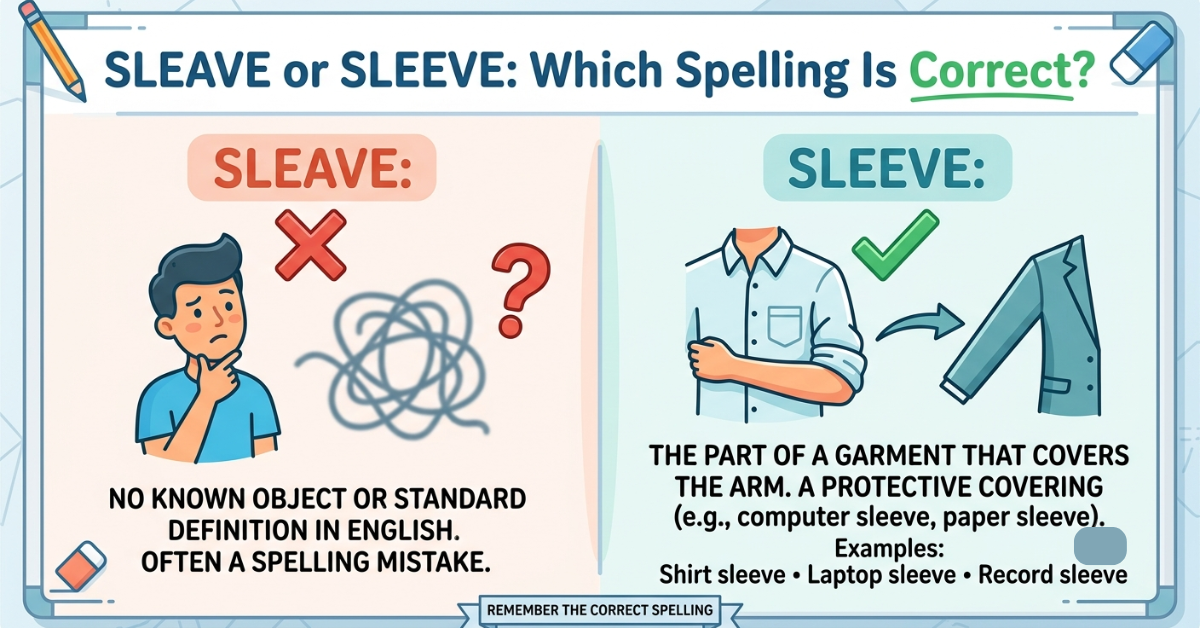
Have you ever typed “sleave” instead of “sleeve” and wondered if both words are correct? You’re not alone. It’s one of those spelling questions that catches many English learners and even native speakers off guard.
If you’ve searched for sleave or sleeve, you’re probably trying to figure out which spelling is correct, whether they mean the same thing, or if “sleave” is simply a typo. The answer is a little more interesting than you might expect. While sleeve is the standard English word used in everyday conversation, sleave is actually a real—but extremely rare—English word with a completely different meaning.
In this guide, you’ll learn the difference between the two words, when to use each one, common spelling mistakes, memorable grammar tips, and practical examples that make the distinction easy to remember.
Sleave or Sleeve: What’s the Difference?
Although these words differ by just one letter, they have very different meanings and usage.
| Word | Meaning | Common Usage |
| Sleeve | The part of a garment that covers the arm | Very common |
| Sleave | Fine silk thread or untwisted silk fiber (archaic) | Extremely rare |
For nearly every modern writing situation, sleeve is the correct choice.
What Does “Sleeve” Mean?
A sleeve is the part of clothing that covers all or part of your arm. It appears in everyday English and is used across fashion, tailoring, sportswear, and casual conversation.
Examples
- She rolled up her sleeves before washing the dishes.
- His jacket has long sleeves.
- The dress features elegant lace sleeves.
- My shirt sleeve got caught on the door handle.
You’ll also encounter sleeve in many technical contexts beyond clothing.
For example:
- Protective cable sleeves
- Laptop sleeves
- Baseball card sleeves
- Document sleeves
- Pipe sleeves in construction
In all of these cases, the word refers to something that surrounds, protects, or covers another object.
What Does “Sleave” Mean?
Unlike sleeve, sleave is an old English word that refers to:
- Fine silk thread
- Untwisted silk fiber
- Delicate strands used in textile production
Today, the word is considered archaic, meaning it has largely disappeared from everyday English.
Unless you’re reading historical literature, studying textile history, or analyzing Shakespearean language, you’re unlikely to encounter it.
Why Do People Confuse Sleave and Sleeve?
The confusion usually happens because the words:
- Look almost identical.
- Sound somewhat similar.
- Differ by only one letter.
- Are easily mistyped while typing quickly.
Autocorrect doesn’t always catch the mistake because sleave is technically a legitimate English word, even though it’s rarely used.
As a result, writers may accidentally leave “sleave” in documents without realizing it’s incorrect for modern usage.
Which Spelling Is Correct in Everyday English?
For almost every situation, sleeve is the correct spelling.
Use sleeve when referring to:
- Shirts
- Jackets
- Dresses
- Sweaters
- Protective covers
- Fabric components
- Accessories
Only use sleave when discussing historical textiles or quoting classic literature.
Easy Trick to Remember the Difference
Here’s a simple memory tip:
Sleeve has two “e”s—just like it covers two arms.
Meanwhile, sleave belongs to old-fashioned vocabulary and has almost disappeared from modern English.
Whenever you’re talking about clothing, always think sleeve.
Common Examples Using “Sleeve”
Here are some everyday sentences.
Clothing
- This sweater has extra-long sleeves.
- She prefers short-sleeve shirts in summer.
- His coat sleeves are too short.
Protection
- Place the document inside a plastic sleeve.
- The laptop sleeve protects the computer from scratches.
Sports
- He wears a compression sleeve during games.
- The baseball cards were stored in protective sleeves.
Common Mistakes to Avoid
Many writers accidentally replace sleeve with sleave.
Incorrect
- I bought a shirt with short sleaves.
- Roll up your sleave.
- The dress has beautiful sleaves.
Correct
- I bought a shirt with short sleeves.
- Roll up your sleeve.
- The dress has beautiful sleeves.
Notice another common error: sleaves.
The correct plural is sleeves, not sleaves.
Is “Sleave” Ever Correct?
Yes—but only in specialized or historical contexts.
You might see it in:
- Historical dictionaries
- Textile research
- Medieval literature
- Shakespearean analysis
- Linguistic studies
For general communication, emails, blogs, business writing, and academic papers, sleeve is the word you want.
Origin of the Words
Sleeve
The word sleeve comes from Old English slēfe, referring to the arm portion of a garment. Over centuries, it evolved into the modern spelling we use today.
Sleave
Sleave originates from an old Scottish and Middle English term referring to silk fibers or untwisted thread. Its use gradually declined, making it one of many obsolete English words that survive mainly in historical texts.
Popular Idioms Using “Sleeve”
The word sleeve appears in many common English expressions.
Wear your heart on your sleeve
Meaning:
Show your emotions openly.
Example:
She wears her heart on her sleeve and tells everyone how she feels.
Have an ace up your sleeve
Meaning:
Have a hidden advantage or secret plan.
Example:
The company had an ace up its sleeve before launching the product.
Roll up your sleeves
Meaning:
Prepare to work hard.
Example:
It’s time to roll up our sleeves and finish the project.
These idioms all use sleeve, never sleave.
Practical Tips for Remembering the Correct Spelling
If you’re still unsure which word to use, keep these tips in mind:
- If you’re talking about clothing, it’s sleeve.
- If you’re discussing protective covers, it’s sleeve.
- If you’re writing everyday English, it’s almost always sleeve.
- If you encounter sleave, check whether you’re reading historical or literary material.
- Proofread clothing-related content carefully, as spell-checkers may not always flag “sleave.”
Key Takeaways
- Sleeve is the standard modern English spelling.
- Sleave is a real but archaic word meaning fine silk thread.
- Most people searching sleave or sleeve need the word sleeve.
- Common expressions like “roll up your sleeves” always use sleeve.
- The plural form is sleeves, not sleaves.
- In modern writing, sleeve is almost always the correct choice.
Frequently Asked Questions
Is it sleave or sleeve?
Sleeve is correct in modern English when referring to clothing or protective covers. Sleave is an archaic word with a different meaning.
Is “sleave” a real English word?
Yes. Although uncommon today, sleave is a genuine English word that historically referred to fine silk thread or untwisted silk fiber.
Why does spell-check sometimes allow “sleave”?
Because sleave exists in English dictionaries, spell-check software may not mark it as an error, even though it is rarely appropriate in modern writing.
What is the plural of sleeve?
The correct plural is sleeves.
Example:
- The jacket has wide sleeves.
Can I use “sleave” in everyday writing?
Generally, no. Unless you’re discussing historical textiles or quoting old literature, sleeve is the correct word.
How can I remember the difference between sleave and sleeve?
Think of sleeve as the part of clothing that covers your arm. Since it’s used every day, it’s the spelling you’ll almost always need. Reserve sleave for historical or literary contexts.
Conclusion
The confusion between sleave or sleeve is understandable because the words are visually similar. However, they serve very different purposes. Sleeve is the correct and widely accepted spelling for the arm section of clothing, protective covers, and numerous everyday expressions. Sleave, while technically a valid English word, is an archaic term referring to fine silk thread and is rarely used outside historical or literary discussions.
When in doubt, choose sleeve. It’s the spelling expected by readers, recognized in modern English, and appropriate in nearly every context. Understanding this small distinction helps improve your writing accuracy and ensures your message is clear and professional.