

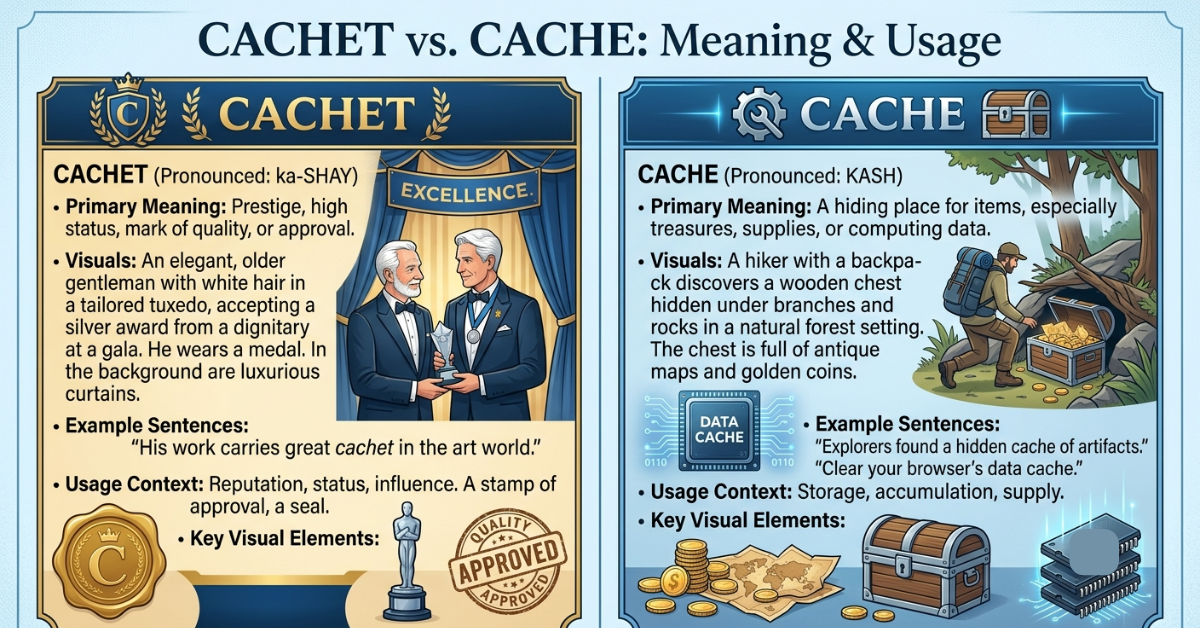
Have you ever read the words cache and cachet and wondered whether they’re related? They look remarkably similar, yet they mean completely different things. This confusion is surprisingly common because both words come from French and are pronounced differently from how they’re spelled.
In this guide to cachet vs cache, you’ll discover what each word means, how to pronounce them correctly, when to use them, and easy tricks to remember the difference. By the end, you’ll be able to use both words confidently in everyday conversations and writing.
What Does “Cache” Mean?
A cache is a hidden storage location or a temporary place where information or valuable items are stored for quick access.
The word has two primary meanings.
1. Cache in Technology
In computing, a cache temporarily stores data so a device or application can retrieve it faster instead of loading it again.
Examples include:
- Browser cache
- CPU cache
- App cache
- DNS cache
Example sentences:
- Clearing your browser cache may fix website loading problems.
- My phone’s cache is taking up several gigabytes of storage.
2. Cache as a Hidden Storage Place
Outside technology, a cache refers to a concealed collection of supplies or valuables.
Examples:
- A cache of gold coins
- A cache of emergency food
- A cache of survival equipment
Example sentences:
- Archaeologists discovered a cache of ancient jewelry.
- Campers hid a cache of supplies for the return trip.
What Does “Cachet” Mean?
A cachet refers to prestige, distinction, status, or a mark of excellence that makes someone or something admired or respected.
It often describes reputation rather than physical objects.
Example sentences:
- Owning an original painting gives the collection extra cachet.
- The university has international cachet.
- Working for a famous company adds professional cachet.
In another, less common sense, cachet can also mean an official seal or stamp used on documents or packages.
Cachet vs Cache: Quick Comparison
| Feature | Cache | Cachet |
| Meaning | Hidden storage or temporary data storage | Prestige, distinction, reputation |
| Common Use | Technology, storage, hidden supplies | Social status, branding, reputation |
| Pronunciation | Cash | Cash-AY |
| Part of Speech | Noun | Noun |
| Origin | French | French |
| Example | Clear your cache | The award gave her cachet |
Pronunciation Guide
Many people confuse these words because of their spelling.
Cache
Pronounced:
Cash
One syllable.
Cachet
Pronounced:
Cash-AY
Two syllables, with emphasis on the second.
Remember:
- Cache = Cash
- Cachet = Cash-AY
Why People Confuse Cache and Cachet
Several factors contribute to the confusion.
Similar Spellings
Only two letters separate the words.
Shared French Origins
Both entered English from French, making their spellings unfamiliar to many English speakers.
Similar Pronunciation at First
Both begin with the “cash” sound.
Lack of Familiarity
Many people encounter “cache” through computers but rarely see “cachet” outside books, journalism, or marketing.
Easy Memory Trick
Here’s a simple way to remember the difference.
Cache = Computer
Both words begin with C and relate to storing something.
Think:
Cache stores data.
Cachet = Elite
The ending -et sounds elegant.
Think:
Cachet equals prestige and style.
Examples of Cache in Everyday Life
Technology examples:
- Clear your browser cache.
- The processor cache improves computer speed.
- Your phone cache stores temporary files.
Non-technology examples:
- Explorers found a cache of supplies.
- Police uncovered a cache of illegal weapons.
- Hunters kept a hidden cache of food.
Examples of Cachet in Everyday Life
Professional settings:
- An MBA from a respected university carries cachet.
- Luxury brands have global cachet.
Business:
- Winning the award gave the company added cachet.
- Celebrity endorsements increase brand cachet.
Personal life:
- Speaking several languages adds cultural cachet.
- The neighborhood gained cachet after famous chefs opened restaurants there.
Common Mistakes to Avoid
Incorrect:
This luxury watch has a lot of cache.
Correct:
This luxury watch has a lot of cachet.
Incorrect:
Clear your browser cachet.
Correct:
Clear your browser cache.
Incorrect:
The archaeologists found a cachet of coins.
Correct:
The archaeologists found a cache of coins.
Cache vs Cachet in Technology
Only cache is used in computing.
Examples include:
- Cache memory
- Browser cache
- Cached files
- Cache server
- Cache clearing
You’ll never hear professionals talk about “clearing the cachet” because cachet has nothing to do with computers.
Cachet in Business and Marketing
In branding, cachet refers to the intangible value that makes a brand desirable.
For example:
- Luxury fashion labels have cachet because of exclusivity.
- Premium hotels build cachet through exceptional service.
- Awards and certifications can add cachet to a business.
Cachet influences perception rather than functionality.
Origins of the Words
Although both words come from French, they evolved differently.
Cache
Derived from the French word meaning “to hide.”
Its original sense referred to concealed storage before expanding into computing.
Cachet
Originally referred to an official seal or stamp.
Over time, it came to represent distinction, authenticity, and prestige.
Cachet vs Cache: Which Word Should You Use?
Ask yourself one simple question.
Are you talking about storage?
Use cache.
Are you talking about prestige or reputation?
Use cachet.
This quick test works almost every time.
Key Differences at a Glance
- Cache means hidden storage or temporary computer data.
- Cachet means prestige, distinction, or reputation.
- Cache is pronounced cash.
- Cachet is pronounced cash-AY.
- Cache is common in technology.
- Cachet is common in business, luxury, branding, education, and culture.
Practical Tips to Remember
- Think browser cache whenever you hear “cache.”
- Think luxury brands whenever you hear “cachet.”
- If the conversation involves computers, the correct word is almost certainly cache.
- If the discussion is about reputation, status, or elegance, choose cachet.
Frequently Asked Questions
Is cache the same as cachet?
No. Cache refers to hidden or temporary storage, while cachet refers to prestige, distinction, or reputation. Although they look alike, they have completely different meanings.
How do you pronounce cache and cachet?
Cache is pronounced “cash.” Cachet is pronounced “cash-AY,” with emphasis on the second syllable.
Which word is used in computers?
Only cache is used in computing. It describes temporary storage that helps software and hardware retrieve information more quickly.
Can cachet mean luxury?
Not exactly. Cachet doesn’t mean luxury itself; it refers to the prestige, exclusivity, or status associated with something. Luxury products often have cachet because people admire their reputation.
What is an example of cache?
A browser storing website images for faster loading is a cache. Another example is a hidden cache of emergency supplies kept in a safe location.
Why are cache and cachet often confused?
People confuse cachet vs cache because the words share similar spellings, French origins, and the same opening pronunciation. However, their meanings are entirely unrelated.
Conclusion
Understanding cachet vs cache is easier once you know what each word represents. Cache is all about storing information or hidden supplies, whether in a computer or the real world. Cachet, on the other hand, is about prestige, reputation, and the special quality that makes someone or something stand out.
The next time you encounter these words, remember the simple rule: storage equals cache, prestige equals cachet. Keeping this distinction in mind will make your writing clearer, more accurate, and more professional. If you’re expanding your vocabulary, mastering commonly confused word pairs like this is an excellent way to communicate with greater confidence.