

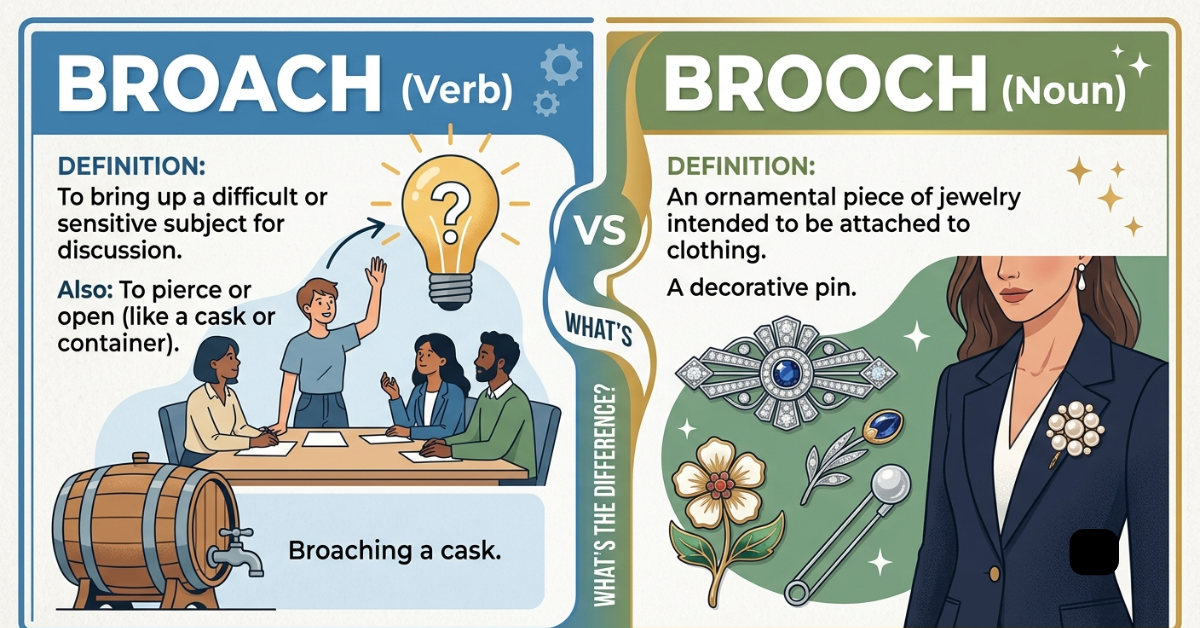
Have you ever seen someone write “beautiful diamond broach” when they were actually talking about jewelry? You’re not alone. These two words look and sound similar, making them one of the most commonly confused pairs in English.
Understanding broach vs brooch is easier than it seems. While they differ by just one letter, they have completely different meanings and uses. In this guide, you’ll learn what each word means, how to pronounce them correctly, when to use each one, common mistakes to avoid, memory tricks, and plenty of real-life examples so you’ll never mix them up again.
Why Do People Confuse Broach and Brooch?
The confusion comes down to three simple reasons:
- Their spellings are almost identical.
- Their pronunciations are somewhat similar.
- Both words appear in formal writing more often than everyday conversation.
However, once you understand what each word represents, choosing the correct one becomes straightforward.
Broach Meaning
The word broach is primarily used as a verb.
It means:
- To introduce a topic for discussion
- To bring up a difficult or sensitive subject
- To begin talking about something
Although broach can occasionally be used as a noun in technical contexts (such as a metal-cutting tool), most people encounter it as a verb.
Examples
- She decided to broach the subject of moving overseas.
- I’d like to broach an important issue during today’s meeting.
- Nobody wanted to broach the conversation about budget cuts.
In every example, broach refers to starting a discussion.
How to Remember “Broach”
Think of this phrase:
Broach = Bring up a topic.
Both broach and bring start with the letter B, making it easier to remember.
Brooch Meaning
A brooch is a noun.
It refers to a decorative piece of jewelry that is attached to clothing with a pin.
Brooches have been worn for centuries and can be made from:
- Gold
- Silver
- Diamonds
- Pearls
- Enamel
- Gemstones
- Vintage metals
Today, brooches are popular fashion accessories worn on jackets, dresses, scarves, hats, and coats.
Examples
- She wore a vintage sapphire brooch to the wedding.
- My grandmother gave me a beautiful gold brooch.
- The antique brooch became the centerpiece of her outfit.
In every case, brooch refers to jewelry, not conversation.
How to Remember “Brooch”
Think:
Brooch = Beautiful jewelry.
The double “oo” can remind you of the round decorative shape found on many brooches.
Broach vs Brooch: Quick Comparison
| Feature | Broach | Brooch |
| Part of speech | Verb | Noun |
| Meaning | Introduce a topic | Decorative pin or jewelry |
| Used for | Conversations | Fashion accessories |
| Example | Let’s broach the issue. | She wore a pearl brooch. |
| Common context | Meetings, discussions | Clothing, style, jewelry |
Pronunciation Difference
One reason people confuse these words is pronunciation.
Broach
Pronounced:
BROHCH
Rhymes with:
- Coach
- Roach
- Approach
Brooch
Pronounced:
BROHCH
Interestingly, despite the spelling, brooch is usually pronounced exactly the same as broach.
This identical pronunciation is one reason spelling mistakes happen so often.
When Should You Use Broach?
Use broach whenever you’re talking about introducing a discussion.
Examples include:
- Bringing up a concern
- Mentioning a sensitive issue
- Starting an important conversation
- Raising a question
- Opening negotiations
Example Sentences
- He finally broached the topic of retirement.
- When should we broach salary expectations?
- She carefully broached the subject with her parents.
When Should You Use Brooch?
Use brooch whenever you’re referring to a decorative accessory.
Common situations include:
- Fashion
- Jewelry collections
- Family heirlooms
- Vintage accessories
- Formal outfits
Example Sentences
- The queen wore an emerald brooch.
- Her floral brooch matched the dress perfectly.
- Antique brooches are highly collectible.
Common Mistakes
Many English learners—and even native speakers—accidentally swap these words.
Incorrect
- She wore a beautiful broach.
Correct
- She wore a beautiful brooch.
Incorrect
- I’d like to brooch an important topic.
Correct
- I’d like to broach an important topic.
Easy Memory Trick
Here’s one of the simplest ways to remember the difference.
Broach
Think:
Broach = Bring up
Both begin with B.
Brooch
Think:
Brooch = Jewelry you wear
Notice the double OO, which looks decorative—just like jewelry.
Real-Life Examples
At Work
“We need to broach the issue of project delays.”
Correct because it’s about starting a discussion.
At a Jewelry Store
“This antique brooch belonged to my grandmother.”
Correct because it’s a piece of jewelry.
During a Meeting
“I wasn’t sure how to broach the conversation.”
Correct because someone is introducing a topic.
During a Fashion Event
“The diamond brooch completed the outfit.”
Correct because it’s an accessory.
Historical Background
Origin of Broach
The word broach comes from Old French and originally referred to a pointed tool or spit. Over time, its meaning expanded to include the idea of opening or introducing something, which led to the modern expression of introducing a topic.
Origin of Brooch
The word brooch developed from similar historical roots but evolved specifically to describe ornamental pins used to fasten clothing. Over the centuries, it became associated with decorative jewelry rather than tools or conversations.
Why This Difference Matters
Using the wrong word may not completely confuse readers, but it can make writing appear less polished.
For example:
- Business emails
- Academic assignments
- Job applications
- Articles
- Professional reports
Correct word choice demonstrates attention to detail and strong language skills.
Tips to Never Mix Them Up Again
- Use broach only for discussions.
- Use brooch only for jewelry.
- Remember: Bring up = Broach.
- Remember: Brooch = Ornament.
- Proofread if you’re unsure.
- Read the sentence aloud and ask yourself whether you’re talking about a conversation or an accessory.
Key Differences at a Glance
- Broach is a verb.
- Brooch is a noun.
- Broach means to introduce a subject.
- Brooch is a decorative pin worn on clothing.
- Although they’re pronounced the same, their meanings are completely different.
- The correct choice depends entirely on context.
Frequently Asked Questions
Is it broach or brooch when talking about jewelry?
The correct word is brooch. A brooch is a decorative pin worn on clothing, while broach refers to introducing a topic.
What does broach mean in English?
Broach means to introduce or raise a subject for discussion, especially one that may be sensitive or important.
Why are broach and brooch pronounced the same?
English contains many words with historical spellings that don’t perfectly match modern pronunciation. Although broach and brooch are spelled differently, both are commonly pronounced brohch.
Can broach be used as a noun?
Yes, but only in specialized fields such as engineering and metalworking, where a broach is a cutting tool. In everyday English, it is most often used as a verb.
Is “diamond broach” correct?
No. If you’re referring to jewelry, the correct phrase is diamond brooch.
How can I remember the difference between broach and brooch?
Remember this simple rule:
- Broach = Bring up a conversation
- Brooch = Beautiful piece of jewelry
This quick association makes choosing the correct word much easier.
Conclusion
The distinction between broach vs brooch is simple once you know what each word represents. Broach is used when introducing a topic or starting a discussion, while brooch refers to a decorative pin or jewelry accessory worn on clothing. Although they share the same pronunciation, their meanings are entirely different.
By remembering that broach relates to conversations and brooch relates to fashion, you’ll avoid one of the most common spelling mistakes in English. The next time you’re writing an email, describing a piece of jewelry, or discussing an important topic, you’ll know exactly which word belongs. Keep practicing with real-world examples, and the distinction will soon become second nature.