

Have you ever sent an important email and wondered whether the recipient actually received it? Whether you’re sharing a contract, sending business documents, or following up on a job application, knowing your email has safely reached the other person provides peace of mind.
This is exactly why the phrase please acknowledge the receipt of this email is so commonly used in professional communication. It’s a polite request asking the recipient to confirm that they have received your message. In this guide, you’ll learn what the phrase means, when to use it, when to avoid it, professional alternatives, real-life examples, and best practices for writing courteous business emails.
What Does “Please Acknowledge the Receipt of This Email” Mean?
The phrase please acknowledge the receipt of this email is a formal way of asking someone to confirm that they have received your message.
It’s important to understand that this request is not asking for a full reply or an immediate solution. Instead, it’s simply requesting a confirmation such as:
- “Received, thank you.”
- “I have received your email.”
- “Noted with thanks.”
- “Acknowledged.”
- “Received. I’ll review it shortly.”
The purpose is to reassure the sender that the email has successfully arrived.
Why Do People Use This Phrase?
In professional settings, emails often contain valuable or time-sensitive information. A simple acknowledgment helps avoid confusion and unnecessary follow-ups.
Common reasons include:
- Sending contracts
- Sharing legal documents
- Delivering invoices
- Providing project files
- Sending confidential information
- Confirming business agreements
- HR communications
- Academic submissions
Without confirmation, the sender may wonder whether the email landed in the inbox, went to spam, or was overlooked.
When Should You Use “Please Acknowledge the Receipt of This Email”?
This phrase works best in situations where confirming receipt is genuinely important.
Business Documents
If you’re sending official paperwork, it’s reasonable to request confirmation.
Example:
Please acknowledge the receipt of this email and confirm that the attached agreement has been received.
Job Applications
Candidates sometimes politely ask recruiters to confirm receipt of application materials.
Example:
Kindly acknowledge the receipt of this email containing my resume and cover letter.
Legal Communication
Law firms and legal professionals frequently request acknowledgment when sharing important documents.
Financial Transactions
Banks, accountants, and finance teams often use the phrase when sending invoices or payment confirmations.
Project Management
Managers may request acknowledgment after sharing deadlines, project plans, or client deliverables.
Academic Communication
Students may ask professors or administrators to confirm receipt of assignments or important documents.
Situations Where You Should Avoid Using It
Although professional, this phrase isn’t necessary in every email.
Avoid using it for:
- Casual conversations
- Friendly emails
- Quick workplace chats
- Routine updates
- Internal messages that don’t require confirmation
For example:
Instead of saying:
Please acknowledge the receipt of this email.
Simply write:
Let me know if you received this.
or
Just checking that this reached you.
These alternatives sound warmer in informal communication.
Is It Polite?
Yes.
The phrase is considered polite, respectful, and professional.
However, because it’s fairly formal, some workplaces prefer softer wording.
Instead of sounding overly official, many professionals now write:
- Please confirm receipt.
- Kindly confirm you’ve received this email.
- Let me know once you’ve received this.
- Please confirm that this has reached you.
These versions feel more conversational while remaining professional.
Professional Alternatives
Here are excellent alternatives depending on the situation.
| Formal | Semi-Formal | Friendly |
| Kindly acknowledge receipt. | Please confirm receipt. | Let me know if you got this. |
| Please confirm receipt of this email. | Kindly confirm you’ve received this. | Just checking this reached you. |
| Please acknowledge receipt at your earliest convenience. | Please let me know once received. | Hope this arrived safely. |
| Kindly confirm safe receipt. | Please confirm this has reached you. | Thanks for confirming receipt. |
Using different expressions prevents your emails from sounding repetitive.
Email Examples
Example 1: Business Email
Subject: Project Documents
Dear Mr. Ahmed,
Please find the project documents attached for your review.
Please acknowledge the receipt of this email at your earliest convenience.
Thank you.
Kind regards,
Sarah Khan
Example 2: Job Application
Dear Hiring Manager,
Please find attached my resume and cover letter for the Marketing Executive position.
I would appreciate it if you could please acknowledge the receipt of this email.
Thank you for your consideration.
Best regards,
Ali Hassan
Example 3: Invoice Submission
Dear Finance Team,
Attached is Invoice No. 2045 for this month’s services.
Kindly acknowledge receipt of this email.
Thank you.
Common Mistakes to Avoid
Many people accidentally make their emails sound demanding.
1. Being Too Forceful
Instead of:
Acknowledge receipt immediately.
Write:
Please confirm receipt when convenient.
2. Overusing the Phrase
Not every email requires acknowledgment.
Reserve it for important communication.
3. Using It Without Context
Always explain what you’re sending.
Poor example:
Please acknowledge the receipt of this email.
Better:
Please find the signed agreement attached. Kindly acknowledge receipt once you’ve received it.
4. Forgetting Attachments
Many acknowledgment requests involve attachments.
Always double-check that you’ve actually attached the files before sending.
Email Etiquette Tips
Following proper email etiquette makes your communication more effective.
Keep Your Subject Line Clear
Examples:
- Contract Documents
- Updated Proposal
- Invoice Attached
- Project Files
- Employment Documents
Be Polite
Use courteous phrases like:
- Thank you.
- I appreciate your assistance.
- Looking forward to your confirmation.
Mention Attachments
Tell recipients exactly what you’ve attached.
Avoid Excessive Formality
Modern business communication favors clear, concise language over overly formal expressions.
Follow Up Only When Necessary
If you don’t receive acknowledgment after a reasonable time:
- Wait 1–2 business days.
- Send a polite reminder.
- Avoid sending multiple follow-up emails too quickly.
Is “Please Acknowledge the Receipt of This Email” Still Common?
Yes, but it’s evolving.
Many organizations now prefer simpler language because it feels more natural.
Instead of lengthy formal wording, professionals increasingly use:
- Please confirm receipt.
- Let me know once received.
- Kindly confirm you’ve received the attached documents.
- Please let me know if everything came through correctly.
These alternatives communicate the same message while sounding more approachable.
Why Acknowledging Emails Matters
Replying with a quick acknowledgment benefits both parties.
It:
- Confirms successful delivery
- Prevents unnecessary follow-up emails
- Builds trust
- Demonstrates professionalism
- Improves workplace communication
- Keeps projects moving smoothly
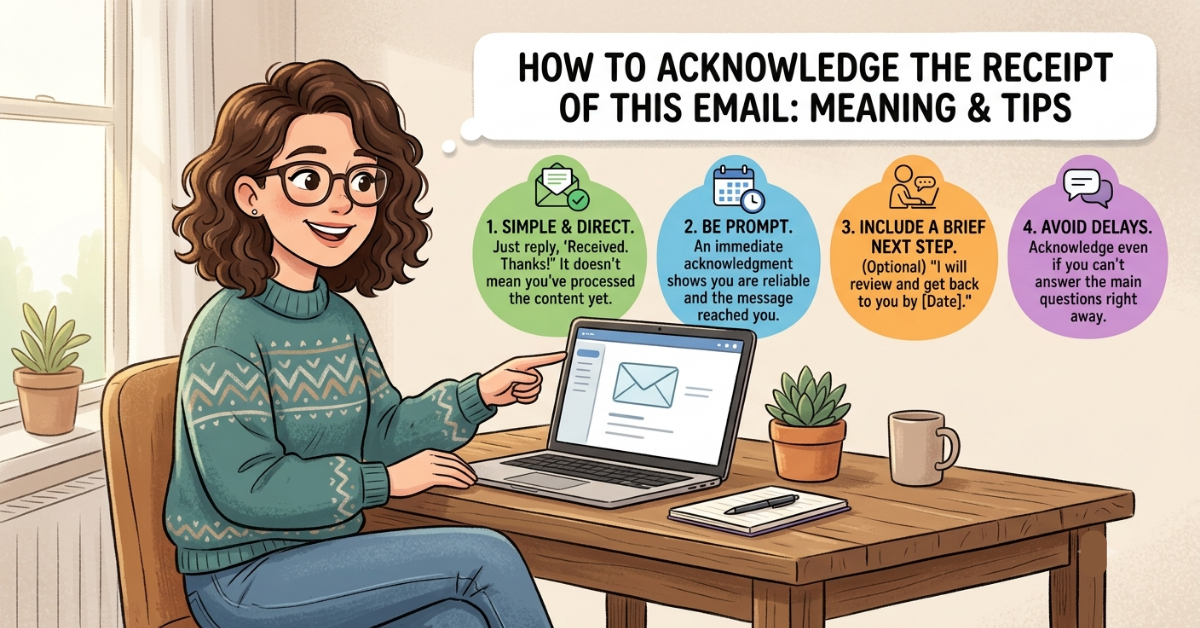
Even a two-word reply like “Received, thanks” can save time for everyone involved.
Practical Tips for Better Email Communication
To make your emails more effective:
- Ask for acknowledgment only when it’s truly necessary.
- Match your level of formality to your audience.
- Keep your request brief and polite.
- State clearly what the recipient is confirming.
- Proofread before sending, especially when attachments are involved.
- Use a professional closing such as “Kind regards” or “Best regards.”
These small habits can make your communication clearer and more professional.
Key Takeaways
- Please acknowledge the receipt of this email means “please confirm you’ve received my message.”
- It is most appropriate for formal and professional communication.
- The phrase requests confirmation of receipt, not a detailed response.
- Simpler alternatives often sound more natural in modern workplaces.
- Use acknowledgment requests only when confirmation is genuinely important.
- Clear, polite email writing helps improve communication and reduce misunderstandings.
Frequently Asked Questions
Is “please acknowledge the receipt of this email” grammatically correct?
Yes. The phrase is grammatically correct and widely accepted in professional and business communication. It politely asks the recipient to confirm receipt of your email.
What is a simpler way to say “please acknowledge the receipt of this email”?
You can say:
- Please confirm receipt.
- Let me know you’ve received this.
- Kindly confirm you’ve received my email.
- Please let me know if this reached you.
These alternatives are often more natural while remaining professional.
Is it rude to ask someone to acknowledge receipt of an email?
No. Asking someone to acknowledge receipt is perfectly acceptable when the email contains important information or documents. The key is to phrase the request politely and avoid sounding demanding.
Should I use “please acknowledge the receipt of this email” in every email?
No. It’s best reserved for emails involving contracts, invoices, legal documents, applications, or other important communications where confirmation is necessary.
How should someone respond to an acknowledgment request?
A brief reply is usually sufficient. Responses like “Received, thank you,” “I have received your email,” or “Acknowledged. I’ll review it shortly” clearly confirm receipt without requiring a lengthy response.
What’s the difference between acknowledging receipt and replying?
Acknowledging receipt simply confirms that the email was received. Replying usually addresses the email’s content, answers questions, or provides additional information.
Conclusion
The phrase please acknowledge the receipt of this email remains a valuable part of professional communication, especially when you’re sending important documents or time-sensitive information. While it’s formal, it’s also respectful and effective when used appropriately.
That said, modern workplaces often favor shorter and more conversational alternatives like “Please confirm receipt” or “Let me know once you’ve received this.” Choosing the right wording depends on your audience, the context, and the level of formality required.
By understanding when to use this phrase—and when a simpler alternative is better—you can write clearer, more professional emails that encourage prompt communication and build stronger working relationships.