

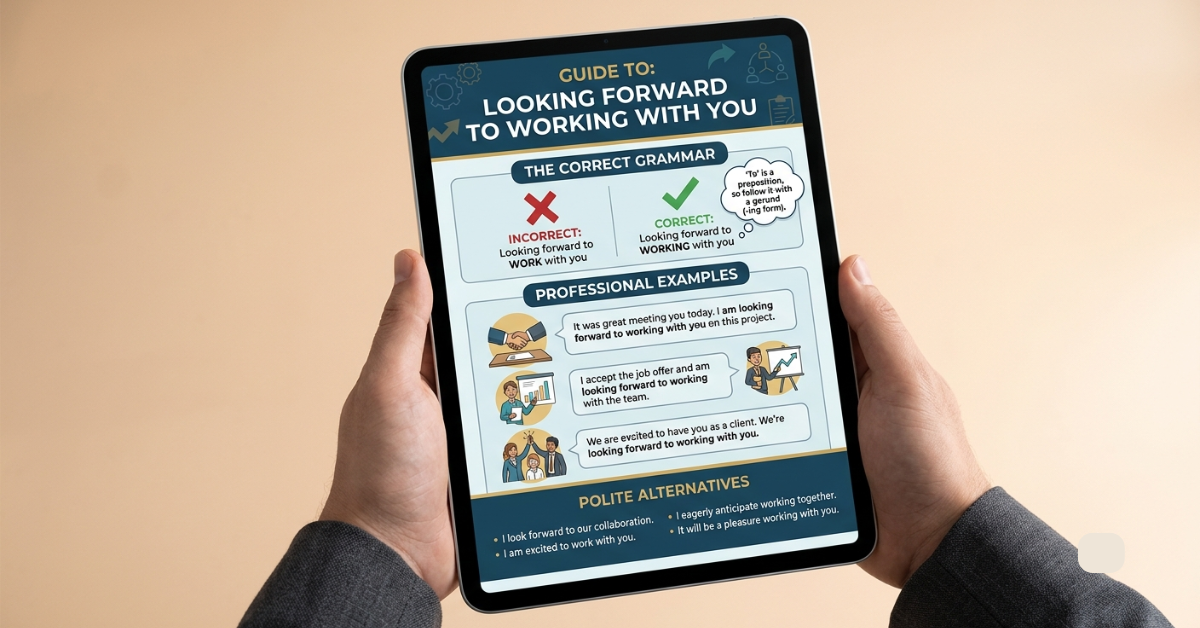
Have you ever finished writing an email and paused at the closing line, wondering whether you should write looking forward to work with you or looking forward to working with you? You’re not alone. It’s one of the most common grammar questions in professional communication.
Many people write I’m looking forward to work with you or I am looking forward to work with you, believing they’re correct. While these phrases are widely used, English grammar follows a different rule. In this guide, you’ll learn the correct expression, why it matters, when to use each variation, professional alternatives, and examples for emails, business communication, interviews, and teamwork.
What Does “Looking Forward to Work With You” Mean?
The phrase expresses excitement, anticipation, or enthusiasm about collaborating with someone in the future. It is commonly used at the end of:
- Business emails
- Job offer acceptance emails
- Client communications
- Partnership proposals
- Team introductions
- Networking messages
Its purpose is simple: it tells the other person that you’re positive about your future relationship or collaboration.
For example:
Thank you for the opportunity. I’m looking forward to working with you.
This sentence sounds warm, professional, and confident.
Looking Forward to Work With You or Working With You?
This is the question most people search for.
The Correct Version
Looking forward to working with you
This is grammatically correct because to is part of the phrasal verb look forward to, not an infinitive.
After look forward to, English requires:
- a noun
- a pronoun
- or a gerund (verb + -ing)
Therefore:
- Looking forward to working with you.
- Looking forward to meeting you.
- Looking forward to hearing from you.
Not:
- Looking forward to work with you.
- Looking forward to meet you.
Why Is “Working” Correct?
Many people assume to should always be followed by the base verb.
That’s true in sentences like:
- I want to work.
- I need to study.
However, look forward to is a fixed expression.
Here, to acts as a preposition rather than part of an infinitive.
Because prepositions are followed by nouns or gerunds, the correct form becomes:
Looking forward to working with you.
Is “I’m Looking Forward to Work With You” Correct?
No.
The phrase I’m looking forward to work with you is grammatically incorrect in standard English.
Correct version:
I’m looking forward to working with you.
Although you may occasionally see the incorrect version online or in casual writing, professional emails, academic writing, and formal communication should always use the gerund.
Is “I Am Looking Forward to Work With You” Correct?
This version has the same issue.
Incorrect:
I am looking forward to work with you.
Correct:
I am looking forward to working with you.
Adding “am” doesn’t change the grammar rule.
Is “Looking Forward to Work With You All” Correct?
When addressing a group, the grammar remains exactly the same.
Instead of:
Looking forward to work with you all.
Use:
Looking forward to working with you all.
This is commonly used when joining:
- A new company
- A project team
- A volunteer organization
- A classroom
- A committee
Example:
Thank you for the warm welcome. I’m looking forward to working with you all.
Why Do So Many People Make This Mistake?
There are several reasons.
1. Confusion About “To”
Most learners associate to with infinitive verbs.
Examples:
- to eat
- to play
- to work
But in look forward to, to is a preposition.
2. Direct Translation
In many languages, the equivalent expression uses the base verb instead of the gerund.
As a result, speakers naturally write:
Looking forward to work with you.
3. Informal Internet Usage
The incorrect phrase appears on websites, social media posts, and online comments.
Repeated exposure makes it seem acceptable, even though grammar references consider it incorrect.
When Should You Use “Looking Forward to Working With You”?
This phrase works in almost every professional setting.
After Accepting a Job
Example:
Thank you for the opportunity. I’m looking forward to working with you and the team.
After Meeting a Client
Example:
It was wonderful speaking with you today. I look forward to working with you on this project.
After Signing a Contract
Example:
We’re excited to begin and look forward to working together.
Team Introduction
Example:
Hello everyone! I’m excited to join the team and look forward to working with you all.
Business Partnership
Example:
Thank you for choosing our company. We look forward to working with you.
Professional Email Examples
Example 1: New Job
Hi Sarah,
Thank you for the warm welcome. I appreciate the opportunity to join the team and am looking forward to working with everyone.
Best regards,
Emma
Example 2: Client Email
Dear Mr. Ahmed,
Thank you for your trust in our services. We look forward to working with you and delivering excellent results.
Kind regards,
Michael
Example 3: Project Collaboration
Hello Team,
I’m excited to begin this project and look forward to working with you all over the coming months.
Best,
Daniel
Professional Alternatives
Using the same phrase repeatedly can sound repetitive.
Here are excellent alternatives.
| Instead of… | Try… |
| Looking forward to working with you | Excited to collaborate with you |
| Looking forward to working together | Eager to begin our partnership |
| Looking forward to hearing from you | I await your response |
| Looking forward to meeting you | Excited to meet you soon |
| Looking forward to joining the team | Thrilled to become part of the team |
| Looking forward to your feedback | I appreciate your feedback |
Formal Alternatives
For business correspondence:
- I anticipate working with you.
- I appreciate the opportunity to collaborate.
- We value this partnership.
- I look forward to our collaboration.
- I welcome the opportunity to work together.
Friendly Alternatives
If your tone is casual:
- Can’t wait to work with you!
- Excited to get started.
- Really looking forward to this.
- Happy to be part of the team.
- Looking forward to creating something amazing together.
Common Grammar Mistakes
Here are mistakes people frequently make.
| Incorrect | Correct |
| Looking forward to work with you | Looking forward to working with you |
| Looking forward to meet you | Looking forward to meeting you |
| Looking forward to hear from you | Looking forward to hearing from you |
| Looking forward to see you | Looking forward to seeing you |
| Looking forward to talk with you | Looking forward to talking with you |
Notice the pattern?
Every verb after look forward to ends with -ing.
Can You Say “We Look Forward to Working With You”?
Absolutely.
This version is extremely common in business.
You’ll often see it on:
- Company websites
- Service emails
- Proposal documents
- Customer support messages
- Marketing materials
Example:
We look forward to working with you on your upcoming project.
Is It Too Formal?
Not at all.
The phrase strikes a balance between professionalism and friendliness.
Depending on the context, it can sound:
- Professional
- Respectful
- Warm
- Positive
- Collaborative
That’s why it’s one of the most popular email closings worldwide.
Tips for Using This Phrase Naturally
Keep these best practices in mind:
- Use it near the end of an email.
- Pair it with a thank-you message.
- Match the tone to your audience.
- Avoid repeating it in every email.
- Use alternatives when communicating regularly with the same person.
Key Takeaways
- Looking forward to working with you is the correct grammatical expression.
- Looking forward to work with you is incorrect because to functions as a preposition.
- Always use a gerund (-ing verb) after look forward to.
- The same rule applies to I’m looking forward to work with you, I am looking forward to work with you, and looking forward to work with you all—all should use working instead.
- The phrase works well in professional emails, business communication, networking, and team introductions.
Frequently Asked Questions
Is “looking forward to work with you” grammatically correct?
No. The correct expression is looking forward to working with you because look forward to is followed by a gerund rather than a base verb.
Is “I’m looking forward to work with you” correct?
No. The correct sentence is I’m looking forward to working with you.
Looking forward to work with you or working with you—which is right?
Working with you is correct. After look forward to, English grammar requires an -ing form.
Can I say “looking forward to work with you all”?
It’s better to say looking forward to working with you all. This follows the same grammatical rule and sounds natural in professional communication.
Is “we look forward to working with you” formal?
Yes. It’s a professional and widely accepted phrase used by businesses, organizations, and individuals in formal correspondence.
What can I say instead of “looking forward to working with you”?
You can say:
- Excited to collaborate with you
- Eager to get started
- Happy to work together
- I appreciate the opportunity to collaborate
- Excited about our partnership
Conclusion
Knowing the difference between looking forward to work with you and looking forward to working with you can make your writing sound more polished and professional. While the incorrect version is common online, standard English grammar requires a gerund after look forward to, making working with you the right choice.
Whether you’re accepting a new job, emailing a client, joining a team, or starting a partnership, using the correct phrase creates a positive first impression. Apply these tips in your next email, vary your wording when appropriate, and you’ll communicate with greater confidence and clarity.