

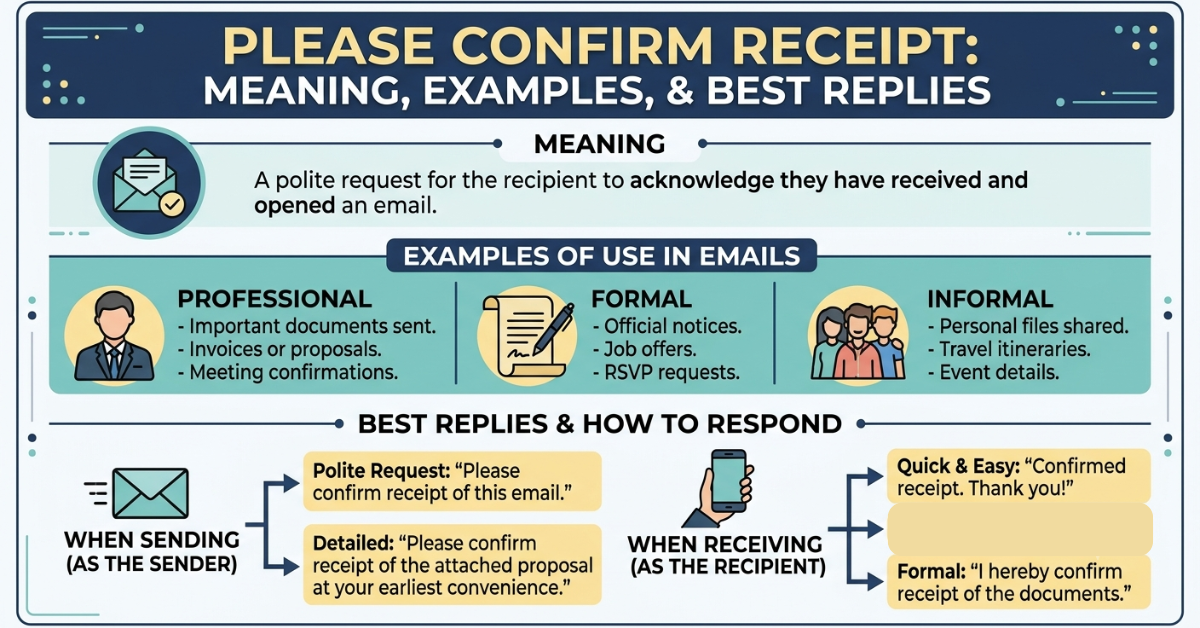
Have you ever sent an important email and then waited, wondering whether it actually landed in the other person’s inbox? That is where please confirm receipt becomes useful. It is a polite way to ask someone to acknowledge that they received your message, file, invoice, or payment request.
In this guide, we will break down please confirm receipt meaning, show how the phrase is used in real emails, explain when it sounds formal, and give you better alternatives when a softer tone is needed. You will also see practical examples and short reply options you can use right away.
What Does “Please Confirm Receipt” Mean?
At its core, the phrase means: “Please let me know you got this.”
It is a request for acknowledgment, not necessarily a full response. In professional communication, it is often used when the sender needs proof that an email, attachment, document, or payment notice has been received.
Simple explanation
If someone writes please confirm receipt of this email, they are usually asking for a quick reply such as:
- Received, thank you.
- Confirmed.
- Got it.
- I have received your email.
This phrase is especially common in business, legal, and administrative communication.
When Is This Phrase Used?
You will usually see it in situations where the sender wants a clear record that something arrived safely.
Common situations include:
- Business emails
- Invoice follow-ups
- Contract sharing
- Payment reminders
- Delivery or shipping notices
- Job application communication
- Internal office messages
For example, a manager may use please confirm receipt of this email after sending a contract draft, a report, or updated instructions.
Please Confirm Receipt Meaning in Email Communication
In email etiquette, this phrase is a formal way to check whether your message reached the recipient.
People use it when:
- the message is time-sensitive
- the attachment matters
- the sender needs written acknowledgment
- the email contains payment or legal information
- they want to avoid confusion later
So when someone asks, what does please confirm receipt mean, the answer is simple: it means “acknowledge that you got this message.”
Is It Formal?
Yes, it is generally formal and professional. It fits well in corporate emails, client communication, and official notices.
In casual conversations, though, it can sound a little stiff. If you are writing to a colleague you know well, a friendlier version may feel more natural.
Softer alternatives
- Please let me know you received this.
- Kindly confirm that you got it.
- Just reply once you have seen this.
- Please acknowledge receipt of this email.
These options sound smoother while still keeping the message clear.
Please Confirm Receipt of This Email: When to Use It
The phrase please confirm receipt of this email is best used when the email contains something important, such as:
- a deadline
- an attachment
- a contract
- payment details
- a schedule update
- confidential information
Example
“Hi Sarah, I’ve attached the revised proposal. Please confirm receipt of this email when you get a chance.”
This version is polite, professional, and easy to understand.
Please Confirm Receipt of Payment: What It Means
When someone writes please confirm receipt of payment, they are asking the recipient to acknowledge that money has been received or processed.
This phrase is common in:
- finance departments
- freelancing
- vendor communication
- landlord-tenant correspondence
- small business invoicing
Example
“Kindly confirm receipt of payment for Invoice #2048.”
It helps create a written record and reduces the chance of later disputes.
How to Say “Please Confirm Receipt of This Email” in Different Ways
You do not always need the exact phrase. Depending on the situation, you can use a more natural alternative.
Professional alternatives
- Kindly confirm that you have received this email.
- Please acknowledge receipt of the attached document.
- I would appreciate confirmation that this message has reached you.
- Please let me know once you have received the file.
- Could you please confirm you received this email?
More casual alternatives
- Just let me know you got this.
- Please reply when you see this.
- Send a quick confirmation when you can.
- Let me know once this comes through.
The right choice depends on the tone you want and how formal the relationship is.
How to Reply to This Kind of Message
If someone sends you a message asking for acknowledgment, your reply should be short, clear, and polite.
Simple reply examples
- Received, thank you.
- Confirmed, thank you.
- I have received your email.
- Got it, thanks.
- Received and noted.
If a next step is needed, you can add one short sentence:
- Received, thank you. I will review it today.
- Confirmed. I’ll get back to you shortly.
- I have received the document and will check it now.
Common Mistakes to Avoid
Even a short phrase can sound awkward if it is used the wrong way.
1. Repeating it too often
Using the exact phrase in every email can make your writing feel mechanical. It works best when acknowledgment truly matters.
2. Leaving out context
A message that only says “please confirm receipt” may feel abrupt. It is better to mention what was sent.
3. Sounding too forceful
Phrases like “confirm receipt immediately” can sound harsh unless the situation is urgent.
4. Confusing acknowledgment with agreement
Receipt means the person got the message. It does not mean they agree with it or accept it.
Real-World Email Examples
Here are a few practical examples that show how the phrase works in real communication.
Example 1: Document sharing
“Dear Ahmed, attached is the signed agreement. Please confirm receipt of this email once you have downloaded the file.”
Example 2: Invoice follow-up
“Hello, I have resent the invoice for June. Kindly confirm receipt of payment once it is processed.”
Example 3: Team update
“Hi team, I’ve shared the final agenda for tomorrow’s meeting. Please acknowledge receipt so everyone has the latest version.”
Example 4: Recruitment message
“Dear Candidate, we have sent your interview details. Please confirm receipt of this email so we know everything is clear.”
Receipt vs. Received
These two words are closely related, but they are not exactly the same.
- Received describes the action.
- Receipt refers to acknowledgment or proof that something arrived.
That is why please confirm receipt sounds more formal than simply saying “please confirm you got it.”
Key Takeaways
- Please confirm receipt means “please acknowledge that you got this.”
- It is common in formal email communication, billing, and document sharing.
- It works well when the message is important, urgent, or needs a clear record.
- You can use softer alternatives depending on the relationship and situation.
- Short, polite replies are usually enough.
FAQ
1. What does please confirm receipt mean?
It means the sender wants you to acknowledge that you received the message, document, or payment request. It is often used in professional emails.
2. Is “please confirm receipt of this email” correct?
Yes, it is correct and widely used in formal communication. It is especially useful when the sender needs a written acknowledgment.
3. How do I reply to please confirm receipt?
A short reply like “Received, thank you” or “Confirmed” is usually enough. If needed, you can add a sentence about next steps.
4. What is another way to say please confirm receipt of this email?
You can say “please acknowledge receipt of this email,” “please let me know once you receive this,” or “kindly confirm that you received this message.”
5. What does please confirm receipt of payment mean?
It means the sender wants confirmation that the payment has been received or processed. This phrase is common in billing and finance communication.
6. Is please confirm receipt formal?
Yes, it is a formal and professional phrase. It is best used in business emails, contracts, invoices, and official messages.
Conclusion
The phrase please confirm receipt is simple, but it plays an important role in professional communication. It helps the sender know the message arrived, gives the recipient a clear action, and creates a polite written record.
Whether you are asking someone to acknowledge an email, confirm payment, or verify a document, using the phrase correctly can make your communication feel more polished and reliable. Keep the tone clear, natural, and context-specific, and your emails will sound professional without feeling repetitive.