

Have you ever paused while typing and wondered, “Is it whether or wether?” You’re not alone. It’s one of the most commonly searched spelling questions because these words look similar, yet only one is correct in most everyday writing.
If you’ve searched for whether or wether, is it whether or wether, or even weather or whether or wether, this guide will clear up the confusion once and for all. You’ll learn the correct spelling, what each word means, when to use them, how they differ from weather, and easy memory tricks to help you never mix them up again.
Is It Whether or Wether?
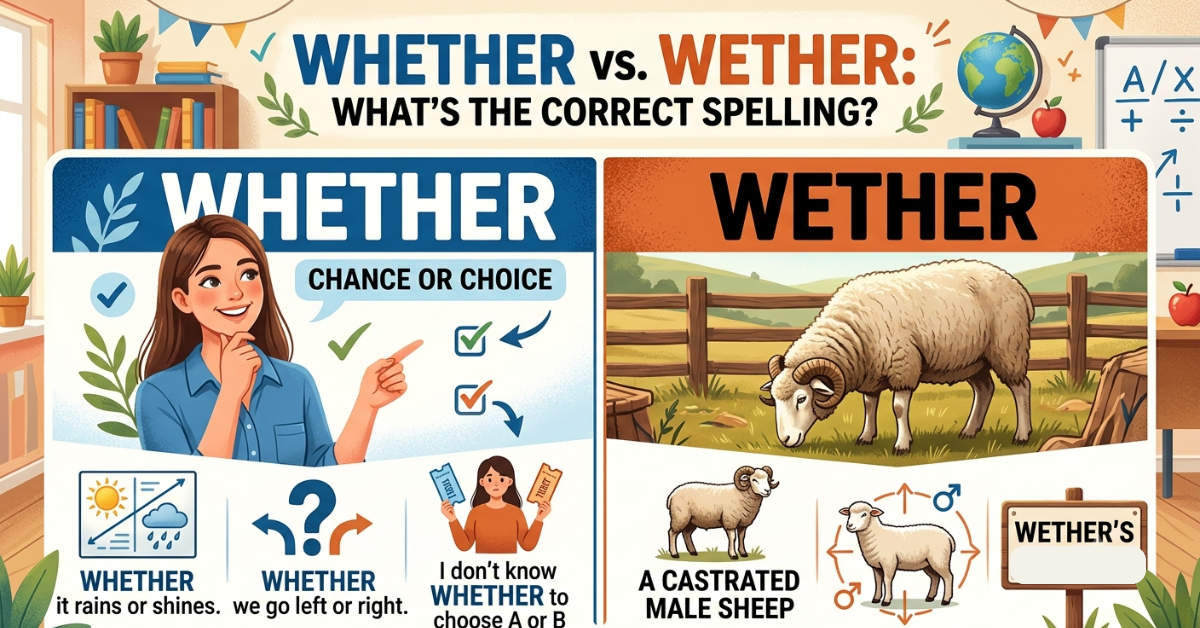
The correct spelling in almost every situation is whether.
Whether is a conjunction used to introduce alternatives, possibilities, or choices.
Examples:
- I don’t know whether she’ll attend the meeting.
- Please tell me whether you agree.
- We haven’t decided whether to travel this summer.
On the other hand, wether is a real English word—but it’s extremely rare and unrelated to grammar.
What Does “Whether” Mean?
Whether introduces a choice, uncertainty, or alternative between two or more possibilities.
Think of it as another way of saying:
- if
- which option
- regardless of which
Examples
- I’m not sure whether it’s true.
- She asked whether I had finished the report.
- Decide whether you want tea or coffee.
- We don’t know whether the package has arrived.
In all these sentences, the speaker is expressing uncertainty or presenting alternatives.
What Does “Wether” Mean?
Many people assume wether is simply a misspelling. While that’s true in everyday writing, it is actually a legitimate English noun.
A wether is:
A castrated male sheep, typically raised for wool or meat.
This word is mainly used in:
- Agriculture
- Veterinary science
- Farming
- Animal husbandry
Example
- The farmer separated the wether from the breeding flock.
Unless you’re discussing livestock, you’ll almost certainly need whether, not wether.
Whether or Wether: Quick Comparison
| Whether | Wether |
| Conjunction | Noun |
| Used in everyday English | Used in farming |
| Means “if” or expressing alternatives | Castrated male sheep |
| Very common | Very rare |
Weather or Whether or Wether: What’s the Difference?
Many English learners confuse all three because they sound alike.
| Word | Meaning | Example |
| Whether | Expresses alternatives or uncertainty | I don’t know whether he’ll come. |
| Weather | Climate or atmospheric conditions | The weather is beautiful today. |
| Wether | A castrated male sheep | The wether grazed quietly in the field. |
Although they are pronounced similarly, their meanings are completely different.
Weather Whether or Wether: How to Remember Them
A simple memory trick can help.
Whether
Contains the word “he”.
Think:
He is deciding whether to go.
It relates to making decisions.
Weather
Contains “ea”, like Earth.
Think of:
- Earth
- Air
- Environment
All relate to the weather.
Wether
Think of sheep.
It’s an agricultural word that most people rarely use.
Whether or Wether or Not: Which Is Correct?
The correct phrase is:
Whether or not
It means regardless of the outcome or if something happens or doesn’t happen.
Examples
- I’ll support you whether or not you succeed.
- We’re leaving tomorrow whether or not it rains.
- She’ll attend whether or not she’s invited.
This phrase is extremely common in spoken and written English.
Can You Replace “Whether” with “If”?
Sometimes, yes.
In many sentences, if and whether can both work.
Examples
I don’t know whether he’s coming.
I don’t know if he’s coming.
However, there are situations where only whether is correct.
Before “or not”
Correct:
- I don’t know whether or not she’ll arrive.
Less natural:
- I don’t know if or not she’ll arrive.
After prepositions
Correct:
- It depends on whether they agree.
Incorrect:
- It depends on if they agree.
Before infinitives
Correct:
- She couldn’t decide whether to stay.
Incorrect:
- She couldn’t decide if to stay.
Common Mistakes People Make
Mistake 1: Writing “wether” Instead of “whether”
Incorrect: I don’t know wether to call him.
Correct: I don’t know whether to call him.
Mistake 2: Mixing Up Weather and Whether
Incorrect: I wonder weather she’ll come.
Correct: I wonder whether she’ll come.
Mistake 3: Using “if” Everywhere
Sometimes if works, but in formal writing, whether is often more precise.
Formal:
- The committee discussed whether the proposal should proceed.
Less formal:
- The committee discussed if the proposal should proceed.
Examples in Everyday Conversations
At School
- The teacher asked whether we had completed the homework.
At Work
- We’re deciding whether to launch the project this month.
While Traveling
- Check the weather before booking your trip.
On a Farm
- The veterinarian examined the wether.
These examples show how each word fits naturally into different contexts.
Why Do People Confuse These Words?
There are several reasons:
- They sound almost identical.
- English has many homophones.
- Spell-check doesn’t always catch the mistake because wether is a valid word.
- Fast typing often leads to accidental misspellings.
Understanding each word’s meaning is the easiest way to avoid confusion.
Practical Tips to Remember the Difference
Here are a few tricks that actually work:
- Think decision = whether.
- Think forecast = weather.
- Think sheep = wether.
- Read your sentence aloud.
- Ask yourself: Am I talking about choices, climate, or livestock?
That simple question usually gives you the correct answer instantly.
Real-World Importance
Using the correct spelling improves:
- Professional emails
- Academic assignments
- Business communication
- Social media writing
- Blog articles
- Job applications
Small spelling mistakes can affect credibility, especially in professional settings. Learning the distinction helps you write with greater confidence and accuracy.
Key Takeaways
- Whether is the correct word for expressing choices or uncertainty.
- Wether is a real but uncommon word referring to a castrated male sheep.
- Weather refers to atmospheric conditions.
- The phrase whether or not is always correct.
- While if can sometimes replace whether, there are many situations where only whether is grammatically correct.
- Understanding context is the easiest way to choose the right word.
Frequently Asked Questions
1. Is it whether or wether?
The correct spelling in almost every sentence is whether. Wether is a rare noun referring to a castrated male sheep and is unrelated to expressing choices or uncertainty.
2. What does whether mean?
Whether introduces alternatives, possibilities, or uncertainty. It’s commonly used when discussing choices, such as “I’m unsure whether to stay or leave.”
3. What is the difference between weather, whether, and wether?
Weather refers to atmospheric conditions, whether expresses alternatives or uncertainty, and wether is a farming term for a castrated male sheep. Despite sounding alike, they have completely different meanings.
4. Is “whether or not” grammatically correct?
Yes. Whether or not is a standard English expression used to mean “regardless of the outcome” or “whether something happens or doesn’t happen.”
5. Can I use “if” instead of “whether”?
Sometimes you can, especially in informal conversation. However, after prepositions, before infinitives, or when using whether or not, whether is the correct and more precise choice.
6. Why is “wether” considered a spelling mistake?
In everyday writing, wether is usually an accidental misspelling of whether. Although wether is a legitimate English word, it only refers to a specific type of sheep and is rarely used outside agricultural contexts.
Conclusion
Understanding the difference between whether or wether is easier once you know the role each word plays. In nearly every conversation, email, essay, or article, whether is the word you’ll need because it introduces choices or uncertainty. Weather belongs to discussions about climate, while wether is a specialized farming term referring to a castrated male sheep.
The next time you hesitate over the spelling, remember this simple rule: choices use whether, climate uses weather, and sheep use wether. Keeping this distinction in mind will help you write more accurately, communicate more confidently, and avoid one of English’s most common spelling mix-ups.