

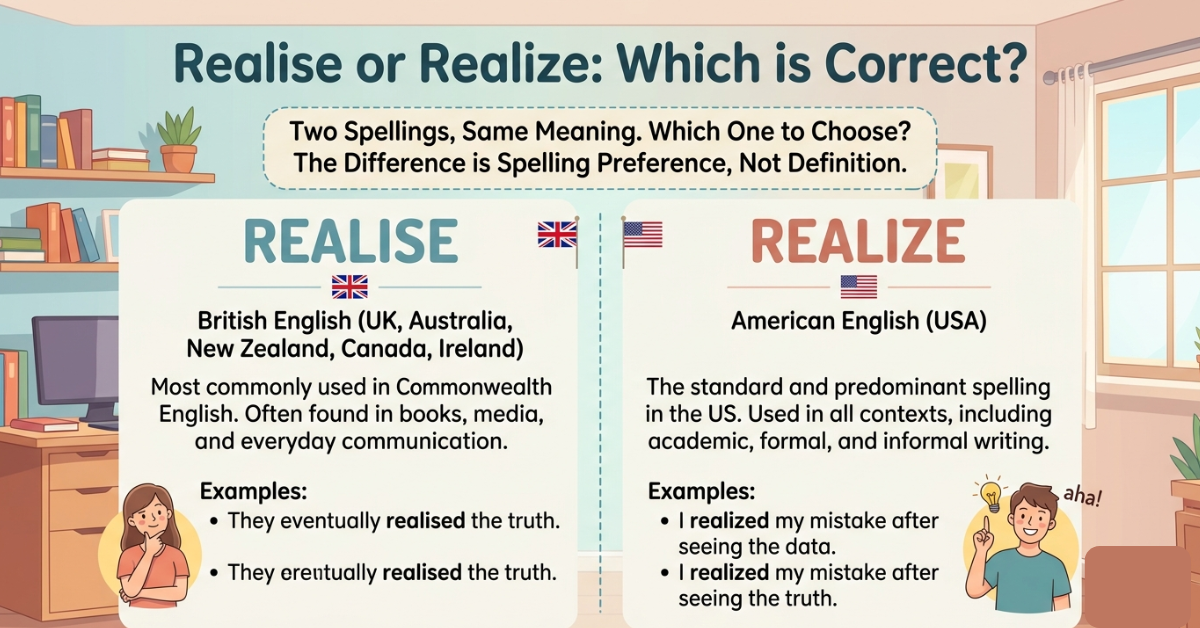
Have you ever typed a document, only for your spell checker to underline realise or realize in red? It can leave anyone wondering which spelling is actually correct.
If you’ve searched for realise or realize or asked yourself is it realise or realize, the good news is that both spellings are correct. The key difference lies in the variety of English you’re using. In this guide, you’ll discover when to use each spelling, why both exist, and how to choose the right one depending on your audience.
What Is the Difference Between Realise and Realize?
The difference between realise and realize isn’t about meaning—it’s about spelling conventions.
- Realize is the preferred spelling in American English.
- Realise is commonly used in British English and many countries that follow British spelling.
Both words mean exactly the same thing:
- To become aware of something.
- To understand a fact or situation.
- To achieve or fulfill something.
Examples
American English:
- I didn’t realize how late it was.
- She finally realized her dream of becoming a doctor.
British English:
- I didn’t realise how late it was.
- She finally realised her dream of becoming a doctor.
The meaning remains identical regardless of the spelling.
Is It Realise or Realize?
The answer depends on the English standard you’re following.
| English Variety | Preferred Spelling |
| American English | Realize |
| British English | Realise (more common) |
| Australian English | Realise |
| New Zealand English | Realise |
| South African English | Realise |
| Canadian English | Both are accepted, though realize is also widely used |
If you’re writing for an American audience, use realize.
If you’re writing for readers in the UK, Australia, or New Zealand, realise is generally the better choice.
Why Are There Two Different Spellings?
The existence of two spellings goes back centuries.
The suffix -ize comes from the Greek root -izein, which later entered English through Latin and French. Historically, many British publishers actually used -ize.
Over time, however, -ise became increasingly popular in British English because many verbs naturally ended with that pattern.
Today:
- American English strongly prefers -ize.
- British English often prefers -ise, although -ize is still considered correct by several respected British publishers and dictionaries.
This historical background explains why the debate continues today.
Does Oxford Prefer Realise or Realize?
Interestingly, many people assume Oxford prefers realise simply because it’s a British publisher.
In reality, Oxford traditionally recommends realize with the -ize ending.
That surprises many English learners because modern British writing often uses realise instead.
Both spellings are accepted in British English, although newspapers, schools, and publishers may have their own style preferences.
Meaning of Realise and Realize
Whether spelled with -ise or -ize, the verb has several meanings.
1. To Become Aware
This is the most common meaning.
Example:
- I suddenly realized I had forgotten my wallet.
- She realised she had taken the wrong train.
2. To Understand Something Clearly
Example:
- He didn’t realize how difficult the project would be.
- We realised the importance of planning ahead.
3. To Achieve a Goal
Example:
- She realized her lifelong ambition.
- They realised their vision after years of hard work.
4. To Convert Into Money
In finance or business contexts:
Example:
- The company realized significant profits.
- The property realised a high selling price.
Realise vs Realize: Quick Comparison
| Feature | Realise | Realize |
| Meaning | Same | Same |
| British English | Preferred by many | Also accepted |
| American English | Rare | Standard |
| Formal Writing | Yes | Yes |
| Informal Writing | Yes | Yes |
| Pronunciation | Same | Same |
Pronunciation
Both spellings are pronounced exactly the same.
/ˈriːəlaɪz/
There is no pronunciation difference whatsoever.
Only the spelling changes.
Examples in Everyday Sentences
Using “Realize”
- I didn’t realize you were waiting.
- She realized her mistake immediately.
- They realized the project needed more funding.
- We realized how important teamwork was.
- He realized he had left his keys at home.
Using “Realise”
- I didn’t realise you had arrived.
- She realised her phone battery was dead.
- We realised the meeting had been cancelled.
- They realised the opportunity was too good to miss.
- He realised the answer after thinking carefully.
Common Mistakes People Make
Mixing Spellings
Avoid switching between spellings in the same document.
She realised her mistake and later realized the answer.
Choose one style and stick with it.
Assuming One Is Incorrect
Many learners think one spelling is wrong.
Actually:
- Realise
- Realize
Both are legitimate English spellings.
Ignoring Your Audience
If you’re writing:
- For American readers → use realize
- For British readers → use realise
Consistency is more important than personal preference.
Which Spelling Should You Use?
Choose based on where your readers are located.
Use “Realize” If You Are Writing For
- American businesses
- US universities
- American websites
- International audiences using US English
- Academic papers following American style guides
Use “Realise” If You Are Writing For
- UK businesses
- British schools
- Australian publications
- New Zealand audiences
- British newspapers
Matching your audience helps your writing feel more natural and professional.
Other Words That Follow the Same Pattern
Many English verbs have similar spelling differences.
| American English | British English |
| Realize | Realise |
| Organize | Organise |
| Recognize | Recognise |
| Apologize | Apologise |
| Civilize | Civilise |
Remember that some British publishers still use the -ize versions, so always check the style guide you’re following.
Tips for Choosing the Right Spelling
Here are a few practical tips:
- Decide whether you’re writing in American or British English before you begin.
- Keep the spelling consistent throughout the document.
- Use your organization’s preferred style guide.
- Let your spell checker match the language setting you’re using.
- If writing for a global audience, American English is often the safest choice unless instructed otherwise.
Why Consistency Matters
Readers usually don’t mind whether you choose realise or realize.
What they do notice is inconsistency.
Imagine reading:
The company realised its mistake. Later it realized the issue could have been avoided.
Switching between spellings makes writing appear less polished.
Professional writers, editors, and businesses stick to one variety of English throughout their content.
Key Takeaways
- Both realise and realize are correct.
- The meaning is exactly the same.
- American English prefers realize.
- British English commonly uses realise, though realize is also accepted in some style guides.
- Pronunciation never changes.
- Always stay consistent within a piece of writing.
- Choose the spelling that matches your audience.
Frequently Asked Questions
Is it realise or realize in British English?
Both spellings are accepted in British English. However, realise is more common in everyday British writing, while some publishers and dictionaries also accept realize.
Is realize wrong in the UK?
No. Realize is not incorrect in the UK. Although realise is more widely used, realize remains an accepted British spelling in several editorial style guides.
Why does American English use realize?
American English generally favors the -ize ending for verbs like realize, organize, and recognize. This spelling became standardized in American usage over time.
Which spelling should I use in academic writing?
Use the spelling required by your institution or publication. If you’re following American English, choose realize. If you’re following British English, realise is usually preferred unless the style guide specifies otherwise.
Do realise and realize have different meanings?
No. They have identical meanings. The only difference is the spelling convention based on the variety of English being used.
Is realize grammatically correct?
Yes. Realize is grammatically correct and is the standard spelling in American English. It is also accepted by some British style guides.
Conclusion
The debate over realise or realize is simpler than it first appears. Both spellings are correct, both carry exactly the same meaning, and both have long histories in the English language. The deciding factor is your audience and the variety of English you’re using.
Whether you’re writing an academic paper, business email, blog post, or social media caption, consistency is the key to polished, professional communication. Choose one spelling, stick with it throughout your writing, and you’ll communicate with confidence. Understanding these subtle differences not only improves your writing but also helps you connect more effectively with readers around the world.