

Have you ever received a message that simply says “OK noted” and wondered what the sender actually meant? Was it agreement, acknowledgment, or just a polite way of ending the conversation?
Understanding the ok noted meaning is important because it’s one of the most common expressions used in emails, workplace chats, customer service, and everyday conversations. Although it seems simple, the phrase can carry different tones depending on the context.
In this guide, you’ll learn what “OK noted” means, when it’s appropriate to use it, professional alternatives, examples in different situations, common mistakes, and answers to frequently asked questions.
What Does “OK Noted” Mean?
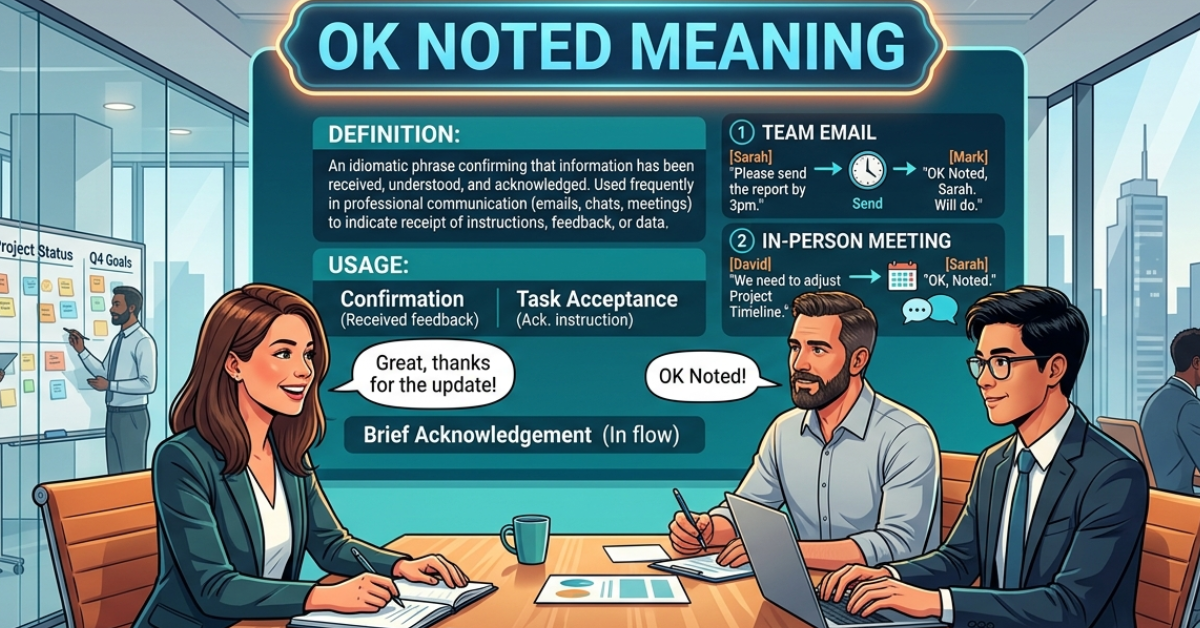
The phrase “OK noted” means:
“I have received your message, understood it, and taken note of the information.”
It doesn’t necessarily mean the person agrees with you or will act immediately. Instead, it simply confirms that your message has been acknowledged.
For example:
Person A: The meeting has been moved to 3 PM tomorrow.
Person B: OK noted.
Here, Person B confirms they have seen and understood the update.
Breaking Down the Phrase
Understanding each word makes the meaning even clearer.
OK
“OK” indicates acceptance, acknowledgment, or understanding.
It often means:
- I understand.
- That’s fine.
- I received your message.
Noted
“Noted” means:
- I have taken note of it.
- I have recorded the information mentally.
- I understand and will remember it.
Together, OK noted communicates:
“I understand your message and have taken note of it.”
Is “OK Noted” Grammatically Correct?
Yes.
The phrase is grammatically acceptable in informal and professional communication.
However, many language experts consider it slightly repetitive because:
- “OK” already shows acknowledgment.
- “Noted” also indicates acknowledgment.
Despite this redundancy, OK noted has become widely accepted in business communication, messaging apps, and emails.
When Should You Use “OK Noted”?
The phrase works best when someone shares information rather than asks a question.
Common situations include:
Workplace Communication
Managers often send updates like:
- Project deadlines
- Schedule changes
- Policy updates
- Task assignments
Example:
Manager: Please submit the report by Friday.
Employee: OK noted.
Emails
In professional emails, it serves as a quick acknowledgment.
Example:
“OK noted. I’ll update the document accordingly.”
Team Chats
Applications like Slack, Microsoft Teams, and WhatsApp frequently use short acknowledgments.
Example:
“The client meeting starts at 11.”
Reply:
“OK noted.”
Customer Service
Support representatives sometimes use it internally after receiving customer information.
Example:
“OK noted. We’ll investigate the issue.”
What Does “OK Noted” Actually Communicate?
Depending on context, it can imply different things.
| Situation | Meaning |
| Receiving instructions | I understand your instructions. |
| Receiving information | I have noted the information. |
| Receiving updates | I acknowledge the update. |
| Receiving corrections | I understand the correction. |
| Receiving reminders | I’ll keep that in mind. |
Does “OK Noted” Mean Agreement?
Not always.
This is a common misunderstanding.
Someone can reply:
“OK noted.”
without agreeing with your opinion.
Example:
“I think we should redesign the website.”
Reply:
“OK noted.”
This simply means the idea has been acknowledged—not necessarily accepted.
Is “OK Noted” Professional?
Yes, in most workplaces.
However, it’s often considered too brief for formal business communication.
For professional emails, consider expanding it slightly.
Better examples include:
- OK noted. Thank you.
- Noted with thanks.
- Understood.
- Thanks for letting me know.
- I have noted the information.
- Acknowledged.
- Understood. I’ll proceed accordingly.
These responses sound warmer while remaining professional.
Formal Alternatives to “OK Noted”
If you’re communicating with clients, senior managers, or executives, these alternatives are often more polished.
Professional Options
- Understood.
- Noted with thanks.
- Thank you for the update.
- Message received.
- I acknowledge your instructions.
- I’ll take care of it.
- I appreciate the information.
- Consider it noted.
- I’ve made a note of that.
- Thank you. I’ll follow up accordingly.
Informal Alternatives
When chatting with friends or teammates, simpler replies work well.
Examples include:
- Got it.
- Sure.
- Sounds good.
- Will do.
- No problem.
- Alright.
- Thanks.
- Copy that.
- Understood.
- Okay.
Difference Between “OK Noted” and Similar Expressions
OK Noted vs Noted
Noted
More professional and commonly used in emails.
Example:
“Noted. I’ll update the presentation.”
OK Noted
Slightly more conversational and relaxed.
OK Noted vs Understood
“Understood” emphasizes comprehension.
Example:
“Understood. I’ll make the requested changes.”
This is often preferred in business communication.
OK Noted vs Got It
“Got it” sounds friendly and casual.
Suitable for:
- Friends
- Team chats
- Informal conversations
Not ideal for highly formal emails.
OK Noted vs Acknowledged
“Acknowledged” sounds official and is commonly used in:
- Military communication
- IT operations
- Customer support
- Corporate environments
Examples of “OK Noted” in Different Situations
Example 1: Office
Manager:
“Please finish the budget report today.”
Employee:
“OK noted.”
Example 2: School
Teacher:
“Assignment submissions close at midnight.”
Student:
“OK noted.”
Example 3: Customer Support
Customer:
“I’ve attached the requested documents.”
Support Agent:
“OK noted. We’ll review them shortly.”
Example 4: Family
Parent:
“Don’t forget to buy milk.”
Child:
“OK noted.”
Example 5: Event Planning
Organizer:
“The venue has changed.”
Volunteer:
“OK noted.”
When You Should Avoid Saying “OK Noted”
Although useful, there are situations where it may seem too short or impersonal.
Avoid using it when:
- Expressing sympathy
- Responding to complaints
- Speaking with upset customers
- Thanking someone for significant help
- Replying to emotional messages
Instead, choose responses that acknowledge feelings as well as information.
Example:
Instead of:
“OK noted.”
Say:
“Thank you for letting me know. I’m sorry you experienced this.”
Common Mistakes People Make
Assuming It Means Agreement
It usually means acknowledgment, not approval.
Using It in Emotional Conversations
It may appear cold or dismissive.
Replying Too Briefly in Formal Emails
Adding a few extra words improves professionalism.
Instead of:
“OK noted.”
Use:
“OK noted. Thank you for the update.”
Overusing It
Repeating the same response in every email can sound robotic.
Mix in alternatives for more natural communication.
Why Is “OK Noted” So Popular?
Several reasons explain the widespread use of ok noted meaning.
- It’s short.
- It’s easy to understand.
- It works across different cultures.
- It saves time.
- It clearly confirms receipt of information.
In today’s fast-paced digital communication, quick acknowledgments are often appreciated.
Practical Tips for Using “OK Noted”
To communicate more effectively:
- Use it for acknowledging information rather than opinions.
- Add “thank you” in professional emails.
- Choose warmer responses for sensitive conversations.
- Consider your audience before using brief replies.
- Use alternatives occasionally to sound more natural.
Key Takeaways
- OK noted means you have received and understood the information.
- It does not automatically mean agreement.
- The phrase is acceptable in professional and casual communication.
- More formal alternatives include “Understood,” “Noted with thanks,” and “Acknowledged.”
- Context determines whether the phrase sounds polite or too brief.
- Adding a few extra words often improves clarity and professionalism.
Frequently Asked Questions
What is the exact OK noted meaning?
The ok noted meaning is that the sender has received, understood, and acknowledged the information. It does not necessarily indicate agreement or immediate action.
Is “OK noted” polite?
Yes. It is generally considered polite in workplace chats and casual emails. For formal communication, adding “Thank you” makes it sound more courteous.
Is “OK noted” professional in emails?
Yes, especially for internal communication. For client-facing or formal emails, responses like “Noted with thanks” or “Understood. Thank you for the update” are often better choices.
Does “OK noted” mean yes?
Not necessarily. It confirms receipt and understanding of information but doesn’t always mean the person agrees with what’s being said.
Can I say “OK noted” to my boss?
Yes, many workplaces consider it acceptable. However, a slightly more complete response such as “Understood, thank you” or “Noted with thanks” creates a more professional impression.
What are the best alternatives to “OK noted”?
Some excellent alternatives include:
- Understood
- Noted with thanks
- Acknowledged
- Got it
- Thanks for the update
- I’ll take care of it
- Message received
Conclusion
The ok noted meaning is simple but useful: it tells someone you’ve received and understood their message. While it’s perfectly acceptable in many professional and casual settings, choosing the right alternative based on the situation can make your communication clearer, warmer, and more effective.
Whether you’re replying to emails, workplace updates, or everyday messages, understanding when and how to use “OK noted” helps you communicate with confidence. Keep these examples and alternatives in mind, and you’ll always know the most appropriate response for any conversation.