

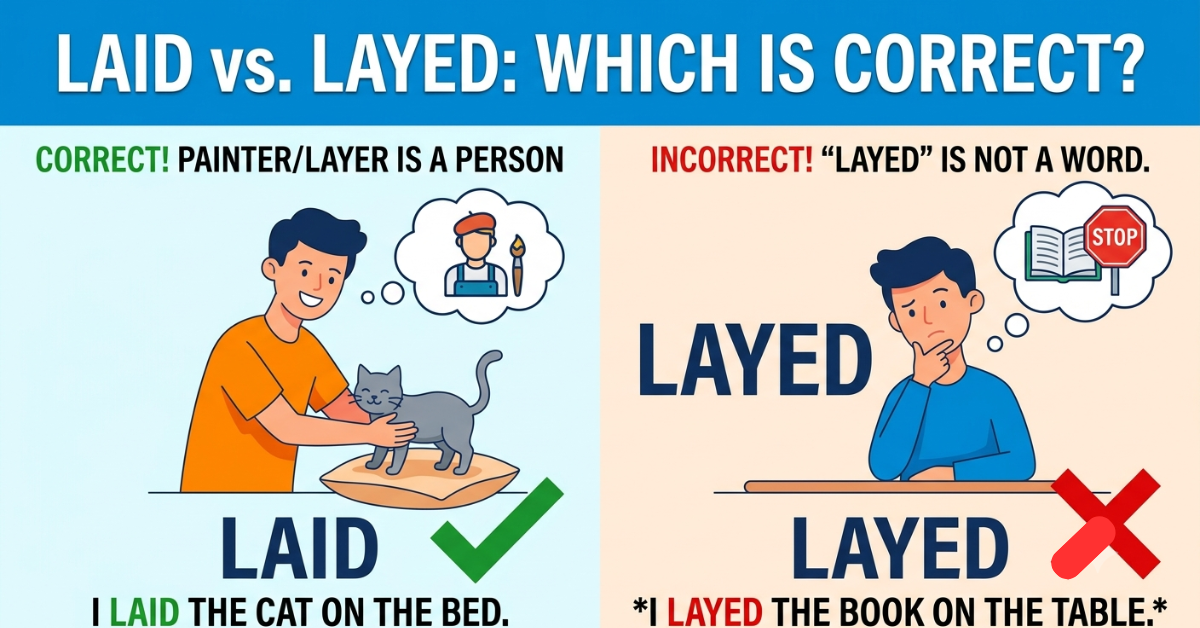
Have you ever typed layed into a message or document and wondered whether it was actually correct? You’re not alone. Thousands of people search for laid off or layed off, laid out or layed out, every month because English verb forms can be surprisingly confusing.
The good news is that the rule is much simpler than it seems. In this guide, you’ll learn why it is almost always incorrect, when to use laid, how to avoid common mistakes, and easy tricks to remember the difference forever.
Is “Layed” a Real Word?
The short answer is not in standard English.
Although it is frequently appears online, in text messages, and even in business emails, it is considered a spelling mistake in modern English.
The correct past tense and past participle of lay is:
- Present: lay
- Past: laid
- Past participle: laid
Examples:
- She laid the book on the table.
- The workers were laid off last week.
- He laid out the project plan.
In nearly every situation, laid is the correct choice.
Laid vs Layed: What’s the Difference?
Many people assume is simply the past tense, but English doesn’t work that way.
| Word | Correct? | Meaning |
| Lay | Yes | To put or place something down |
| Laid | Yes | Past tense of lay |
| Layed | No | Incorrect spelling in standard English |
Think of it this way:
- Today I lay the blanket.
- Yesterday I laid the blanket.
There is no standard situation where it is replaced.
Why Do So Many People Write “Layed”?
Several reasons contribute to this common mistake.
1. Regular Verb Expectations
Most English verbs simply add -ed.
Examples:
- Walk → Walked
- Jump → Jumped
- Cook → Cooked
Naturally, people assume:
- Lay → Layed
However, lay is an irregular verb.
2. Confusion with “Lie”
Another reason is the confusing relationship between lay and lie.
Compare them carefully.
| Verb | Present | Past | Past Participle |
| Lay (put something down) | Lay | Laid | Laid |
| Lie (recline) | Lie | Lay | Lain |
Notice something surprising?
The past tense of lie is actually lay.
That overlap causes many grammar mistakes.
Laid Off or Layed Off?
One of the most searched grammar questions is:
Should I write “laid off” or “layed off”?
The correct phrase is always:
laid off
Examples:
- The company laid off 200 employees.
- Several workers were laid off during restructuring.
- She was laid off after the project ended.
Incorrect:
- The company layed off employees.
The expression is widely used in business, employment, and HR contexts to mean someone’s job has ended because of organizational reasons rather than personal performance.
Laid Out or Layed Out?
Another common search is:
Laid out or layed out?
Again, the correct expression is:
laid out
Examples:
- She laid out the clothes for tomorrow.
- The architect laid out the building plans.
- The instructions were clearly laid out.
Incorrect:
- She layed out the clothes.
Whenever you mean “arranged,” “organized,” or “presented,” use laid out.
What Does “Laid Out” Mean?
The phrase has several meanings depending on context.
Arranged
- She laid out the decorations.
Explained
- The lawyer laid out the evidence.
Planned
- They laid out the strategy for the next quarter.
Knocked unconscious (informal)
- The boxer was laid out after one punch.
In every case, laid out is the correct spelling.
Common Examples of Correct Usage
Here are everyday examples to reinforce the rule.
Home
- She laid the baby in the crib.
- Dad laid the tools on the shelf.
School
- The teacher laid out today’s lesson.
- Students laid their notebooks on the desk.
Workplace
- Several employees were laid off.
- Management laid out the new policies.
Sports
- The coach laid out the game plan.
Easy Trick to Remember
If you’re talking about placing something somewhere, think:
Lay → Laid
Never:
Lay → Layed
A quick memory tip:
If you see “layed,” it’s almost certainly a mistake. Replace it with “laid.”
Common Grammar Mistakes
People often make these errors.
| Incorrect | Correct |
| I layed the phone down. | I laid the phone down. |
| He was layed off yesterday. | He was laid off yesterday. |
| She layed out the clothes. | She laid out the clothes. |
| They layed the foundation. | They laid the foundation. |
| We layed everything on the table. | We laid everything on the table. |
When Is “Lay” Correct?
Use lay when describing a present action involving an object.
Examples:
- Please lay the papers here.
- Lay the keys on the counter.
- They lay fresh towels every morning.
Remember:
If something is being placed somewhere right now, use lay.
If it already happened, use laid.
Why Grammar Checkers Flag “Layed”
Modern grammar tools almost always underline it because standard dictionaries and style guides recognize laid as the correct past tense.
Professional writing—including business reports, academic papers, resumes, and emails—should always use laid instead of layed.
Using the correct form improves clarity and credibility.
Quick Comparison Chart
| Situation | Correct Form |
| Past tense of lay | Laid |
| Past participle of lay | Laid |
| Employment termination | Laid off |
| Arrange something | Laid out |
| Incorrect spelling | <p>Layed |
Practical Tips to Avoid This Mistake
Here are a few simple ways to remember the rule:
- Think of paid, not payed. Just as “pay” becomes paid, “lay” becomes laid.
- Read your writing aloud. “Laid” usually sounds more natural.
- Double-check phrases like laid off and laid out, especially in professional writing.
- Use grammar-checking software, but also understand the rule so you don’t rely on tools alone.
Key Takeaways
- Laid is the correct past tense of lay.
- Always write laid off, never nd=”6826″>layed off.
- Always write laid out, never nd=”6876″>layed out.
- Understanding the difference between lay and lie helps prevent many grammar mistakes.
Frequently Asked Questions
In modern standard English, nd=”7076″>layed is considered incorrect for the verb lay. The correct past tense is laid.
Is it “laid off” or “layed off”?
The correct expression is laid off. It refers to losing a job because of company decisions rather than employee performance.
Should I write “laid out” or “layed out”?
Always use laid out. Whether you’re describing arranging items, explaining information, or planning something, laid out is correct.
Why do people confuse laid vs layed?
Most English verbs form the past tense by adding -ed, so people naturally expect nd=”7664″>layed. However, lay is an irregular verb whose past tense is laid.
Is “laid” the past tense of “lie”?
No. Laid is the past tense of lay, meaning “to place something.” The verb lie (to recline) has the past tense lay, which is one reason these verbs are often confused.
Can I use “layed” in formal writing?
No. Whether you’re writing an email, report, resume, article, or academic paper, use laid instead of nd=”8123″>layed to ensure correct grammar.
Conclusion
The confusion surrounding is understandable, but the rule is straightforward once you know it. In standard English, laid is the correct past tense of lay, making phrases like laid off and laid out the only grammatically correct options. Although nd=”8460″>layed appears frequently online, it remains a common spelling mistake rather than an accepted form.
The next time you’re unsure, remember this simple rule: if you’re tempted to write “layed,” the correct word is almost always “laid.” Mastering this small distinction will make your writing clearer, more professional, and grammatically accurate. If you’re interested in improving your English further, continue exploring common grammar confusions to build stronger writing skills.