

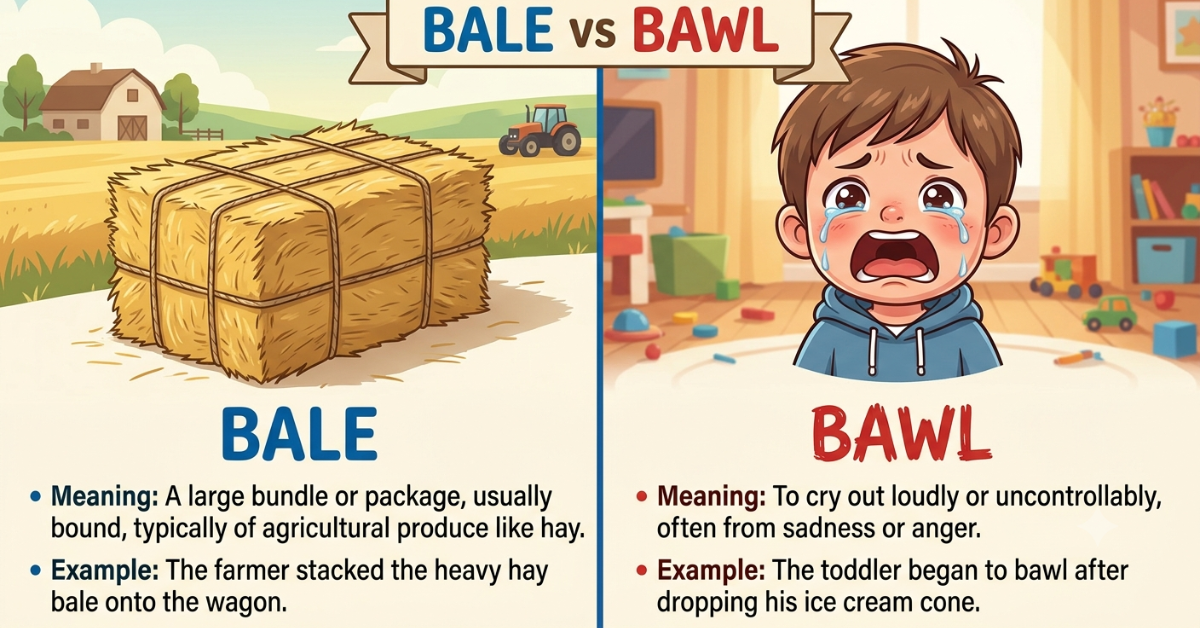
Have you ever read a sentence and wondered whether it should say bale or bawl? You’re not alone. These two words sound exactly alike, making them classic examples of English homophones that often confuse both native speakers and English learners.
In this guide to Bale vs Bawl, you’ll discover what each word means, when to use it, why they are commonly mixed up, and practical tips to remember the difference forever. By the end, you’ll be able to use both words confidently in writing and everyday conversation.
What Does “Bale” Mean?
The word bale is primarily a noun, although it can also be used as a verb. It refers to a tightly wrapped bundle of materials such as hay, cotton, paper, or straw.
Bale as a Noun
A bale is a compact package created for easier storage, transportation, or sale.
Examples:
- The farmer stacked several bales of hay in the barn.
- The warehouse stored hundreds of cotton bales.
- We recycled a large bale of cardboard.
Bale as a Verb
As a verb, bale means to make something into bales.
Examples:
- Workers baled the straw after harvesting.
- The recycling company bales used paper before shipping it.
Common Phrases with Bale
- Bale of hay
- Bale of cotton
- Bale of straw
- Bale of paper
These expressions are especially common in farming, agriculture, manufacturing, and recycling industries.
What Does “Bawl” Mean?
Unlike bale, the word bawl relates to making loud sounds. It is almost always used as a verb.
Bawl as a Verb
Bawl means to cry loudly or shout in a loud, forceful voice.
Examples:
- The baby began to bawl after waking up.
- He bawled with laughter during the comedy show.
- The coach bawled instructions across the field.
Depending on context, bawl can express sadness, excitement, anger, or urgency.
Bale vs Bawl: The Main Difference
Although they sound identical, their meanings are completely different.
| Feature | Bale | Bawl |
| Meaning | A tightly packed bundle | To cry or shout loudly |
| Part of Speech | Noun and verb | Mostly verb |
| Common Context | Farming, recycling, shipping | Emotions, communication |
| Example | A bale of hay | The child bawled loudly |
The easiest way to distinguish them is by thinking about the context. If you’re talking about bundles or packaging, choose bale. If someone is crying or shouting, use bawl.
Why Do People Confuse Bale and Bawl?
There are several reasons these words are commonly mixed up.
They Sound Exactly the Same
Both words are pronounced:
/beɪl/
Since English contains many homophones, writers often rely on spelling rather than pronunciation to distinguish meaning.
Spell Check Doesn’t Always Help
Both bale and bawl are correctly spelled English words. Grammar software won’t necessarily detect the wrong choice if the sentence remains grammatically correct.
For example:
The baby started to bale.
The spelling is correct, but the meaning is wrong.
Easy Memory Trick
A simple memory device can prevent confusion.
Remember Bale
Think of the letter E in Bale for Equipment, Farm, or Packaging.
- Bale = Bundle
- Bale = Farming
- Bale = Storage
Remember Bawl
Think of the letter W in Bawl as Wailing.
- Bawl = Wail
- Bawl = Cry loudly
- Bawl = Shout
This quick association makes choosing the correct spelling much easier.
Example Sentences
Bale Examples
- Farmers loaded hay bales onto the truck.
- The warehouse received cotton bales from the supplier.
- The machine can bale recycled plastic efficiently.
- We watched workers bale straw before sunset.
- Several bales were stored for winter.
Bawl Examples
- The toddler started to bawl after dropping her toy.
- Fans bawled with excitement when the singer appeared.
- He bawled across the room to get everyone’s attention.
- She couldn’t stop bawling after hearing the emotional news.
- The teacher told the students not to bawl during class.
Common Mistakes
Here are mistakes people frequently make.
Incorrect
- The farmer bawled the hay.
- She carried a bawl of cotton.
- They stacked several bawls in the barn.
Correct
- The farmer baled the hay.
- She carried a bale of cotton.
- They stacked several bales in the barn.
Bale vs Bawl in Everyday Life
You may encounter bale in:
- Agriculture
- Recycling
- Warehouses
- Shipping
- Manufacturing
- Supply chains
You may hear bawl in:
- Parenting
- Sports
- Movies
- Storytelling
- Schools
- Everyday conversations
Understanding these contexts helps you identify the correct word naturally.
Related Homophones Worth Knowing
If you’re learning English vocabulary, these similar-sounding word pairs are also useful:
- Bear vs Bare
- Brake vs Break
- Flour vs Flower
- Peace vs Piece
- Principal vs Principle
- Mail vs Male
- Sale vs Sail
- Pair vs Pear
Mastering homophones improves both writing accuracy and reading comprehension.
Quick Comparison Chart
| Bale | Bawl |
| Bundle of material | Loud crying or shouting |
| Used in farming | Used for emotions |
| Can be noun or verb | Usually a verb |
| Physical object | Action or behavior |
| Bale of hay | Bawl with tears |
Practical Tips to Remember the Difference
- Think about whether the sentence involves a physical object or an action.
- If the topic is farming or packaging, choose bale.
- If someone is crying or yelling, choose bawl.
- Read the sentence aloud and imagine the situation.
- Practice with example sentences until the difference feels natural.
These habits quickly reduce spelling mistakes.
Key Takeaways
- Bale refers to a tightly packed bundle of materials.
- Bawl means to cry or shout loudly.
- Both words are homophones but have completely different meanings.
- Context is the easiest way to determine the correct spelling.
- A simple memory trick—Bale = Bundle, Bawl = Wail—makes them easier to remember.
Frequently Asked Questions
Is bale the same as bawl?
No. Although they sound identical, bale refers to a bundle of materials, while bawl means to cry or shout loudly.
What is an example of bale?
A common example is, “The farmer stacked several bales of hay in the barn.” Here, bale refers to tightly packed hay.
What does bawl mean in English?
Bawl means to cry loudly, wail, or shout in a loud voice. It often describes strong emotions or someone calling out forcefully.
Why are bale and bawl confusing?
They are homophones, meaning they have the same pronunciation but different spellings and meanings. This makes them easy to confuse in writing.
Can bale be used as a verb?
Yes. As a verb, bale means to gather and compress materials into bales, such as hay or paper.
How can I remember Bale vs Bawl?
Remember that Bale is a Bundle, while Bawl is Wailing or crying loudly. Associating each word with its meaning helps prevent confusion.
Conclusion
Understanding Bale vs Bawl is easier once you recognize that they belong to completely different contexts. Bale deals with bundled materials used in farming, recycling, and shipping, while bawl describes loud crying or shouting. Even though they sound exactly alike, remembering their meanings and practicing with real examples will help you choose the correct word every time.
The next time you encounter these homophones, pause for a moment and think about the context. With a little practice, distinguishing between bale and bawl will become second nature, making your writing clearer, more accurate, and more professional.