

Have you ever received an email ending with “awaiting your response” and wondered exactly what it meant? Or perhaps you’ve wanted to use the phrase yourself but weren’t sure whether it sounded too formal or even a little demanding.
Understanding the awaiting your response meaning can help you communicate more confidently in professional situations. Whether you’re writing business emails, following up with clients, or responding to colleagues, knowing when to use this phrase makes your communication clearer. In this guide, you’ll discover its meaning, appropriate usage, professional alternatives, common mistakes, and practical examples you can apply right away.
“What Does ‘Awaiting Your Response’ Mean?”
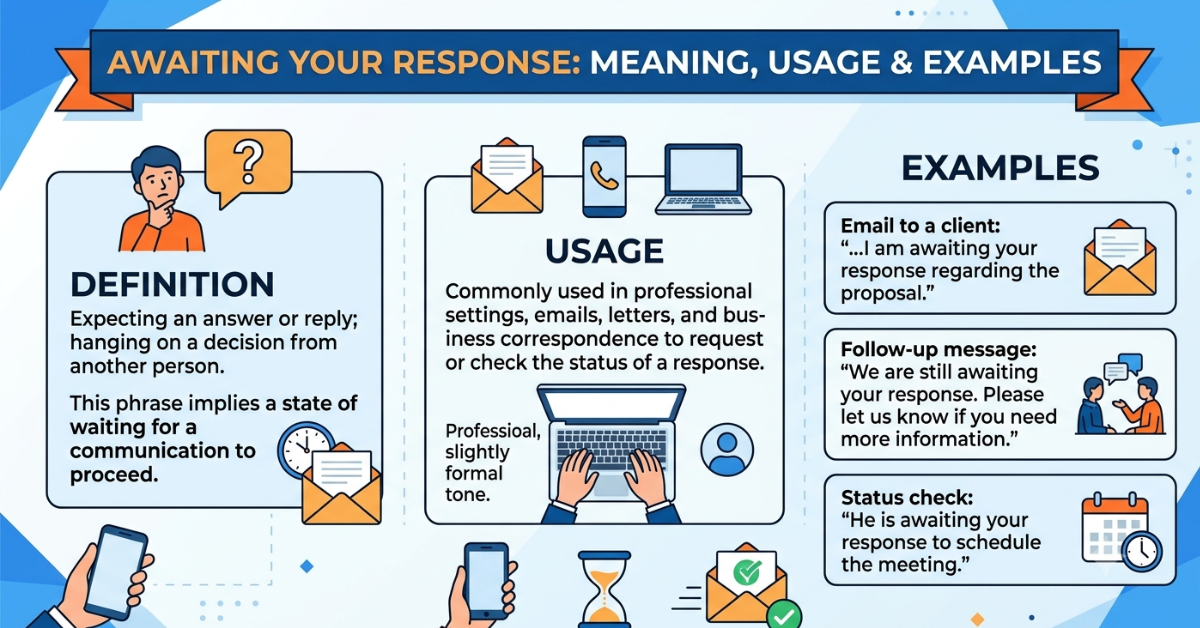
The phrase “awaiting your response” simply means:
I am waiting for you to reply.
In other words, it politely tells the recipient that you’re expecting a reply before moving forward with a conversation, project, request, or decision. Although the wording sounds formal, it is widely used in professional communication because it expresses patience while setting clear expectations.
You’ll commonly see this phrase in:
- Business emails
- Customer support messages
- Job applications
- Project discussions
- Academic communication
- Legal correspondence
Overall, the expression is respectful rather than demanding, though its tone can vary depending on the context.
“Breaking Down the Phrase”
To better understand the expression, let’s look at each word individually.
Awaiting
The word “awaiting” means waiting for something to happen or arrive, usually with expectation or anticipation.
For example:
We are awaiting the delivery.
Your
Meanwhile, “your” indicates that the expected action belongs to the person receiving the message.
Response
A response is simply a reply, answer, or reaction to a question, request, or message.
When combined, the phrase “awaiting your response” means:
I am waiting for your reply before proceeding.
“Is It Professional?”
Absolutely. In fact, the phrase is commonly used in workplaces, corporate communication, and official correspondence.
Many professionals end emails with expressions such as:
- Awaiting your response.
- Looking forward to your response.
- I look forward to hearing from you.
- Please let me know your thoughts.
Among these options, “awaiting your response” is one of the most formal choices. However, if you want to sound warmer and more conversational, “Looking forward to hearing from you” is often a better alternative.
“Does ‘Awaiting Your Response’ Sound Demanding?”
Generally, no. Instead, it is considered polite and professional in most business settings.
However, repeatedly sending follow-up emails with only this phrase may make your message seem impatient. Therefore, it’s a good idea to soften your wording with a thank-you or a friendly closing.
Compare these examples:
Less friendly
Awaiting your response.
More professional
Thank you for your time. I look forward to your response.
Even better
Please let me know if you need any additional information. I look forward to hearing from you.
As you can see, small wording changes create a much friendlier impression.
“Practical Tips”
To sound professional without appearing overly formal, keep these best practices in mind:
- Include the reason you’re expecting a reply.
- Thank the reader before requesting a response.
- Keep your email concise and easy to read.
- Mention deadlines only when they’re genuinely necessary.
- Choose a friendlier alternative for colleagues or familiar contacts.
For example:
Thank you for reviewing the proposal. I’m awaiting your response so we can begin the next stage of the project.
As a result, your message sounds clear, respectful, and collaborative.
“Why This Phrase Matters”
Professional communication is about more than correct grammar. Instead, it’s also about creating a positive impression and setting clear expectations.
When used appropriately, phrases like “awaiting your response” can help you:
- Show professionalism
- Set clear expectations
- Encourage timely replies
- Improve business communication
- Build stronger workplace relationships
Ultimately, choosing the right wording helps conversations move forward while demonstrating respect for the recipient’s time.
Conclusion
Understanding the awaiting your response meaning helps you write emails that are both professional and courteous. While the phrase simply means you’re waiting for someone’s reply, using it in the right context makes your communication more effective.
Whether you’re sending a job application, following up with a client, or communicating with colleagues, this expression clearly signals that a response is expected. At the same time, friendlier alternatives such as “Looking forward to hearing from you” may be a better fit for less formal situations.
Ultimately, choosing the right closing phrase improves your email etiquette, encourages timely responses, and leaves a positive impression. By applying these tips, you’ll communicate with greater confidence in both personal and professional settings.