

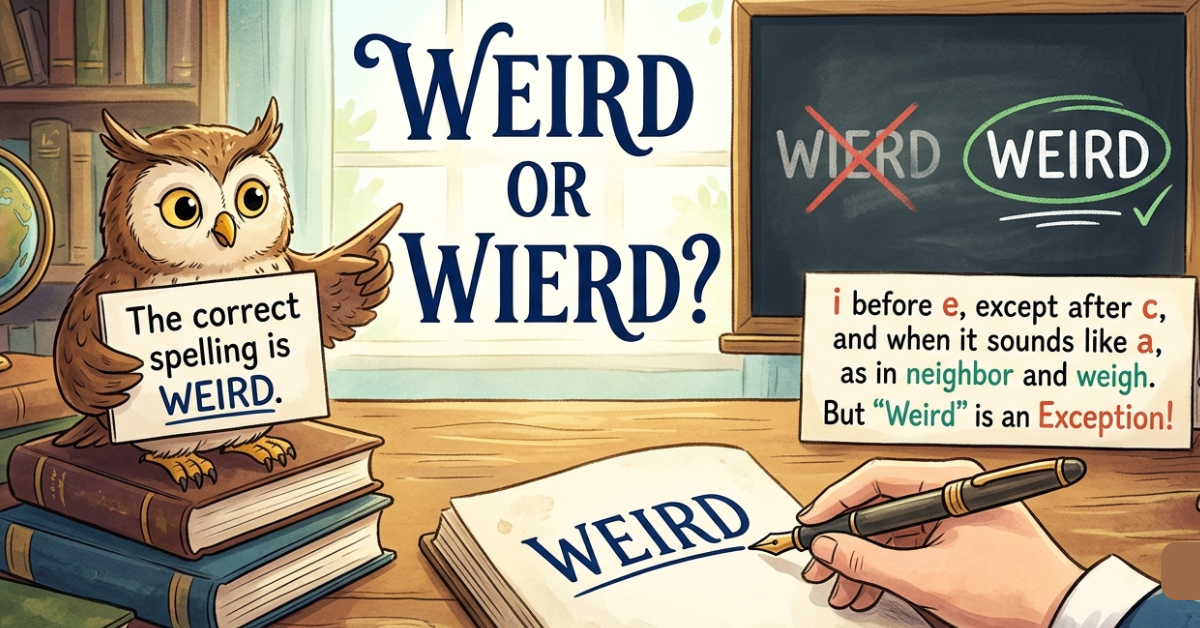
Have you ever stopped mid-sentence and wondered whether the correct spelling is wierd or weird? That confusion is extremely common, and for good reason. English spelling is full of exceptions, so this word often trips people up.
Still, the answer is simple: weird is correct, while wierd is incorrect. In this guide, you will learn the meaning of the word, why the mistake happens, how to remember the right spelling, and how to use it confidently in real sentences.
Wierd or Weird: The Correct Spelling
The correct spelling is weird.
- Weird = correct
- Wierd = incorrect
Although both versions may look familiar, only weird appears in standard English dictionaries. Therefore, whenever you are writing formally or casually, weird is the spelling to use.
What Does Weird Mean?
The word weird is an adjective. It describes something that feels strange, unusual, odd, unexpected, or hard to explain.
For example:
- That was a weird dream.
- The weather has been weird lately.
- She gave me a weird look.
- It felt weird going back to my old school.
In other words, the wierd or weird meaning question is easy to settle: only weird is a real word with a proper meaning.
Is It Wierd or Weird?
Yes, this is one of those spelling questions that many people search for. However, the correct form is always weird.
A helpful way to remember it is this: the word begins with w, followed by e i r d. Even though many English words follow the “i before e” pattern, this one is an exception.
For instance:
- This feels weird.
- It is weird how quiet the room is.
- That was the weirdest comment I heard all day.
By contrast, these are incorrect:
- This feels wierd.
- It is wierd how quiet the room is.
- That was the wierdest comment I heard all day.
Why Do So Many People Misspell Weird?
There are a few reasons this spelling mistake is so common. First, English spelling rules are not always consistent. Many learners grow up hearing the rule “i before e except after c,” but that rule has plenty of exceptions, and weird is one of them.
Second, people often type quickly, so the letters get flipped by habit. In addition, because ie appears in so many English words, the brain sometimes chooses that sequence automatically.
Finally, pronunciation does not clearly reveal the spelling. As a result, the word can be tricky even for fluent speakers.
Easy Ways to Remember the Correct Spelling
Fortunately, there are a few simple tricks that can help.
1. Break It Into Parts
Think of the word like this:
WE + IRD = WEIRD
That small split can make the spelling easier to remember.
2. Use a Short Reminder
Repeat this phrase:
“Weird uses EI, not IE.”
Because the sentence is short, it is easy to recall when you are writing.
3. See It More Often
Reading well-written articles, books, and captions can also help. Over time, your brain starts recognizing the correct form automatically.
Real Examples of Weird in Everyday English
The word weird appears in daily speech all the time. It can describe people, situations, sounds, feelings, and events.
Here are some natural examples:
- My phone is acting weird again.
- I had a weird feeling about that place.
- The lights made a weird noise.
- He has a weird sense of humor.
- It was weird seeing that old photo after so many years.
Notice how flexible the word is. Because of that, it works in both casual and formal writing.
Weird in Different Forms
Like many adjectives, weird can change form.
- weird — This movie is weird.
- weirder — Today feels weirder than yesterday.
- weirdest — That was the weirdest story I have heard.
- weirdly — Weirdly, the mistake happened twice.
Importantly, the spelling stays the same base form: weird.
Common Mistakes to Avoid
Many people accidentally write:
- wierd
- wierder
- wierdest
- wierdly
However, all of these are wrong. The correct versions are:
- weird
- weirder
- weirdest
- weirdly
So, if you are checking your writing, look carefully at the letter order.
Wierd vs Weird: Quick Comparison
| Feature | Wierd | Weird |
| Correct English spelling | No | Yes |
| Found in dictionaries | No | Yes |
| Accepted in exams | No | Yes |
| Suitable for formal writing | No | Yes |
This comparison makes the answer clear: weird is the only correct choice.
The Origin of Weird
Interestingly, the word weird did not originally mean “strange.” It comes from the Old English word wyrd, which referred to fate, destiny, or supernatural power. Over time, the meaning shifted.
Later, writers used it to describe something mysterious or uncanny. Eventually, the modern meaning developed: odd, unusual, or unexpected.
That history explains why the spelling looks a little unusual today.
Why Correct Spelling Matters
Spelling may seem small, but it affects how your writing feels. For example, correct spelling can make your message look:
- more professional
- more polished
- easier to trust
- clearer to understand
On the other hand, repeated mistakes can distract readers. Therefore, learning words like weird helps improve both confidence and credibility.
Key Takeaways
- The correct spelling is weird.
- Wierd is incorrect.
- The word means strange, unusual, or unexpected.
- It is a common exception to English spelling patterns.
- A simple memory trick is: Weird uses EI, not IE.
Frequently Asked Questions
Is it wierd or weird?
The correct spelling is weird. The spelling wierd is incorrect in standard English.
What does weird mean?
Weird means strange, unusual, odd, or unexpected. It is commonly used in everyday English.
Why do people spell weird as wierd?
People often confuse the order of i and e. Since English has many spelling exceptions, this mistake happens a lot.
Is weird an adjective?
Yes, weird is an adjective. It describes something unusual or odd.
Is wierd ever correct?
No, wierd is not correct in modern English. Dictionaries recognize only weird.
How can I remember the spelling?
Remember this simple line: “Weird uses EI, not IE.” That small trick helps many people avoid the mistake.
Conclusion
Now the spelling question is clear: weird is correct, and wierd is not. Although the word looks simple, it is one of the most common spelling traps in English.
As a result, remembering its correct form can improve your writing, your confidence, and your professionalism. Keep the spelling trick in mind, use the word in real sentences, and it will become second nature.