

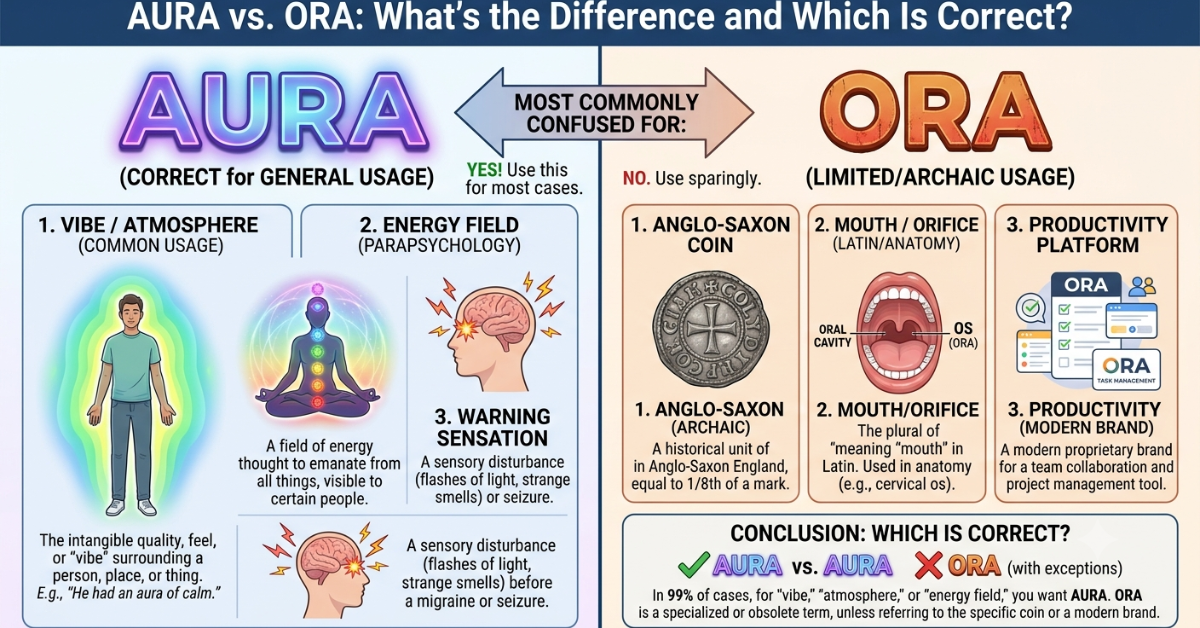
Have you ever come across the words aura and ora and wondered whether they mean the same thing or if one is simply a misspelling? It’s a common point of confusion, especially since they sound similar in everyday conversation.
Understanding Aura vs Ora is important because these words have completely different meanings, origins, and uses. In this guide, you’ll learn what each word means, when to use them correctly, why people often confuse them, and how to remember the difference with practical examples.
What Does “Aura” Mean?
An aura is an invisible quality, atmosphere, or energy that seems to surround a person, place, or object. Depending on the context, it may refer to emotional presence, spiritual energy, or even a medical symptom.
The word comes from the Latin word aura, meaning “breeze” or “air.”
Common meanings of aura include:
- A special atmosphere surrounding someone
- A person’s perceived energy or presence
- A warning sensation before a migraine or seizure
- A spiritual energy field in metaphysical beliefs
Examples
- The old castle had an aura of mystery.
- She carried an aura of confidence wherever she went.
- He experienced a visual aura before his migraine began.
In modern English, aura is a well-established dictionary word used in literature, psychology, medicine, wellness, and everyday conversation.
What Does “Ora” Mean?
Unlike aura, ora is not commonly used as an English vocabulary word.
Instead, it appears in several specific contexts:
1. A Proper Name
Ora is used as a first name for both men and women in different cultures.
Example:
- Ora is a popular Hebrew name meaning “light.”
2. Brand Names
Several businesses and products use Ora as part of their branding.
Examples include:
- Ora dental care products
- ORA biotechnology companies
- Fashion and beauty brands
3. Latin and Other Languages
In Latin, ora can refer to “edges,” “coasts,” or “borders.”
In Italian, ora means “now.”
Example:
- Italian: Vengo ora. (I’m coming now.)
Aura vs Ora: Quick Comparison
| Feature | Aura | Ora |
| English dictionary word | Yes | Generally no |
| Common meaning | Energy, atmosphere, presence | Mostly a name or foreign-language word |
| Everyday English usage | Very common | Rare |
| Medical meaning | Yes | No |
| Spiritual meaning | Yes | No |
| Proper noun | Sometimes | Frequently |
Why Do People Confuse Aura and Ora?
Several reasons contribute to the confusion.
Similar Pronunciation
In fast speech, “aura” and “ora” may sound somewhat alike depending on the speaker’s accent.
Autocorrect Errors
Typing quickly on smartphones sometimes changes one word into another.
Social Media
Many usernames, brands, and creative spellings intentionally replace aura with ora, making people think they’re interchangeable.
Lack of Context
Without surrounding words, readers may assume both spellings are acceptable.
Is “Ora” Ever a Correct Substitute for “Aura”?
The simple answer is no.
If you’re referring to:
- someone’s energy
- a mysterious atmosphere
- a personal presence
- migraine symptoms
- spiritual energy
then aura is always the correct spelling.
Using ora instead would usually be considered incorrect unless you’re referring to a specific name, brand, or another language.
Common Examples of Correct Usage
Correct
- The mountain has an aura of peace.
- She gives off an elegant aura.
- The patient noticed an aura before the seizure.
Incorrect
- The mountain has an ora of peace.
- She has a calming ora.
- His migraine ora lasted ten minutes.
These should all use aura instead.
Aura in Different Contexts
Spiritual Context
Many spiritual traditions describe an aura as an invisible field surrounding living beings.
Some believe aura colors represent different personality traits or emotional states.
Examples include:
- Blue aura
- Purple aura
- Green aura
- Golden aura
While widely discussed in spiritual communities, scientific evidence supporting visible human auras remains limited.
Medical Context
Doctors use the term aura to describe sensory symptoms that occur before certain neurological conditions.
Examples include:
- Migraine aura
- Epileptic aura
- Visual disturbances
- Tingling sensations
- Flashing lights
Here, the word has a precise medical definition rather than a spiritual one.
Literary Context
Writers often use aura figuratively to create vivid descriptions.
Example:
The abandoned house possessed an aura of forgotten memories.
This type of usage helps establish mood and atmosphere.
Ora in Different Contexts
Although uncommon in English vocabulary, Ora appears in various settings.
Personal Names
Ora has been used for centuries as a given name in multiple cultures.
Company Names
Many companies choose Ora because it’s short, memorable, and easy to pronounce.
Examples include businesses in:
- Healthcare
- Cosmetics
- Technology
- Hospitality
Foreign Languages
In Italian:
- Ora = now
In Latin:
- Ora = shores or borders (depending on grammatical form)
These meanings differ completely from the English word aura.
Aura vs Ora: How to Remember the Difference
A simple memory trick can help.
Think of the extra “u” in aura as standing for “unique energy.”
Aura = Unique energy around someone.
Ora = Usually a name, brand, or foreign-language word.
This small reminder makes the distinction much easier.
Common Mistakes to Avoid
Many writers accidentally make these errors.
- Using ora when discussing someone’s personality
- Assuming both spellings are interchangeable
- Confusing brand names with dictionary words
- Copying incorrect spellings from social media
Before publishing or sending important writing, double-check which meaning you intend.
When Should You Use Aura?
Use aura when discussing:
- Personal presence
- Emotional atmosphere
- Spiritual energy
- Migraines
- Neurological symptoms
- Literary descriptions
- Mood or ambiance
When Should You Use Ora?
Use Ora only when referring to:
- A person’s name
- A company or brand
- Italian language (“now”)
- Latin expressions
- Specific proper nouns
Key Differences at a Glance
Here are the most important distinctions:
- Aura is a standard English word.
- Ora is usually a proper noun or foreign-language term.
- Aura relates to energy, atmosphere, or medical symptoms.
- Ora generally does not carry those meanings.
- They are not interchangeable in normal English writing.
Practical Writing Tips
If you’re writing professionally, keep these tips in mind:
- Check the context before choosing the spelling.
- Use aura for descriptions of mood or presence.
- Capitalize Ora when it’s someone’s name or a brand.
- Don’t rely solely on spell-check, as proper names may not be flagged.
- Consider your audience, especially if writing for international readers.
Frequently Asked Questions
Is Aura or Ora the correct spelling?
If you’re referring to someone’s energy, atmosphere, or a medical warning sign before a migraine, aura is the correct spelling. Ora has different meanings and is not a replacement.
Is Ora a real English word?
Not as a common vocabulary word. Ora is primarily used as a personal name, company name, or a word in languages like Italian.
Why do people spell aura as ora?
The confusion usually comes from similar pronunciation, autocorrect, creative branding, or simple spelling mistakes.
Can aura refer to personality?
Yes. People often describe someone’s presence, confidence, or emotional influence as their aura. It’s commonly used in both casual and literary English.
Does ora mean energy?
No. The meaning of “energy surrounding a person” belongs to aura, not ora.
Are Aura and Ora interchangeable?
No. They have different meanings and should only be used in the appropriate context.
Conclusion
The comparison of Aura vs Ora becomes much clearer once you understand their origins and meanings. Aura is a widely recognized English word that describes atmosphere, presence, spiritual energy, or certain medical symptoms. Ora, on the other hand, is primarily a name, brand, or word from another language and is rarely used as standard English vocabulary.
Whenever you’re writing about someone’s presence, a mysterious atmosphere, or a neurological symptom, aura is almost always the correct choice. Knowing this distinction helps you communicate more accurately, avoid common spelling mistakes, and write with greater confidence. Keep this guide in mind whenever you’re unsure, and you’ll be able to choose the right word every time.