

Have you ever looked at a record player and wondered what the long arm holding the needle is called—or why it plays such an important role in sound quality? While most people focus on the turntable platter or speakers, the tonearm is one of the most critical components of any vinyl setup.
Understanding tonearm meaning helps you appreciate how vinyl records are played with precision and care. It’s far more than a simple arm that holds a needle—it directly affects tracking accuracy, sound clarity, record wear, and the overall listening experience.
In this guide, you’ll learn what a tonearm is, how it works, the different types available, its main components, and practical tips for choosing and maintaining one.
What Is the Tonearm?
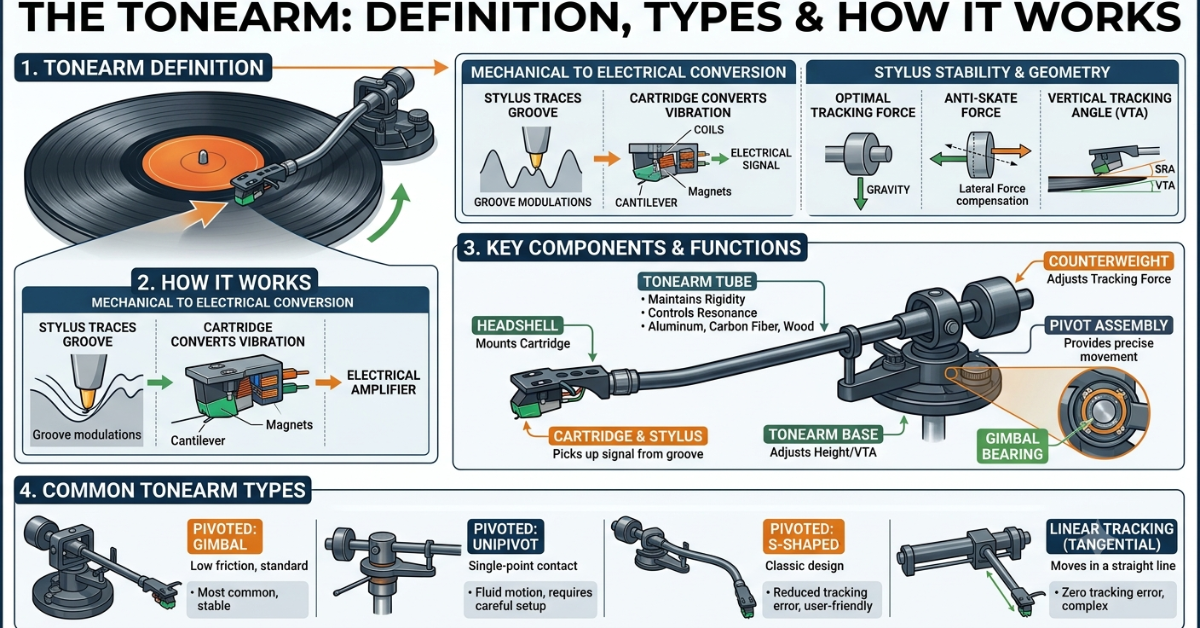
The tonearm is the movable arm on a turntable that holds the cartridge and stylus (needle). Its primary purpose is to guide the stylus smoothly through the grooves of a vinyl record while maintaining the correct pressure and angle.
In simple terms, the tonearm acts as a bridge between the record and your audio system. It allows the stylus to accurately read the tiny groove patterns that contain the recorded music.
Without a properly functioning tonearm, even the highest-quality turntable cannot produce accurate sound.
Simple Definition
Tonearm Meaning: A tonearm is the mechanical arm on a record player that supports the cartridge and stylus while allowing them to track the grooves of a vinyl record accurately.
Why Is the Tonearm Important?
Many beginners assume the stylus alone determines sound quality. In reality, the tonearm plays an equally important role.
A well-designed tonearm helps:
- Maintain stable tracking
- Reduce unwanted vibrations
- Minimize record wear
- Improve stereo imaging
- Deliver cleaner and more accurate sound
If the tonearm is poorly balanced or improperly adjusted, it can cause distortion, skipping, excessive record wear, or uneven sound.
How Does a Tonearm Work?
The operation is surprisingly simple but incredibly precise.
Here’s the basic process:
- The vinyl record rotates on the platter.
- The stylus sits inside the record groove.
- The cartridge converts groove vibrations into electrical signals.
- The tonearm keeps the stylus positioned correctly while allowing it to move inward naturally.
- The electrical signal travels to an amplifier and eventually reaches your speakers.
Throughout playback, the tonearm ensures the stylus follows the groove without applying too much or too little pressure.
Main Parts of a Tonearm
Understanding the individual tonearm meaning components makes it easier to appreciate how everything works together.
1. Headshell
The headshell attaches to the front of the tonearm and holds the cartridge securely.
Some turntables feature removable headshells, making cartridge replacement much easier.
2. Cartridge
The cartridge converts mechanical vibrations into electrical audio signals.
There are two common cartridge types:
- Moving Magnet (MM)
- Moving Coil (MC)
3. Stylus
The stylus, commonly called the needle, sits inside the record grooves and reads the music information.
4. Counterweight
Located at the back of the tonearm, the counterweight balances the arm and sets the correct tracking force.
5. Anti-Skate Mechanism
As records spin, a natural inward pulling force develops.
The anti-skate adjustment compensates for this force to ensure even pressure on both sides of the groove.
6. Tonearm Bearings
High-quality bearings allow smooth horizontal and vertical movement with minimal friction.
Different Types of Tonearms
Not all tonearms are built the same. Their design affects both tracking performance and sound characteristics.
Straight Tonearm
Straight tonearms are known for:
- Excellent tracking accuracy
- Lower resonance
- Popular use among DJs and modern turntables
Pros:
- Precise playback
- Better groove tracking
Cons:
- May require more careful cartridge alignment
S-Shaped Tonearm
The classic S-shaped design is commonly found on many vintage and hi-fi turntables.
Benefits include:
- Easier cartridge alignment
- Good balance between performance and usability
- Traditional appearance
J-Shaped Tonearm
Less common today, J-shaped tonearms offer another geometry option that balances tracking performance with ease of setup.
Linear Tracking Tonearm
Unlike conventional pivoting arms, linear tracking tonearms move straight across the record.
Advantages:
- Eliminates tracking angle error
- More accurate playback
Disadvantages:
- More complex
- Higher maintenance
- Generally more expensive
Tonearm Materials
Manufacturers use different materials to reduce resonance while maintaining rigidity.
Common materials include:
- Aluminum
- Carbon fiber
- Magnesium
- Titanium
- Stainless steel
- Composite materials
Carbon fiber has become especially popular because it’s lightweight yet extremely rigid.
Tonearm Length Explained
Tonearms typically come in different lengths.
Common sizes include:
- 9-inch
- 10-inch
- 12-inch
Longer tonearms generally reduce tracking angle error but require larger turntables.
Shorter tonearms are more compact and common on consumer models.
Tonearm Balance and Tracking Force
One of the most important adjustments involves balancing the tonearm correctly.
Tracking force refers to the downward pressure applied by the stylus.
Too much force can:
- Wear out records
- Damage the stylus
Too little force can:
- Cause skipping
- Reduce sound quality
- Increase distortion
Manufacturers specify the ideal tracking force for each cartridge.
Common Tonearm Problems
Even quality tonearms can develop issues over time.
Some common problems include:
Skipping
Usually caused by:
- Incorrect tracking force
- Dirty records
- Damaged stylus
- Improper anti-skate adjustment
Distorted Sound
Possible causes:
- Cartridge misalignment
- Worn stylus
- Damaged bearings
Excessive Record Wear
Often results from:
- Too much tracking force
- Poor cartridge setup
How to Maintain a Tonearm
Regular maintenance extends both record and stylus life.
Here are some helpful tips:
- Keep the stylus clean.
- Dust the tonearm regularly.
- Check tracking force periodically.
- Verify cartridge alignment after replacing the stylus.
- Avoid touching the stylus with your fingers.
- Store the turntable on a stable surface to minimize vibrations.
Proper care keeps playback smooth and protects your vinyl collection.
Choosing the Right Tonearm
If you’re shopping for a turntable or upgrading your setup, consider these factors:
Build Quality
Rigid materials reduce unwanted resonance.
Compatibility
Ensure the tonearm matches your preferred cartridge.
Ease of Adjustment
Features like adjustable counterweights and anti-skate controls simplify setup.
Intended Use
- Audiophiles often prioritize precision.
- DJs may prefer rugged straight tonearms.
- Casual listeners can benefit from well-balanced automatic systems.
Tonearm vs Stylus vs Cartridge
Many beginners confuse these three parts.
| Component | Purpose |
| Tonearm | Holds and guides the cartridge across the record |
| Cartridge | Converts vibrations into electrical signals |
| Stylus | Reads the grooves on the vinyl record |
Together, these components determine playback accuracy and sound quality.
Real-World Example
Imagine driving a car with perfectly good tires but a poorly aligned steering system.
The tires may be excellent, but the vehicle won’t perform properly.
Similarly, a premium cartridge cannot deliver its full potential if the tonearm isn’t properly balanced or aligned.
Key Takeaways
- A tonearm guides the stylus across a vinyl record.
- It directly influences sound quality and record longevity.
- Proper balance and tracking force are essential.
- Different tonearm designs suit different listening needs.
- Regular maintenance improves performance and extends equipment life.
- The tonearm works together with the cartridge and stylus for accurate playback.
Frequently Asked Questions
What is the tonearm meaning on a record player?
The tonearm meaning refers to the movable arm that supports the cartridge and stylus while guiding them through the grooves of a vinyl record for accurate playback.
Why is the tonearm important?
The tonearm maintains proper tracking, minimizes distortion, reduces record wear, and helps produce clear, balanced audio.
Can a damaged tonearm affect sound quality?
Yes. A bent, loose, or poorly adjusted tonearm can cause skipping, distortion, uneven channel balance, and premature wear on both records and the stylus.
What is the difference between a tonearm and a stylus?
The tonearm supports and moves the cartridge assembly, while the stylus is the tiny needle that physically contacts the grooves of the record to read the audio information.
Which tonearm type is best?
There isn’t a single best option. Straight, S-shaped, J-shaped, and linear tracking tonearms each have advantages depending on your budget, listening preferences, and turntable design.
How often should a tonearm be adjusted?
You should check the tonearm whenever you install a new cartridge, replace the stylus, move the turntable, or notice playback issues. Periodic inspection also helps maintain optimal performance.
Conclusion
Understanding tonearm meaning gives you a deeper appreciation of how vinyl records deliver music with such warmth and detail. Although it may seem like a simple mechanical arm, the tonearm plays a vital role in tracking accuracy, protecting your records, and achieving high-quality sound.
Whether you’re buying your first turntable or refining an advanced hi-fi system, learning how the tonearm works will help you make smarter equipment choices and enjoy better playback for years to come. Continue exploring the world of vinyl.