

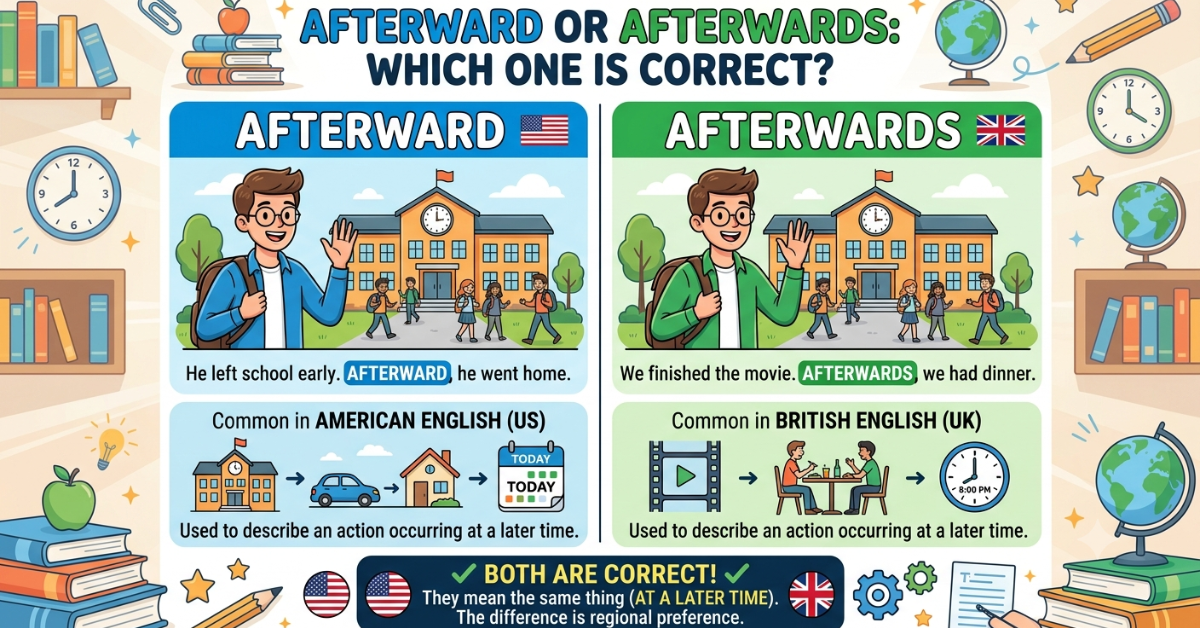
Have you ever finished writing an email or essay and paused because you weren’t sure whether to write afterward or afterwards? You’re not alone. It’s one of those small grammar questions that often catches even fluent English speakers off guard.
If you’ve ever wondered afterward or afterwards, is it afterward or afterwards, or searched for the afterward or afterwards meaning, this guide has everything you need. You’ll learn the difference between these two words, when to use each one, whether one is more correct than the other, and how to avoid common mistakes.
What Do “Afterward” and “Afterwards” Mean?
The good news is that afterward and afterwards have exactly the same meaning.
Both are adverbs that mean:
- At a later time
- Following an event
- Subsequently
- Later on
Examples
- We had dinner, and afterward we watched a movie.
- We had dinner, and afterwards we watched a movie.
Both sentences are grammatically correct and mean the same thing.
Simple definition:
Afterward/afterwards = later, after that, subsequently.
Afterward or Afterwards: What’s the Difference?
The only real difference is regional preference.
| Afterward | Afterwards |
| Preferred in American English | Preferred in British English |
| Common in the United States | Common in the UK, Australia, New Zealand, and many Commonwealth countries |
| Meaning is identical | Meaning is identical |
Think of it like these pairs:
- Toward → Towards
- Forward → Forwards
- Backward → Backwards
In American English, the version without -s is generally preferred. In British English, both forms are acceptable, but the -s ending is more common.
Is It Afterward or Afterwards?
If you’re asking, “Is it afterward or afterwards?”, the answer depends on the variety of English you’re using.
Use “Afterward” if:
- You’re writing in American English.
- Your audience is primarily in the United States.
- You’re following American style guides.
Example:
She completed her presentation and afterward answered questions.
Use “Afterwards” if:
- You’re writing in British English.
- Your audience is in the UK or other Commonwealth countries.
- You’re following British spelling conventions.
Example:
She completed her presentation and afterwards answered questions.
Neither version is more correct than the other.
Afterward or Afterwards Meaning Explained
Many learners think these words describe a specific amount of time. They don’t.
They simply refer to something happening later than another event.
Timeline Example
9:00 AM → Team meeting
10:00 AM → Coffee break
Sentence:
We had a team meeting. Afterwards, we grabbed coffee.
The exact amount of time doesn’t matter. It simply means the coffee happened after the meeting.
When Should You Use Afterward?
Use afterward when you’re writing in American English or following U.S. grammar conventions.
Examples
- We visited the museum and afterward went shopping.
- I’ll finish this project and afterward take a vacation.
- They apologized afterward.
When Should You Use Afterwards?
Use afterwards when writing in British English.
Examples
- We finished lunch and afterwards went for a walk.
- He called afterwards to explain.
- She felt much better afterwards.
Common Situations Where These Words Are Used
You’ll often see these adverbs in everyday communication.
Conversations
- Let’s eat first. Afterwards, we’ll watch TV.
Academic Writing
- Participants completed the survey and afterward discussed their responses.
News Reports
- The investigation continued afterward.
Storytelling
- They laughed about it afterwards.
Grammar Rule: What Part of Speech Are They?
Both afterward and afterwards are adverbs.
An adverb modifies a verb, adjective, or another adverb. In this case, these words describe when something happens.
Example:
She left afterward.
The word afterward tells us when she left.
Where Do They Go in a Sentence?
They are flexible and can appear in different positions.
At the Beginning
- Afterwards, everyone went home.
- Afterward, we celebrated.
In the Middle
- We afterward realized our mistake.
Although correct, this position is less common.
At the End
- We finished the project afterward.
- She apologized afterwards.
This is the most natural placement in everyday English.
Afterward vs Afterwards vs Later
People often compare these words because they all refer to time.
| Word | Meaning | Formality |
| Afterward | After that | Neutral |
| Afterwards | After that | Neutral |
| Later | At some future time | Very common |
Examples
Afterward
We watched the movie. Afterward, we went home.
Later
I’ll call you later.
Notice that later can refer to an unspecified future time, while afterward/afterwards usually connects directly to a previous event.
Afterward vs Then
Both words connect events, but they’re not identical.
Then
Shows sequence.
We packed our bags, then left.
Afterward
Highlights that something happened after a completed event.
We packed our bags. Afterward, we checked into the hotel.
Common Mistakes to Avoid
Mixing British and American English
Incorrect:
We travelled afterwards and checked our favorite color afterward.
The grammar isn’t wrong, but mixing regional styles within the same document can seem inconsistent.
Using Them as Adjectives
Incorrect:
The afterward meeting was short.
Correct:
The meeting afterward was short.
Or better:
The meeting that followed was short.
Using Them with an Exact Time
Less natural:
Afterwards at 5 PM, we left.
Better:
We left at 5 PM afterward.
Or:
We left afterward, at around 5 PM.
Real-Life Examples
Workplace
The manager gave a presentation. Afterwards, employees asked questions.
School
We finished the exam and afterward discussed the difficult questions.
Travel
They visited Paris and afterwards traveled to Rome.
Family
We had dinner. Afterward, everyone played board games.
Tips to Remember the Difference
Here are a few easy tricks:
- American English? Use afterward.
- British English? Use afterwards.
- Both words have the same meaning.
- Stay consistent throughout your writing.
- When in doubt, match your audience’s preferred spelling.
Which Form Is More Common?
It depends on where you are.
American English
- afterward More common
- afterwards Less common but understood
British English
- afterwards More common
- afterward Also accepted
Most grammar checkers, dictionaries, and style guides recommend using the version that matches your chosen variety of English.
Quick Comparison Table
| Feature | Afterward | Afterwards |
| Meaning | Later | Later |
| Part of Speech | Adverb | Adverb |
| American English | Preferred | Less common |
| British English | Acceptable | Preferred |
| Formal Writing | Yes | Yes |
| Everyday Speech | Yes | Yes |
Key Takeaways
- Afterward and afterwards mean exactly the same thing.
- The only difference is regional spelling preference.
- American English usually favors afterward.
- British English typically prefers afterwards.
- Both function as adverbs meaning “later” or “after that.”
- Use one style consistently throughout your writing.
Frequently Asked Questions
Is afterward or afterwards correct?
Both are correct. Afterward is more common in American English, while afterwards is generally preferred in British English.
What is the afterward or afterwards meaning?
The afterward or afterwards meaning is “later,” “after that,” or “following an earlier event.” They describe something that happens after something else.
Is there any difference between afterward and afterwards?
No. Their meanings are identical. The only distinction is regional usage and spelling preference.
Can I use afterward in British English?
Yes. British English accepts afterward, although afterwards is more commonly used.
Which is more formal: afterward or afterwards?
Neither is more formal. Both are suitable for academic writing, professional communication, and everyday conversations.
Can I use later instead of afterward?
Sometimes. Later often refers to an unspecified future time, while afterward or afterwards usually refers to something happening after a specific event.
Conclusion
Understanding afterward or afterwards is much easier than many people expect. Both words mean exactly the same thing, and neither is more grammatically correct than the other. The only real difference is where they’re commonly used—afterward in American English and afterwards in British English.
The key is consistency. Choose the version that matches your audience or writing style and use it throughout your document. Once you know this simple rule, you’ll never have to wonder is it afterward or afterwards again. Keep practicing with real examples, and you’ll naturally become more confident in using both forms correctly.