

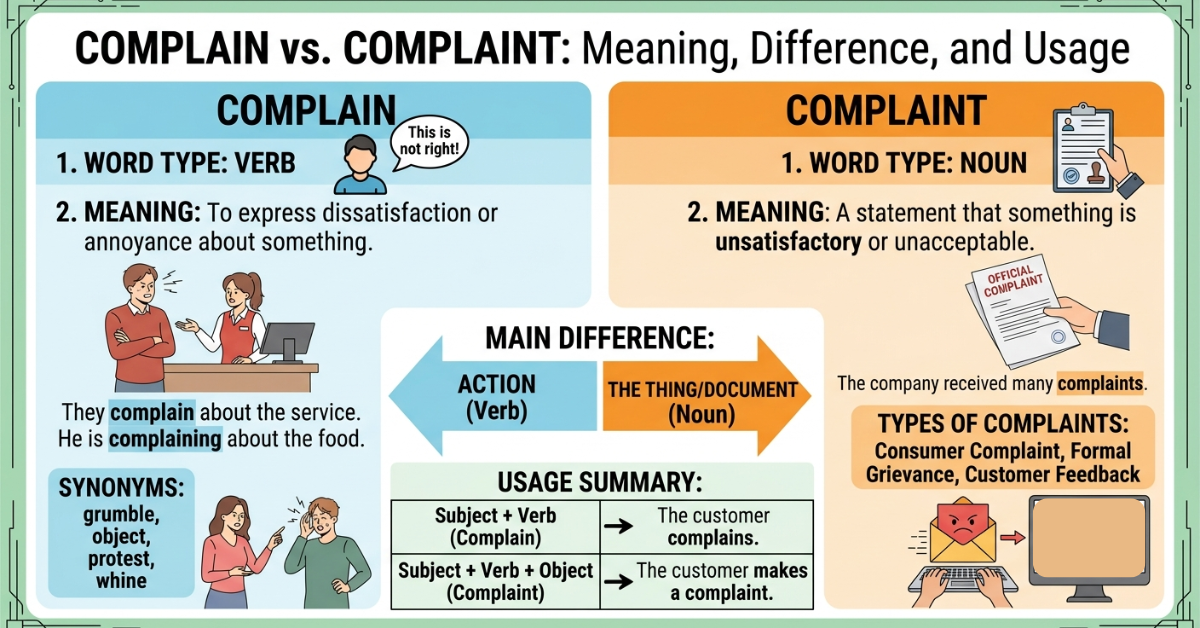
Have you ever paused mid-sentence and wondered whether to say complain or complaint? You are not alone. These two words are closely related, but they are not interchangeable, and using the wrong one can make your writing sound awkward or unclear.
In this guide, you will learn the difference between complain and complaint, how to use each word correctly, common grammar patterns, and practical examples that make the distinction easy to remember. By the end, you will be able to use both words naturally in everyday speech and writing.
What Does “Complain” Mean?
“Complain” is a verb. It means to express dissatisfaction, unhappiness, or annoyance about something.
Examples of “complain” in a sentence
- She always complains about the weather.
- Customers complained about the long wait time.
- Please do not complain unless you have a real issue to report.
When you use “complain,” you are talking about an action. Someone is voicing a problem, concern, or criticism.
Common patterns with “complain”
You will often see these structures:
- complain about something
He complained about the noise. - complain to someone
She complained to the manager. - complain that something is true
They complained that the service was too slow.
These patterns are useful because they show exactly where the dissatisfaction is directed.
What Does “Complaint” Mean?
“Complaint” is a noun. It refers to the thing being said, the issue itself, or an expression of dissatisfaction.
Examples of “complaint” in a sentence
- The hotel received several complaints from guests.
- Her main complaint was the poor customer service.
- We filed a formal complaint with the company.
Here, “complaint” is not the action. It is the report, objection, or problem being raised.
Common uses of “complaint”
A complaint can be:
- a spoken grievance
- a written report
- a formal request for action
- a medical issue or symptom
For example:
- He has a stomach complaint.
- The customer submitted a complaint online.
Complain vs Complaint: The Simple Rule
If you are confused between the two, this easy rule helps:
- Complain = the verb (the action)
- Complaint = the noun (the thing)
Quick comparison
- I will complain to the supervisor.
- I have a complaint about the service.
One shows the act of speaking up. The other names the issue or statement.
How to Remember the Difference
A simple memory trick can make this easy:
- Complain ends in -ain, like “explain” or “remain” — it is something you do
- Complaint ends in -aint, like a thing you can make or file
Another way to think about it:
- You complain
- You make a complaint
That one small shift helps a lot in both writing and speaking.
Real-Life Examples in Different Contexts
Understanding complain or complaint becomes easier when you see them in real situations.
1. Customer service
- Correct: The customer complained about the delay.
- Correct: The customer filed a complaint about the delay.
2. Workplace
- Correct: Employees often complain about unclear instructions.
- Correct: HR received a complaint from an employee.
3. School or college
- Correct: Students complained about the exam timing.
- Correct: The principal addressed the complaint quickly.
4. Everyday conversation
- Correct: Don’t complain if you did not speak up earlier.
- Correct: My complaint is that the food arrived cold.
These examples show that the grammar changes depending on whether you are describing an action or a noun.
Common Grammar Mistakes to Avoid
Many learners mix these words up because they sound related. Here are the most common mistakes:
1. Using “complaint” as a verb
Incorrect: I complaint to the manager.
Correct: I complained to the manager.
2. Using “complain” as a noun
Incorrect: My complain is about the noise.
Correct: My complaint is about the noise.
3. Forgetting the preposition
Incorrect: She complained the service.
Correct: She complained about the service.
Getting these patterns right makes your writing sound much more natural.
Synonyms and Related Words
Depending on the situation, you may also see these related words:
- grumble
- object
- protest
- criticism
- objection
- issue
- grievance
- concern
These words are not exact replacements in every case, but they often appear in similar contexts. For example, a formal workplace issue may be called a grievance, while a casual verbal expression may be a complaint.
Formal vs Informal Usage
The difference between these words also appears in tone.
Informal
- I’m going to complain about the food.
- Everyone kept complaining about the heat.
Formal
- A written complaint was submitted to management.
- The company investigated the customer complaint.
In formal writing, complaint is often used in legal, business, medical, and customer service contexts. Complain is more common in speech and everyday writing.
Practical Tips for Using Them Correctly
Here are a few easy tips to help you remember the correct usage:
- Use complain when someone is doing the action.
- Use complaint when you mean the issue, statement, or report.
- Check whether the word fits as a verb or noun in the sentence.
- Read the sentence aloud. If it sounds like an action, choose complain.
- If you can put “a” or “the” before it, you probably need complaint.
For example:
- He made a complaint — correct
- He made a complain — incorrect
Key Takeaways
- Complain is a verb.
- Complaint is a noun.
- You complain about something.
- You make or file a complaint.
- The two words are related, but they are not interchangeable.
FAQs About Complain or Complaint
1. Is it correct to say “make a complain”?
No, that is incorrect. The correct phrase is make a complaint because “complaint” is the noun.
2. Which is more formal: complain or complaint?
Complaint is generally more formal, especially in business, legal, or customer service contexts. Complain is the action word used in both formal and informal speech.
3. Can I say “complain about”?
Yes, complain about is a very common and correct phrase. For example: She complained about the noise.
4. What is the adjective form of complaint?
A common related adjective is complainant in legal contexts, but that refers to a person who complains. For describing something annoying, words like complaining or problematic may fit better depending on the sentence.
5. What is the difference between a complaint and a grievance?
A complaint is a general expression of dissatisfaction, while a grievance is usually more formal and often used in workplace or legal settings.
6. Can “complain” be used in medical language?
Yes. Doctors may ask about what a patient complains of, meaning the symptoms or concerns the patient reports. In this case, it still functions as a verb.
Conclusion
The difference between complain or complaint is simple once you remember the grammar: one is an action, and the other is the thing being stated. Complain is the verb, while complaint is the noun.
Whether you are writing an email, speaking at work, or improving your grammar, using these words correctly helps you sound clearer and more confident. Keep the rule in mind, practice with examples, and you will stop mixing them up quickly.
Use this guide as a reference whenever you are unsure, and your writing will become more accurate and natural over time.