

Have you ever paused while writing an email or social media post because you couldn’t decide whether to write favourite or favorite? You’re not alone. This is one of the most common English spelling questions, especially for learners, writers, and professionals who communicate with international audiences.
The good news is that both spellings are correct. The real difference lies in where the English is being used, not in grammar or meaning. If you’ve ever wondered is it favourite or favorite, this guide will explain the difference, regional preferences, pronunciation, usage examples, and practical tips to help you choose the right spelling with confidence.
What Is the Difference Between Favourite and Favorite?
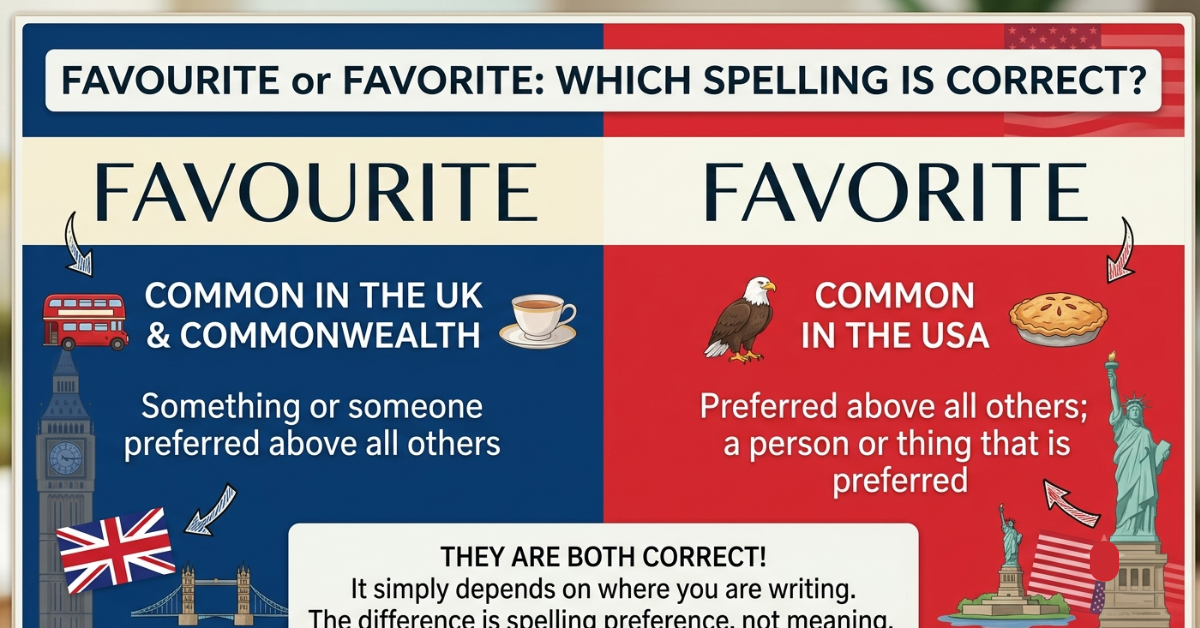
The only difference between favourite and favorite is the spelling.
- Favourite is the standard spelling in British English.
- Favorite is the standard spelling in American English.
Both words have exactly the same meaning:
Favorite/Favourite (noun): A person or thing preferred above others.
Favorite/Favourite (adjective): Most liked or preferred.
The pronunciation, meaning, and grammatical function remain identical regardless of the spelling.
Is It Favourite or Favorite?
The answer depends on the version of English you’re using.
| English Version | Correct Spelling |
| British English | Favourite |
| American English | Favorite |
| Australian English | Favourite |
| Canadian English | Favourite (mostly) |
| New Zealand English | Favourite |
If you’re writing for an American audience, use favorite.
If you’re writing for readers in the UK, Australia, or New Zealand, favourite is the preferred spelling.
Canadian English generally favors favourite, although American spellings appear more frequently due to cultural influence.
Why Are There Two Different Spellings?
The spelling difference dates back hundreds of years.
British English Kept the Original Form
British English preserved spellings influenced by French and Latin, including words ending in -our, such as:
- Colour
- Honour
- Neighbour
- Favourite
These spellings became the accepted standard in the United Kingdom and many Commonwealth countries.
American English Simplified Spellings
In the early 1800s, American lexicographer Noah Webster promoted simplified spellings to make English more consistent.
He encouraged changes like:
| British | American |
| Favourite | Favorite |
| Colour | Color |
| Honour | Honor |
| Labour | Labor |
| Neighbour | Neighbor |
These simplified spellings eventually became standard across the United States.
Meaning of Favourite and Favorite
Whether spelled with or without the “u,” the word means something that is liked more than others.
As an adjective
Examples:
- My favorite movie is Inception.
- My favourite dessert is chocolate cake.
As a noun
Examples:
- She is everyone’s favorite.
- This book has become my favourite.
The meaning never changes because of the spelling.
Favourite vs Favorite: Side-by-Side Comparison
| Feature | Favourite | Favorite |
| Meaning | Preferred or most liked | Preferred or most liked |
| Grammar | Noun and adjective | Noun and adjective |
| British English | Yes | No |
| American English | No | Yes |
| Pronunciation | Same | Same |
Which Countries Use Favourite?
The spelling favourite is commonly used in:
- United Kingdom
- Australia
- New Zealand
- Ireland
- South Africa
- Most Commonwealth countries
If you’re writing academic papers or business documents for these regions, use favourite.
Which Countries Use Favorite?
The spelling favorite is standard in:
- United States
- American businesses
- US universities
- American media
- Most US publications
If your audience is primarily American, favorite is the correct choice.
Common Examples in Everyday Writing
Here are some natural examples.
British English
- What’s your favourite colour?
- This is my favourite restaurant.
- She’s my favourite teacher.
- Autumn is my favourite season.
American English
- What’s your favorite color?
- This is my favorite restaurant.
- She’s my favorite teacher.
- Summer is my favorite season.
Notice that other words often change too:
- favourite colour
- favorite color
The spellings usually match the variety of English being used.
Should You Mix Favourite and Favorite?
No.
Consistency is important.
If you’re writing a document in British English, keep all spellings British.
Example:
- favourite
- colour
- organise
- centre
If you’re writing in American English, stay consistent.
Example:
- favorite
- color
- organize
- center
Mixing the two styles can make your writing look unprofessional.
Favourite or Favorite in Academic Writing
Academic institutions usually follow a style guide.
For example:
Use Favourite If
- Your university follows British English.
- You’re submitting work in the UK or Australia.
- Your journal uses British spelling.
Use Favorite If
- You’re studying in the United States.
- Your institution follows American English.
- You’re writing according to APA style.
Always check your organization’s preferred language standard before submitting important work.
Favourite or Favorite in Digital Marketing and SEO
If you create websites or blog content, your audience matters.
Targeting UK Readers
Use:
- favourite
- favourite products
- favourite recipes
- favourite books
Targeting US Readers
Use:
- favorite
- favorite products
- favorite recipes
- favorite books
Search engines recognize regional spelling, so choosing the correct version improves relevance for local audiences.
Common Mistakes People Make
Here are a few mistakes to avoid.
Mixing British and American English
My favourite color is blue.
Choose one style:
My favourite colour is blue.
or
My favorite color is blue.
Thinking One Is Incorrect
Many learners assume one spelling is wrong.
Actually, both are correct—they simply belong to different varieties of English.
Changing Spellings Randomly
Avoid switching between favorite and favourite in the same article, assignment, or report.
Easy Trick to Remember the Difference
Here’s a simple memory tip:
- Favourite has a “u” because British English often keeps the “u.”
- Favorite drops the “u” because American English prefers simplified spellings.
Think of these pairs:
| British | American |
| Favourite | Favorite |
| Colour | Color |
| Honour | Honor |
| Labour | Labor |
Once you remember one pair, the others become easier.
Practical Tips for Choosing the Right Spelling
Use these simple guidelines:
- Know your audience before you write.
- Follow your company’s or school’s language style.
- Keep spelling consistent throughout the document.
- Use your word processor’s language settings.
- When unsure, check whether you’re writing in British or American English.
Key Takeaways
- Both spellings are correct.
- Favourite is British English.
- Favorite is American English.
- The meaning and pronunciation are identical.
- Choose the spelling that matches your audience.
- Never mix British and American spelling in the same document.
Frequently Asked Questions
Is favourite or favorite correct?
Both are correct. Favourite is used in British English, while favorite is the standard American English spelling.
Why does favourite have a “u”?
British English retained the traditional -our spelling from earlier forms of English and French influence, while American English simplified many words by removing the “u.”
Is favorite wrong in the UK?
It’s not grammatically wrong, but it is considered an American spelling. British publications generally prefer favourite.
Which spelling should I use in school assignments?
Use whichever spelling matches your institution’s preferred style. If your school follows British English, write favourite. If it follows American English, use favorite.
Do search engines recognize both spellings?
Yes. Search engines understand both regional spellings. However, using the version that matches your target audience can improve relevance and user experience.
Are favourite and favorite pronounced differently?
No. They are pronounced exactly the same. The difference is purely in spelling, not pronunciation.
Conclusion
The debate over favourite or favorite isn’t about right versus wrong—it’s about choosing the spelling that matches your audience and the variety of English you’re using. If you’ve been asking is it favourite or favorite, the answer is simple: both are correct, but each belongs to a different regional standard.
By staying consistent throughout your writing and understanding the distinction between British and American English, you’ll communicate more clearly and professionally. Whether you’re writing an essay, creating content, or sending business emails, using the appropriate spelling helps your writing feel polished and credible. Explore more common English spelling differences to build even greater confidence in your writing.