

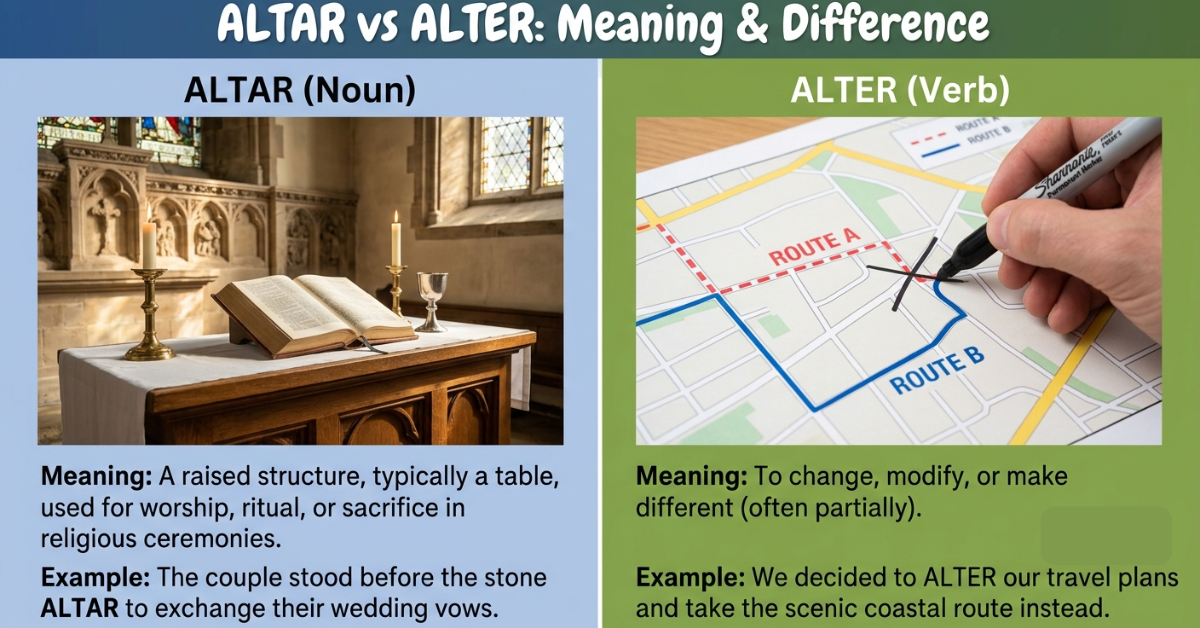
Have you ever paused while writing because you couldn’t remember whether it was altar or alter? You’re not alone. These two words sound exactly the same but have completely different meanings, making them one of the most commonly confused pairs in English.
In this guide to altar vs alter, you’ll learn what each word means, how to use them correctly, simple memory tricks, common mistakes to avoid, and plenty of real-world examples. By the end, you’ll never mix them up again.
Why Do People Confuse Altar and Alter?
The confusion comes from one simple reason—they’re homophones, meaning they have the same pronunciation but different spellings and meanings.
Many English learners and native speakers accidentally swap these words because they rely on sound instead of meaning. Understanding the context is the key to choosing the correct spelling.
Here’s a quick overview:
| Word | Part of Speech | Meaning |
| Altar | Noun | A sacred table or structure used in religious ceremonies |
| Alter | Verb | To change, modify, or make something different |
Although they differ by only one letter, their meanings are entirely unrelated.
What Does Altar Mean?
An altar is a noun that refers to a sacred place used during religious worship or ceremonies. It is commonly found in churches, temples, shrines, and other places of worship.
Traditionally, altars are used for:
- Religious ceremonies
- Weddings
- Offerings
- Prayer
- Sacrifices in ancient traditions
Examples of “Altar”
- The bride walked gracefully toward the altar.
- Flowers decorated the church altar.
- The priest stood behind the altar during the service.
- The family gathered around the home altar for prayer.
In modern language, “at the altar” is also commonly used to refer to getting married.
Example:
They met while studying in college and finally stood together at the altar.
What Does Alter Mean?
Alter is a verb that means to change, modify, adjust, or make something different.
It can refer to changing physical objects, plans, behaviors, opinions, documents, or appearances.
Examples of “Alter”
- We had to alter our travel plans because of the weather.
- She decided to alter the dress before the wedding.
- Exercise can alter your overall health.
- The company altered its pricing strategy.
Unlike altar, alter always involves some kind of change.
Altar vs Alter: The Main Difference
The easiest way to understand altar vs alter is to remember that one is a place, while the other is an action.
| Feature | Altar | Alter |
| Part of Speech | Noun | Verb |
| Meaning | Sacred religious table | Change or modify |
| Used In | Religion, weddings, ceremonies | Everyday actions and changes |
| Example | She stood at the altar. | They altered the design. |
Easy Memory Trick to Remember the Difference
One of the simplest ways to remember the difference is through letter association.
Remember “Altar”
Altar contains the letters A and R, reminding you of:
- Adoration
- Religion
Think:
Altar = A Religious Place
Remember “Alter”
Alter begins with Alt, similar to “alternative.”
Think:
Alter = Alternative = Change
This simple association helps many people avoid spelling mistakes.
Common Examples of Altar
Here are everyday sentences where altar is the correct word.
- The candles surrounded the altar.
- The priest blessed the altar before the ceremony.
- The wedding guests waited near the altar.
- They placed flowers on the family altar.
- The temple’s altar was beautifully decorated.
Common Examples of Alter
These examples show how alter is used correctly.
- You should alter the report before submitting it.
- Tailors alter clothing for a better fit.
- Technology continues to alter our daily lives.
- The architect altered the blueprint.
- The recipe can be altered to suit dietary needs.
Common Mistakes People Make
Many writers accidentally replace one word with the other.
Incorrect
They exchanged vows at the alter.
Correct
They exchanged vows at the altar.
Incorrect
Please altar the document.
Correct
Please alter the document.
Incorrect
The tailor repaired and altared my jacket.
Correct
The tailor repaired and altered my jacket.
Altar vs Alter in Weddings
This is where the confusion appears most often.
When talking about weddings:
- Couples stand at the altar.
- A tailor may alter the wedding dress.
Example:
The bride stood at the altar wearing a gown that had been professionally altered.
Using both words correctly in one sentence highlights their different meanings.
Altar vs Alter in Religion
In religious contexts, altar almost always refers to the sacred structure used during worship.
Examples include:
- Church altar
- Temple altar
- Family altar
- Stone altar
- Memorial altar
The word alter is generally unrelated to religion unless discussing changing something.
Example:
The committee decided to alter the ceremony schedule.
Grammar Difference
Understanding the grammar makes choosing the right word easier.
Altar
- Noun
- Person, place, or thing
- Cannot be used as an action
Example:
The altar was decorated.
Alter
- Verb
- Shows action
- Indicates change
Example:
They altered the design.
Words Commonly Used with Altar
You will often see these combinations:
- Wedding altar
- Church altar
- Family altar
- Stone altar
- Decorated altar
- Sacred altar
- Prayer altar
Words Commonly Used with Alter
Common collocations include:
- Alter plans
- Alter behavior
- Alter appearance
- Alter clothing
- Alter schedule
- Alter strategy
- Alter documents
- Alter policy
Origin of the Words
Knowing their history also explains why they are different.
Altar
The word comes from the Latin altare, referring to a place of sacrifice or worship.
Alter
This word comes from the Latin alterare, meaning “to change.”
Although they sound alike today, they developed from different roots and have unrelated meanings.
Practical Tips to Never Confuse Them Again
Here are a few simple habits that make remembering easier:
- Ask yourself whether you’re talking about a place or a change.
- If it’s related to worship or marriage, use altar.
- If something is being modified, use alter.
- Read the sentence aloud and identify whether you need a noun or a verb.
- Use memory associations until the distinction becomes automatic.
Key Takeaways
- Altar is a noun referring to a sacred religious structure.
- Alter is a verb meaning to change or modify something.
- They sound identical but have completely different meanings.
- Weddings happen at an altar.
- Tailors alter clothing.
- Checking whether your sentence needs a noun or a verb usually reveals the correct spelling.
Frequently Asked Questions
Is it altar or alter at a wedding?
The correct word is altar because weddings traditionally take place at an altar in a church or ceremonial setting. “Alter” means to change and doesn’t fit this context.
How do I remember altar vs alter?
A simple trick is to remember that altar relates to religion and ceremonies, while alter means to change something. Thinking “altar = religious place” helps many learners.
Can altar be used as a verb?
No. Altar is only a noun. If you’re describing making changes, the correct verb is alter.
Why do altar and alter sound the same?
They are homophones—words with identical pronunciation but different spellings, meanings, and grammatical functions. English contains many similar word pairs.
Is “altered dress” correct?
Yes. An altered dress is one that has been modified or adjusted for a better fit. The word altered comes from the verb alter.
What is the easiest way to distinguish altar vs alter?
Think about the meaning of the sentence. If you’re referring to a sacred place for worship or marriage, use altar. If you’re talking about changing or modifying something, use alter.
Conclusion
Understanding altar vs alter is easier than it first appears. Although these words sound identical, they belong to different parts of speech and serve entirely different purposes. Altar refers to a sacred place used in religious ceremonies, while alter means to change or modify something.
By remembering a few simple context clues and using the examples in this guide, you’ll be able to choose the correct word with confidence every time. Whenever you’re unsure, ask yourself one question: Am I talking about a place of worship or making a change? The answer will point you to the right spelling.