

Have you ever felt like your writing sounds repetitive because you keep using the same transition phrase? You’re not alone. Many writers, students, bloggers, and professionals rely heavily on one expression without realizing there are better ways to connect contrasting ideas.
Understanding on the other hand transition words can instantly improve your writing by making arguments clearer, paragraphs smoother, and ideas easier to follow. In this guide, you’ll learn what the phrase means, when to use it, common mistakes to avoid, and dozens of effective alternatives that fit different writing styles.
What Are “On the Other Hand” Transition Words?
On the other hand is a transition phrase used to introduce a contrasting or opposing idea. It signals to readers that another perspective, possibility, or argument is about to be presented.
Instead of abruptly changing direction, this transition creates a logical connection between two ideas.
Example:
Working remotely offers flexibility. On the other hand, it may reduce opportunities for face-to-face collaboration.
The phrase improves readability because it prepares readers for a shift in thinking rather than surprising them with an unrelated statement.
Why Transition Words Matter in Writing
Transition words are the “bridges” between ideas.
Without them:
- Writing feels disconnected.
- Arguments become confusing.
- Readers lose track of your message.
With effective transitions, your content becomes:
- Easier to understand
- More persuasive
- Better organized
- More professional
- More enjoyable to read
Whether you’re writing essays, blog posts, business reports, emails, or research papers, transitions guide readers from one idea to the next.
When Should You Use “On the Other Hand”?
Use this phrase whenever you’re introducing a contrasting point after discussing another idea.
Common situations include:
Comparing Two Choices
Example:
Buying a house builds long-term equity. On the other hand, renting provides greater flexibility.
Presenting Opposite Opinions
Example:
Some experts believe artificial intelligence will increase productivity. On the other hand, others worry about job displacement.
Discussing Advantages and Disadvantages
Example:
Electric vehicles produce fewer emissions. On the other hand, their upfront purchase cost is often higher.
Academic Writing
Researchers frequently use the phrase when evaluating different viewpoints.
Example:
The first study found positive results. On the other hand, later research reached different conclusions.
Best Alternatives to “On the Other Hand”
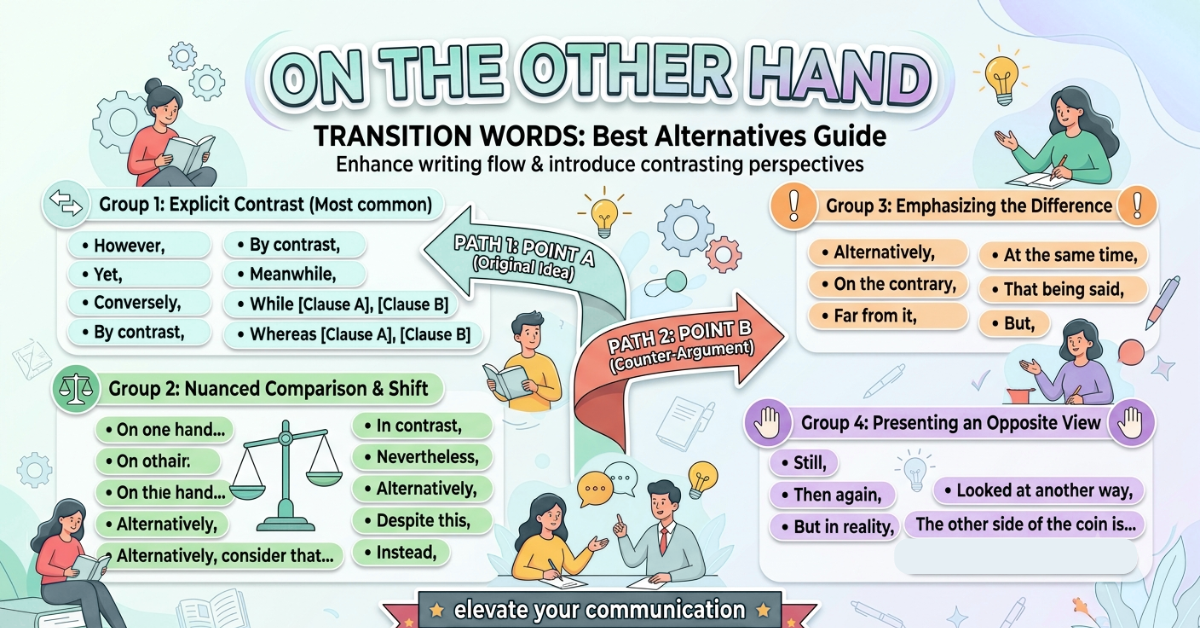
Repeating the same phrase throughout your writing can make it feel monotonous. These alternatives help vary your sentence structure while keeping your meaning clear.
Formal Alternatives
- Conversely
- In contrast
- By contrast
- Alternatively
- Nevertheless
- Nonetheless
- However
- Yet
- Whereas
- Even so
Example:
The proposal saves money. Conversely, it requires additional staff training.
Neutral Alternatives
- At the same time
- In comparison
- Then again
- That said
- Even though
- Still
- At the same time
- Despite this
- On the contrary (only when correcting a statement)
- By comparison
Example:
Online courses are convenient. That said, they require strong self-discipline.
Casual Alternatives
For blogs and conversational writing:
- But
- Still
- Then again
- At the same time
- Even so
- Although
- Yet
- Mind you
- Having said that
Example:
Traveling alone is exciting. Then again, it can sometimes feel lonely.
Difference Between Similar Transition Words
Many transition words appear similar but have slightly different meanings.
| Transition | Purpose | Example |
| On the other hand | Introduces contrast | The job pays well. On the other hand, it’s stressful. |
| However | General contrast | The plan worked. However, improvements are needed. |
| Conversely | Shows opposite relationship | Sales increased in Europe. Conversely, they declined in Asia. |
| Nevertheless | Indicates contrast despite previous point | It was raining. Nevertheless, they continued hiking. |
| In contrast | Direct comparison | Urban areas grew rapidly. In contrast, rural areas declined. |
| On the contrary | Corrects a false assumption | He isn’t lazy. On the contrary, he works extremely hard. |
Common Mistakes to Avoid
Using It Too Often
Repeating one transition throughout an article weakens readability.
Instead, alternate between different connectors.
Confusing It with “On the Contrary”
These phrases are not interchangeable.
Correct:
The hotel is affordable. On the other hand, it’s far from downtown.
Correct:
He isn’t inexperienced. On the contrary, he has twenty years of experience.
Adding Unnecessary Contrast
Only use contrast transitions when two ideas genuinely differ.
Incorrect:
I like coffee. On the other hand, I drink it every morning.
No contrast exists here.
Examples in Different Writing Styles
Academic Example
The experiment produced promising results. On the other hand, the sample size was relatively small.
Business Example
Expanding internationally could increase revenue. However, it also introduces regulatory challenges.
Blog Example
Meal prepping saves time during the week. Then again, it requires planning ahead.
Creative Writing Example
She wanted to leave immediately. Yet, something kept pulling her back.
How to Choose the Right Transition Word
Ask yourself these questions:
Are you showing complete opposition?
Choose:
- Conversely
- In contrast
- On the other hand
Are you acknowledging a limitation?
Choose:
- However
- Nevertheless
- Still
Are you offering another option?
Choose:
- Alternatively
- Instead
- Rather
Are you writing casually?
Choose:
- Then again
- But
- At the same time
More Than 50 Transition Words for Contrast
Strong Contrast
- However
- Nevertheless
- Nonetheless
- Conversely
- Yet
- Still
- Instead
- Rather
- Although
- Though
Comparison
- In comparison
- Likewise
- Similarly
- Equally
- By comparison
Alternative Ideas
- Alternatively
- Otherwise
- Instead
- Or
- Rather
Qualification
- Even so
- Despite this
- That said
- Having said that
- All the same
Practical Tips for Using Contrast Transition Words
- Choose transitions based on your audience.
- Avoid repeating the same phrase multiple times.
- Read your writing aloud to check whether the transition sounds natural.
- Match the transition to the level of formality.
- Keep sentences concise for better readability.
- Don’t force a contrast where none exists.
Real-World Applications
Understanding contrast transitions benefits many types of writing.
Students
- Essays
- Assignments
- Research papers
- Literature reviews
Professionals
- Reports
- Emails
- Business proposals
- Presentations
Content Creators
- Blog posts
- Website content
- Social media captions
- Newsletters
Copywriters
- Product comparisons
- Buying guides
- Landing pages
- Marketing campaigns
Strong transitions improve clarity, credibility, and reader engagement across all these formats.
Key Takeaways
- On the other hand introduces a contrasting idea.
- It helps connect opposing viewpoints smoothly.
- Avoid repeating the phrase throughout your writing.
- Choose alternatives that match your tone and purpose.
- Use transitions naturally rather than forcing them into every paragraph.
- Understanding subtle differences between similar transitions improves writing quality.
Frequently Asked Questions
What are the best on the other hand transition words?
Some of the best alternatives include however, conversely, in contrast, that said, nevertheless, still, and alternatively. The best choice depends on your writing style and the type of contrast you’re expressing.
Is “on the other hand” formal or informal?
It works well in both formal and informal writing. You’ll commonly find it in academic essays, business reports, articles, blogs, and everyday conversations.
Can I use “however” instead of “on the other hand”?
Often, yes. Both introduce contrasting ideas, but on the other hand usually presents another perspective, while however signals a broader contrast or exception.
What is the difference between “on the other hand” and “on the contrary”?
On the other hand introduces an alternative viewpoint or contrasting idea. On the contrary directly contradicts or corrects a previous statement, so the two expressions are not interchangeable.
How many transition words should I use in an article?
Use transition words where they improve flow and understanding. Prioritize natural readability over quantity, and vary your choices instead of repeating the same phrase.
Why are transition words important in academic writing?
Transition words help organize arguments, connect evidence, compare viewpoints, and guide readers through complex ideas. They make academic writing more coherent and easier to follow.
Conclusion
Mastering on the other hand transition words is one of the simplest ways to improve your writing. These transitions help readers understand contrasting ideas, strengthen logical flow, and make your content more engaging. By learning when to use them—and when to choose alternatives like however, conversely, or that said—you’ll create writing that feels polished, natural, and easier to read.
The next time you edit an essay, article, email, or report, review your transitions carefully. Small changes in word choice can make a significant difference in clarity, professionalism, and overall impact.