

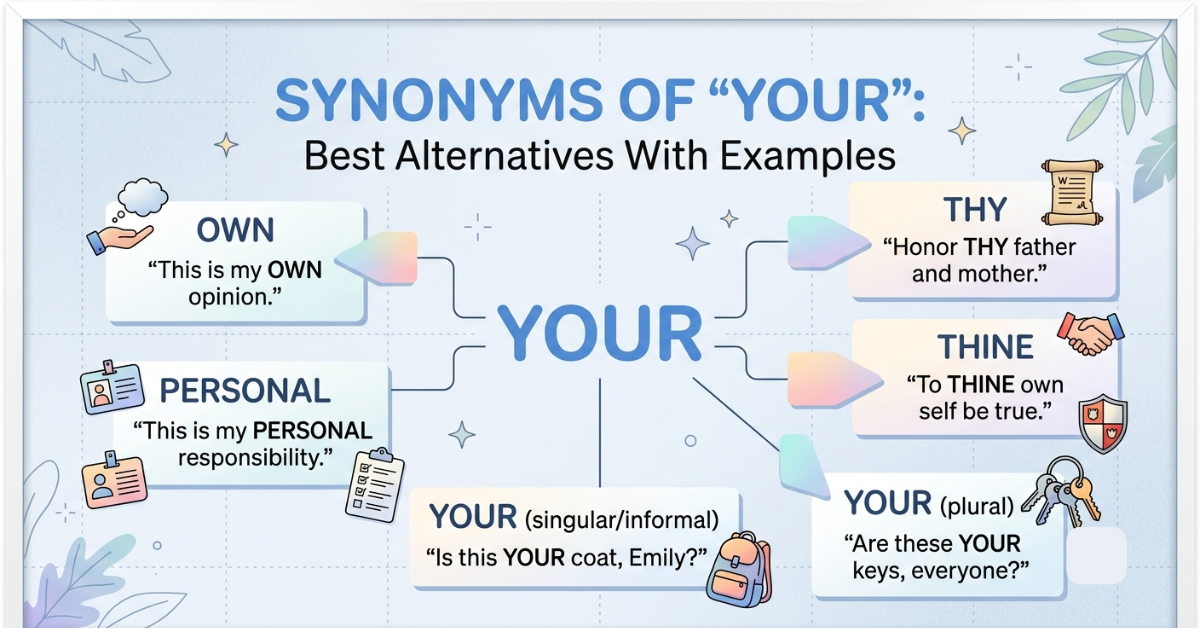
Have you ever found yourself repeating the word “your” over and over in your writing and wondered if there’s a better alternative? While your is one of the most common words in English, there are situations where using a different expression can make your writing sound smoother, more professional, or more engaging.
This guide explores the synonyms of your, explains when they work, when they don’t, and provides plenty of practical examples. You’ll also learn why your doesn’t always have a direct synonym and discover natural alternatives that fit different writing styles.
What Does “Your” Mean?
Before looking for alternatives, it’s important to understand what your actually is.
Your is a possessive determiner (also called a possessive adjective). It shows ownership or association with the person you’re speaking to.
Examples
- Your phone is ringing.
- I like your idea.
- Your presentation was excellent.
Unlike many nouns or adjectives, function words like your usually don’t have perfect one-word synonyms.
Are There True Synonyms of Your?
The short answer is not exactly.
Since your is a grammatical word rather than a descriptive word, English doesn’t offer many direct replacements. Instead, writers use alternative phrases depending on context.
Here are the closest alternatives.
| Alternative | Best Used When | Example |
| Yours | Replacing a noun | This book is yours. |
| Belonging to you | Formal writing | The documents belonging to you have arrived. |
| Owned by you | Legal or business writing | Assets owned by you must be declared. |
| Of yours | Informal conversation | A friend of yours called. |
| In your possession | Formal context | The item is currently in your possession. |
| Under your name | Official documents | The account is under your name. |
These aren’t perfect substitutes, but they communicate similar meanings.
Common Synonyms of Your by Context
1. Yours
Yours is probably the closest alternative.
The difference is that your comes before a noun, while yours replaces the noun entirely.
Example
Correct:
- Is this your jacket?
- Yes, it’s yours.
Incorrect:
- Yours jacket is blue.
2. Belonging to You
This phrase works well in formal writing.
Examples
- The package belonging to you has arrived.
- The files belonging to you were recovered.
3. Owned by You
Often used in business, finance, and legal writing.
Examples
- Property owned by you
- Vehicles owned by you
4. Of Yours
A natural phrase used in everyday English.
Examples
- That idea of yours is brilliant.
- A colleague of yours stopped by.
- This habit of yours makes me laugh.
5. In Your Possession
Useful in professional or legal contexts.
Examples
- Do you still have the documents in your possession?
- Any items in your possession should be returned.
Why “Your” Rarely Has a Direct Synonym
Unlike descriptive words such as:
- Happy
- Fast
- Beautiful
the word your performs a grammatical function. It tells readers who owns something rather than describing it.
That’s why dictionaries usually don’t list many direct synonyms.
Instead, English relies on:
- possessive pronouns
- possessive phrases
- ownership expressions
When Should You Replace “Your”?
Sometimes replacing your improves readability.
Consider changing it when:
- Writing formal reports
- Drafting legal documents
- Avoiding repetition
- Creating polished marketing content
- Writing academic papers
Example
Instead of:
Your account contains your information and your payment history.
You might write:
The account registered under your name contains your information and payment history.
When You Should Keep Using “Your”
In most situations, your is still the best choice.
Keep it when writing:
- Emails
- Blog posts
- Conversations
- Instructions
- Social media captions
- Educational content
Replacing it unnecessarily can make writing sound awkward.
Natural:
Check your email.
Less natural:
Check the email belonging to you.
Synonyms of Your in Different Writing Styles
Formal Writing
Better alternatives include:
- belonging to you
- owned by you
- under your name
- in your possession
Example:
Documents belonging to you require verification.
Casual Conversation
Natural alternatives include:
- yours
- of yours
Examples:
- That’s yours.
- A friend of yours called.
Business Communication
Professional alternatives include:
- registered under your name
- owned by you
- assigned to you
Example:
The account assigned to you has been activated.
Academic Writing
Academic writing often uses:
- the student’s
- the participant’s
- belonging to the individual
instead of repeatedly saying your.
Examples of “Your” and Its Alternatives
| Original Sentence | Alternative |
| Your car is outside. | The car belonging to you is outside. |
| Your opinion matters. | The opinion you hold matters. |
| Your account has been updated. | The account under your name has been updated. |
| This is your seat. | This seat is yours. |
| Your package has arrived. | The package belonging to you has arrived. |
Common Mistakes People Make
Confusing “Your” and “You’re”
Wrong:
You’re book is here.
Correct:
Your book is here.
Remember:
- Your = possession
- You’re = you are
Using “Yours” Before a Noun
Wrong:
Yours house is beautiful.
Correct:
Your house is beautiful.
Replacing “Your” Too Often
Some writers try to avoid repetition by replacing your everywhere.
This often sounds unnatural.
Instead of:
The bag belonging to you is beside the vehicle belonging to you.
Simply write:
Your bag is beside your car.
Practical Tips for Better Writing
If you want your writing to sound more natural:
- Use your in everyday communication.
- Replace it only when repetition becomes distracting.
- Choose alternatives based on context.
- Read your sentence aloud to check whether it sounds natural.
- Avoid overly formal substitutions unless the situation requires them.
Related Words Often Confused with “Your”
Although they aren’t synonyms, these words are closely related.
| Word | Meaning |
| Your | Shows possession before a noun |
| Yours | Possessive pronoun replacing the noun |
| You’re | Contraction of “you are” |
| Yourself | Reflexive pronoun |
| Yourselves | Reflexive pronoun for multiple people |
Understanding these differences helps improve grammar and writing accuracy.
Key Takeaways
- Your is a possessive determiner used to show ownership.
- There are very few true one-word synonyms.
- Yours is the closest grammatical alternative.
- Phrases like belonging to you, owned by you, and of yours work in specific contexts.
- Choosing the right alternative depends on your audience and writing style.
- In most everyday situations, your remains the clearest and most natural option.
Frequently Asked Questions
What are the best synonyms of your?
The closest alternatives include yours, belonging to you, owned by you, of yours, and under your name. The best choice depends on whether you’re writing formally or casually.
Is “yours” the same as “your”?
No. Your comes before a noun (“your phone”), while yours replaces the noun (“The phone is yours”).
Can I replace “your” in every sentence?
No. In most cases, your is already the most natural choice. Replacing it too often can make your writing sound stiff or unnatural.
Why doesn’t “your” have many synonyms?
Because your is a grammatical word that indicates possession rather than describing something. English typically replaces it with possessive phrases instead of direct synonyms.
What’s the difference between “your” and “you’re”?
Your shows ownership, while you’re is short for you are. Mixing them up is one of the most common grammar mistakes in English.
Is “belonging to you” a good replacement for “your”?
Yes, but mainly in formal or legal writing. For everyday conversations, using your is usually simpler and more natural.
Conclusion
Understanding the synonyms of your is less about memorizing replacements and more about knowing how English expresses possession in different situations. While your doesn’t have many direct one-word substitutes, phrases like yours, belonging to you, owned by you, and of yours can add variety when used appropriately.
The key is to prioritize clarity over variety. In most everyday writing, your remains the strongest and most natural option. When you need a more formal tone or want to avoid repetition, choose an alternative that fits the context rather than forcing a replacement. Mastering these subtle differences will make your writing more polished, professional, and enjoyable to read.