

Have you ever paused while writing an invitation, social media post, or wedding announcement because you weren’t sure whether to write fiance or fiancee? You’re not alone. These two words look almost identical, yet they have one important difference that often confuses English learners and native speakers alike.
In this guide, we’ll break down fiance vs fiancee in the simplest way possible. You’ll learn their meanings, pronunciation, spelling differences, grammar rules, real-life examples, and common mistakes so you can use each word with confidence.
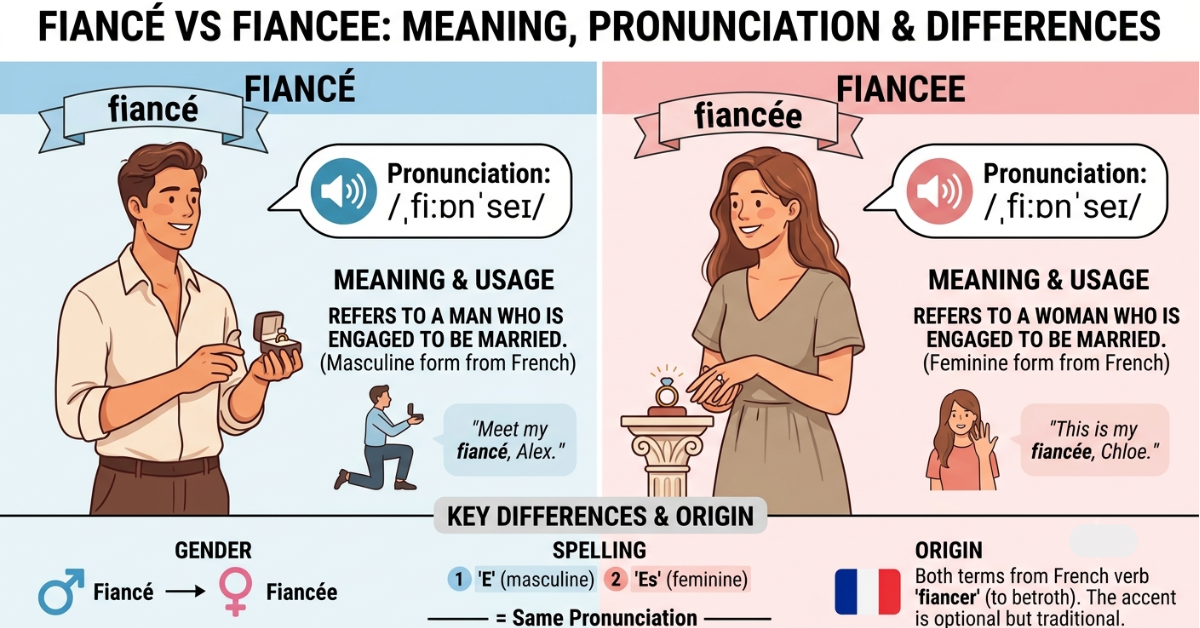
What Is the Difference Between Fiance and Fiancee?
The difference between these words comes down to gender.
| Word | Meaning | Refers To |
| Fiance | A person engaged to be married | A man |
| Fiancee | A person engaged to be married | A woman |
Both words originated from French, where masculine and feminine nouns have different spellings.
In modern English, you’ll still see both forms used, especially in formal writing, wedding announcements, and invitations.
Quick memory trick:
- Fiance → Male (one “e”)
- Fiancee → Female (two “e”s)
Fiance vs Fiancee Meaning
Understanding the meaning is straightforward.
A fiance is the man someone plans to marry.
Example:
- Sarah introduced her fiance to her family.
A fiancee is the woman someone plans to marry.
Example:
- Michael surprised his fiancee with a weekend getaway.
Both people are engaged. The only difference is whether you’re referring to a man or a woman.
Why Do These Words Have Different Spellings?
English borrowed both words from French.
In French:
- Fiancé (masculine)
- Fiancée (feminine)
The extra “e” signals the feminine form.
English has preserved this distinction even though most English nouns don’t change based on gender.
Fiancé vs Fiancée: Should You Use Accent Marks?
Technically, the correct French spellings include accent marks:
- Fiancé
- Fiancée
However, English publications often omit the accents because many keyboards don’t make them easy to type.
You’ll commonly see:
- fiance
- fiancee
Both versions are generally accepted in English writing, although formal publications may prefer the accented spellings.
Fiancé vs Fiancée Pronunciation
Many people assume these words sound different because they’re spelled differently. Surprisingly, they don’t.
How to pronounce fiancé
Pronunciation:
fee-ahn-SAY
IPA: /fiˈɑːnseɪ/
How to pronounce fiancée
Pronunciation:
fee-ahn-SAY
IPA: /fiˈɑːnseɪ/
The pronunciation is identical.
The only clue is the spelling, not the sound.
Fiance vs Fiancee Pronunciation: Is There Any Difference?
No.
One of the biggest misconceptions is that fiancee has a different pronunciation.
Both words are pronounced exactly the same:
fee-ahn-SAY
That’s why context is important when speaking. Listeners understand whether you’re referring to a man or woman based on the sentence rather than pronunciation.
When Should You Use Fiance?
Use fiance whenever you’re talking about a man who is engaged.
Examples
- My fiance proposed during our vacation.
- Her fiance loves cooking.
- Emily and her fiance are planning a beach wedding.
- My sister introduced her fiance at dinner.
When Should You Use Fiancee?
Use fiancee whenever you’re referring to a woman who is engaged.
Examples
- His fiancee designed their wedding invitations.
- Jake surprised his fiancee with flowers.
- Everyone welcomed the fiancee warmly.
- My cousin and his fiancee just bought their first house.
Side-by-Side Comparison
| Feature | Fiance | Fiancee |
| Gender | Male | Female |
| Number of “e”s | One | Two |
| Pronunciation | fee-ahn-SAY | fee-ahn-SAY |
| Meaning | Engaged man | Engaged woman |
| Origin | French | French |
Common Mistakes People Make
Using fiancee for a man
Incorrect: My fiancee is excited for the bachelor party.
Correct: My fiance is excited for the bachelor party.
Using fiance for a woman
Incorrect: His fiance chose the wedding dress.
Correct: His fiancee chose the wedding dress.
Thinking pronunciation changes
Many people expect the extra “e” to change the pronunciation.
It doesn’t.
Both words sound exactly alike.
Forgetting the accent marks
While fiancé and fiancée are technically the original spellings, omitting the accents is acceptable in most English writing.
Is It Okay to Use “Fiancé” for Any Gender?
Language continues to evolve.
Some modern writers use fiancé as a gender-neutral term, especially in casual communication. Others stick with the traditional distinction between fiancé and fiancée.
If you’re writing professionally, academically, or formally, it’s usually best to follow the traditional usage:
- Fiancé = man
- Fiancée = woman
Examples in Everyday Conversations
Correct
“My fiance and I are getting married next spring.”
“My fiancee loves outdoor weddings.”
“They announced their engagement last week.”
“My fiance proposed during our trip to Italy.”
“His fiancee is a graphic designer.”
Related Words You’ll Often See
These words are commonly associated with engaged couples:
- Engagement
- Proposal
- Wedding
- Bride
- Groom
- Marriage
- Spouse
- Husband
- Wife
- Bridal shower
- Bachelor party
- Bachelorette party
- Wedding vows
Knowing these related terms helps you understand wedding-related conversations more naturally.
Easy Memory Tricks
If you often mix them up, try these simple tricks.
Trick 1
Fiance = One “e” = Male
Trick 2
Fiancee = Two “e”s = Female
Think of the extra “e” as representing the feminine ending borrowed from French.
Trick 3
Remember this phrase:
Extra E = Engaged Woman
Which Spelling Is More Common?
Usage depends on the publication and writing style.
Generally:
- News organizations often use the accented forms.
- Casual writing frequently drops the accents.
- Wedding websites may use either version.
- Dictionaries recognize both accented and unaccented spellings.
The important thing is consistency throughout your writing.
Key Takeaways
- Fiance refers to an engaged man.
- Fiancee refers to an engaged woman.
- Both words come from French.
- They are pronounced exactly the same.
- Accent marks are optional in most English writing.
- The spelling—not the pronunciation—shows the gender.
Frequently Asked Questions
Is fiance male or female?
A fiance is traditionally a man who is engaged to be married. For a woman, the correct term is fiancee.
What is the difference between fiancé vs fiancée?
The only difference is gender. Fiancé refers to a man, while fiancée refers to a woman. Both mean someone who is engaged.
How do you pronounce fiancé and fiancée?
Both are pronounced fee-ahn-SAY. The pronunciation is identical despite the spelling difference.
Can I write fiance without the accent?
Yes. In English, writing fiance or fiancee without the accent marks is widely accepted, especially in informal writing.
Why does fiancée have an extra “e”?
The additional “e” comes from French grammar, where feminine nouns often end with an extra letter to distinguish them from masculine forms.
Is it wrong to use fiancé for everyone?
Some people use fiancé as a gender-neutral term in casual contexts. However, traditional English grammar distinguishes between fiancé (male) and fiancée (female), especially in formal writing.
Conclusion
The difference between fiance vs fiancee is much simpler than it first appears. Both words describe someone who is engaged to be married, but fiance refers to a man, while fiancee refers to a woman. Although they share the same pronunciation, their spellings preserve a traditional French distinction that remains common in English today.
Once you remember that the extra “e” belongs to the feminine form, choosing the correct word becomes easy. Whether you’re writing a wedding invitation, announcing an engagement, or simply improving your English, understanding this small spelling difference helps you communicate more accurately and confidently.