

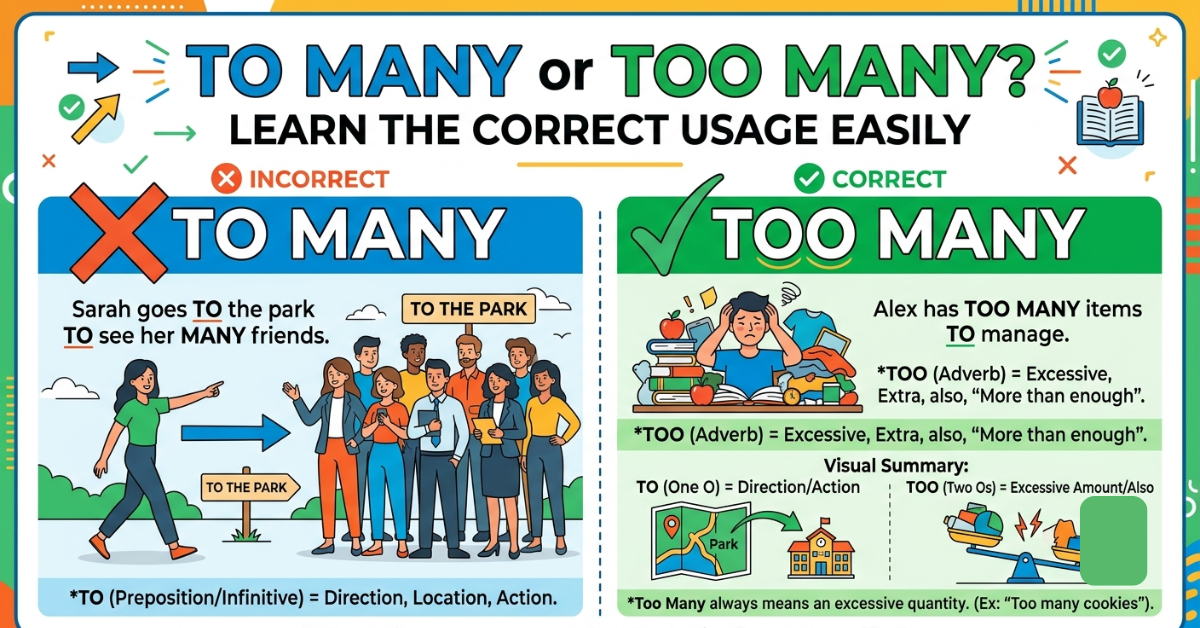
Have you ever typed a sentence and paused to wonder, “Is it to many or too many?” This grammar confusion is surprisingly common because both phrases sound almost identical when spoken. However, their meanings are completely different, and choosing the wrong one can change the message of your sentence.
The correct choice depends on what you want to express. In most cases, people search for is it to many or too many because they want to describe an excessive amount of something. Throughout this guide, you will learn how these phrases differ, why people confuse them, and how to use them correctly in everyday writing.
To Many or Too Many: The Basic Difference
To understand the difference clearly, it helps to look at the role each word plays in a sentence.
Too many means an excessive number of something — more than needed, expected, or manageable. To many, on the other hand, is not a common phrase by itself and is usually used when “to” connects an idea with a group of people or things.
In everyday English, too many is the phrase you will use far more often because it describes an amount that goes beyond what is considered acceptable.
What Does “Too Many” Mean?
The phrase too many is used when something exists in a quantity that feels excessive or unnecessary. In other words, it describes more than what is wanted, required, or comfortable.
For instance:
- There are too many people in this room.
- I made too many mistakes in my assignment.
- She spends too many hours on her phone.
- We received too many messages today.
In these examples, the amount is higher than expected. As a result, the situation becomes difficult, inconvenient, or overwhelming.
What Does “To Many” Mean?
Unlike too many, the phrase to many does not describe an excessive amount. Instead, “to” works as a preposition that shows a connection, direction, or relationship.
For example:
- This message is important to many students.
- The new policy matters to many employees.
- The event was meaningful to many families.
Here, “to” simply connects an idea with a group of people. Therefore, it does not suggest that something is excessive.
Is It To Many or Too Many?
When you want to describe an excessive number, too many is almost always the correct option.
A simple way to check is to ask yourself:
Does the sentence mean “more than necessary”?
If the answer is yes, use too many.
For example:
There are too many cars on the road.
(The number of cars is higher than the road can comfortably handle.)
There are to many cars on the road.
Similarly:
She bought too many clothes.
(She purchased more clothes than she actually needed.)
She bought to many clothes.
To Many or Too Many Times: Which One Is Correct?
When discussing repeated actions, too many times is the correct phrase. It means something has happened more often than expected or necessary.
Examples:
- I have watched that movie too many times.
- He has called me too many times today.
- You have made the same mistake too many times.
In this situation, “too many” modifies the number of times an action occurs.
Common Mistake: Using “To Many Times”
Many people confuse to and too because they have the same pronunciation. However, their meanings and grammatical functions are different.
Incorrect:
- I have told you this to many times.
Correct:
- I have told you this too many times.
The corrected sentence shows that the action has been repeated excessively.
Why Do People Confuse To and Too?
The main reason behind this mistake is that English contains many homophones. These are words that sound the same but have different meanings and spellings.
Common examples include:
- Their / There / They’re
- Your / You’re
- Two / To / Too
Although to and too sound identical, their uses are completely different. Therefore, understanding the meaning behind the sentence is more important than relying only on pronunciation.
Easy Ways to Remember the Difference
1. Remember That “Too” Means Extra
A useful trick is to remember that too has an extra “o.” This extra letter can remind you that it means “extra” or “more than needed.”
Example:
- Too many cookies = extra cookies.
2. Think About Direction or Connection
Meanwhile, to is usually connected with movement, direction, or relationships.
Examples:
- I went to school.
- This gift belongs to my friend.
- This information is useful to many people.
Common Examples of Too Many in Daily Life
The phrase too many appears frequently in conversations, professional writing, and online communication.
In Personal Conversations
People often use it when describing situations that feel overwhelming:
- There are too many things to do today.
- I have too many responsibilities.
- She asks too many questions.
In Professional Communication
In workplaces, the phrase can describe problems related to workload or efficiency:
- Too many meetings can reduce productivity.
- The report contains too many unnecessary details.
- Too many changes can delay the project.
In Social Media and Texting
Similarly, people use “too many” casually online:
- Too many notifications today!
- I have spent too many hours scrolling.
- Too many options make choosing difficult.
Additional Transition Words You Can Add Throughout the Article:
Replace repeated sentence patterns with:
- However → for contrast
- For example → before examples
- In addition → when adding information
- Similarly → when comparing ideas
- Therefore → when showing a result
- Meanwhile → when shifting topics
- As a result → when explaining consequences
- Although → when showing exceptions
- On the other hand → when comparing differences