

Have you ever written a sentence and stopped because two words looked almost identical but had completely different meanings? English is full of these confusing word pairs, and vicious vs viscous is one of the most common examples.
Although these words differ by only one letter, they describe completely different ideas. Vicious relates to violence, cruelty, or harmful behavior, while viscous describes the thickness or resistance of a liquid. Understanding this difference can help you avoid embarrassing grammar mistakes and improve your writing accuracy.
In this guide, you will learn the meanings, pronunciation, examples, common mistakes, and simple tricks to remember when to use each word.
What Is the Difference Between Vicious and Viscous?
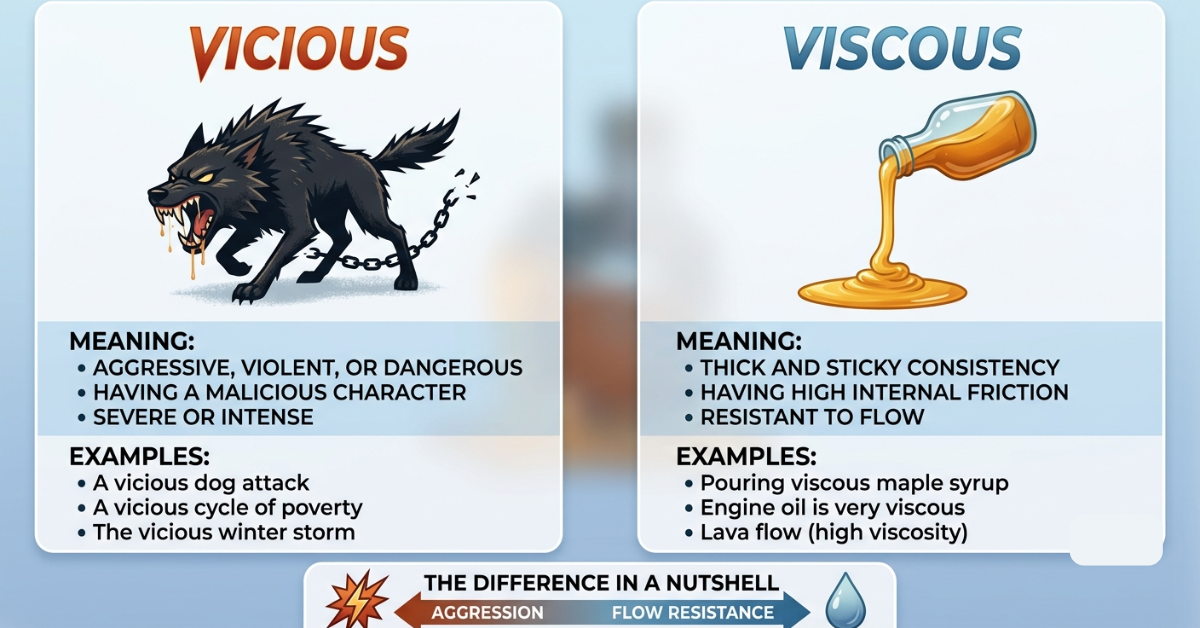
The main difference between vicious and viscous is their meaning and usage.
- Vicious is an adjective used to describe something cruel, aggressive, violent, or dangerous.
- Viscous is an adjective used to describe a liquid that is thick, sticky, or slow-moving.
The two words sound similar, but they belong to completely different areas. One describes behavior or actions, while the other describes the physical properties of materials.
Quick Comparison: Vicious vs Viscous
| Word | Meaning | Used For | Example |
| Vicious | Cruel, violent, or harmful | People, animals, actions, arguments | The dog became vicious when threatened. |
| Viscous | Thick and resistant to flow | Liquids and substances | Honey is a viscous liquid. |
What Does Vicious Mean?
Vicious describes something that shows extreme aggression, cruelty, or a desire to cause harm. It is often used when talking about dangerous behavior, attacks, criticism, or conflicts.
The word comes from the Latin word vitiosus, meaning “faulty” or “corrupt.”
Common Uses of Vicious
You can use vicious to describe:
- A violent animal
- A cruel person
- A harmful action
- A severe attack
- A harsh argument or criticism
Examples of Vicious in Sentences
- The two competitors had a vicious argument during the debate.
- The wild animal became vicious when it felt threatened.
- Online discussions can sometimes turn into vicious attacks.
- The criminal was known for his vicious behavior.
In these examples, the word suggests something harmful, aggressive, or unpleasant.
What Does Viscous Mean?
Viscous refers to the thickness of a liquid and its resistance to flowing easily. A viscous substance moves slowly because of its internal friction.
In science, viscosity is the measurement of how easily a fluid flows.
Examples of Viscous Substances
Many everyday materials are viscous, including:
- Honey
- Syrup
- Motor oil
- Molasses
- Shampoo
- Paint
For example, honey flows much more slowly than water because it has higher viscosity.
Examples of Viscous in Sentences
- The scientist studied the movement of a viscous liquid.
- Motor oil becomes more viscous in colder temperatures.
- The sauce was too viscous to pour easily.
- Honey has a higher viscosity than water.
Unlike vicious, this word has nothing to do with violence or bad behavior. It is purely about physical texture and movement.
Vicious vs Viscous Pronunciation Difference
One reason people confuse these words is because they sound almost identical.
Vicious Pronunciation
Vicious is pronounced:
VISH-us
/ˈvɪʃ.əs/
The second syllable sounds like “shus.”
Viscous Pronunciation
Viscous is pronounced:
VIS-kus
/ˈvɪs.kəs/
The second syllable sounds like “kus.”
A small sound difference can completely change the meaning of the word.
Easy Ways to Remember Vicious vs Viscous
Remembering the meaning becomes easier when you connect each word with a familiar idea.
Trick 1: Associate Vicious With Violence
Both words begin with “vic,” but:
Vicious = Violence
Think of a vicious attack, vicious animal, or vicious argument.
Trick 2: Associate Viscous With Viscosity
Viscous = Viscosity
If you see the word “viscous,” think about liquids like honey, oil, or syrup.
Trick 3: Ask What You Are Describing
Ask yourself:
- Is it a person, animal, action, or behavior? → Use vicious
- Is it a liquid or substance that flows slowly? → Use viscous
Common Mistakes When Using Vicious and Viscous
Many writers accidentally replace one word with the other because of their similar spelling.
Mistake 1: Using Vicious for Liquids
Incorrect:
- The honey is very vicious.
Correct:
- The honey is very viscous.
Honey is thick and slow-moving, not cruel or aggressive.
Mistake 2: Using Viscous for Behavior
Incorrect:
- He gave a viscous response during the argument.
Correct:
- He gave a vicious response during the argument.
A response can be cruel or harsh, but it cannot have physical thickness.
Mistake 3: Confusing Viscosity With Personality
Viscosity only applies to materials. It does not describe emotions, attitudes, or actions.
For example:
- High viscosity oil
- Viscous personality
Real-World Examples of Vicious and Viscous
Understanding these words through real situations makes the difference clearer.
Examples of Vicious Behavior
In everyday life, you might hear:
- “The debate became vicious.”
- “The athlete faced vicious criticism.”
- “The animal showed vicious behavior.”
These examples involve aggression or harm.
Examples of Viscous Materials
In science, cooking, and engineering, you might hear:
- “The experiment tested viscous fluids.”
- “The chef prepared a thick, viscous sauce.”
- “Engineers analyzed the viscosity of the fuel.”
These examples describe how substances move.
Why Do People Confuse These Words?
The confusion happens because English contains many similar-looking words with unrelated meanings. These are called homophones or near-homophones, depending on pronunciation.
Words like:
- Affect vs effect
- Compliment vs complement
- Stationary vs stationery
- Vicious vs viscous
require attention because spelling alone does not reveal meaning.
Learning these distinctions improves vocabulary, writing quality, and communication skills.
Key Takeaways: Vicious vs Viscous
- Vicious means cruel, violent, aggressive, or harmful.
- Viscous means thick, sticky, and resistant to flowing.
- Vicious describes behavior, actions, or situations.
- Viscous describes liquids and physical substances.
- Remember “vicious = violence” and “viscous = viscosity” to avoid confusion.
Frequently Asked Questions (FAQs)
Is vicious the same as viscous?
No, vicious and viscous have completely different meanings. Vicious describes cruelty or aggression, while viscous describes the thickness and flow of liquids.
Is honey vicious or viscous?
Honey is viscous because it is thick and flows slowly. It does not have any connection to violence or harmful behavior.
What is an example of a vicious person?
A person who intentionally harms others or behaves in a cruel and aggressive way may be described as vicious.
What does viscous mean in science?
In science, viscous refers to a fluid’s resistance to flow. A highly viscous liquid moves slowly because it has greater internal friction.
How can I remember the difference between vicious and viscous?
Remember that vicious starts with “violence” and viscous connects with “viscosity.” This simple association helps separate their meanings.
Can an argument be vicious?
Yes. An argument can be described as vicious when it becomes extremely harsh, cruel, or aggressive.
Conclusion
Although vicious vs viscous looks like a small spelling difference, the meanings are worlds apart. Vicious describes harmful behavior, aggression, or cruelty, while viscous explains how thick and slow-moving a liquid is.
By connecting vicious with violence and viscous with viscosity, you can easily remember the difference and use both words correctly. Improving your understanding of commonly confused words will make your writing clearer, more professional, and more accurate.