

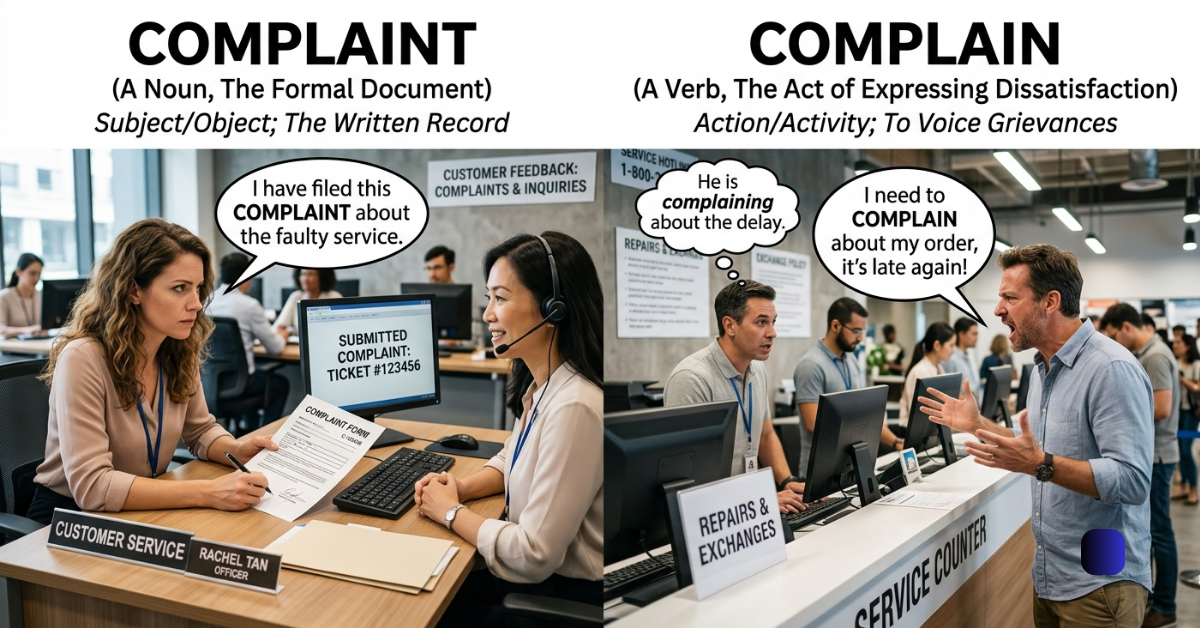
Have you ever written, “I want to complaint about my order” and wondered if it sounded right? You’re not alone. These two words are among the most commonly confused terms in English because they look similar and share the same root. However, they play very different roles in a sentence.
Understanding complaint vs complain is essential for writing professional emails, speaking confidently, and avoiding common grammar mistakes. In this guide, you’ll learn the meaning of each word, when to use it, practical examples, memory tricks, and the most common errors people make.
What Is the Difference Between Complaint and Complain?
The simplest way to understand these words is by identifying their part of speech.
| Word | Part of Speech | Meaning | Example |
| Complaint | Noun | A statement expressing dissatisfaction | The customer filed a complaint. |
| Complain | Verb | To express dissatisfaction | The customer decided to complain. |
Think of it this way:
- Complain = the action.
- Complaint = the result or the thing being expressed.
This is the biggest difference people need to remember.
What Does “Complaint” Mean?
A complaint is a noun. It refers to an expression of dissatisfaction about a product, service, person, or situation.
It names the problem rather than describing the action.
Examples of Complaint
- The manager received a complaint from a customer.
- Please submit your complaint in writing.
- We investigated every complaint carefully.
- Her complaint was resolved within two days.
- The company has a formal complaint procedure.
In each sentence, complaint is a thing that exists. Someone can receive it, file it, or investigate it.
What Does “Complain” Mean?
Complain is a verb.
It means to express dissatisfaction or annoyance about something.
Examples of Complain
- Customers often complain about delayed deliveries.
- I don’t usually complain, but the service was disappointing.
- She decided to complain to customer support.
- Why are you always complaining about the weather?
- He complained that the room was too noisy.
Notice that complain describes an action someone performs.
Complaint vs Complain: Side-by-Side Comparison
| Feature | Complaint | Complain |
| Part of speech | Noun | Verb |
| Function | Names the issue | Describes the action |
| Question answered | What? | What happened? |
| Example | I submitted a complaint. | I want to complain. |
How to Remember the Difference
Here’s an easy memory trick.
Complaint = Thing
If you can place “a” or “the” before the word, it’s probably complaint.
Examples:
- a complaint
- the complaint
- your complaint
Complain = Action
If someone is doing something, use complain.
Examples:
- complain loudly
- complain politely
- complain about the issue
A simple formula:
Complain → Action
Complaint → Object
Common Sentence Patterns
Understanding sentence patterns makes choosing the correct word much easier.
Use “Complaint”
- file a complaint
- make a complaint
- submit a complaint
- receive a complaint
- investigate a complaint
- formal complaint
- customer complaint
Examples:
- She filed a complaint with the airline.
- We received several customer complaints.
Use “Complain”
- complain about
- complain to
- complain that
Examples:
- They complained about the food.
- She complained to the manager.
- He complained that the internet was slow.
Common Mistakes People Make
Many English learners mix these words because they look nearly identical.
Incorrect:
I want to complaint about my order.
Correct:
I want to complain about my order.
Incorrect:
She made a complain.
Correct:
She made a complaint.
Incorrect:
Please complaint to customer service.
Correct:
Please complain to customer service.
Incorrect:
The company received several complains.
Correct:
The company received several complaints.
Complaint vs Complain in Professional Writing
Knowing which word to use is especially important in business communication.
Customer Service
Correct:
- I would like to file a complaint regarding my recent purchase.
- I wish to complain about the damaged product.
Workplace
Correct:
- The employee submitted a formal complaint.
- Several workers complained about unsafe conditions.
Academic Writing
Correct:
- Researchers analyzed consumer complaints.
- Participants complained about technical issues during testing.
Everyday Examples
Here are common situations where these words appear.
Restaurant
Customer:
“I’d like to complain about my meal.”
Manager:
“Please fill out this complaint form.”
Hotel
Guest:
“I want to complain because the room wasn’t clean.”
Receptionist:
“We’re sorry. We’ll record your complaint immediately.”
Online Shopping
Customer:
“I need to complain about the late delivery.”
Support Agent:
“Your complaint has been registered.”
Formal vs Informal Usage
Both words work in formal and casual English, but they often appear differently.
Formal
- submit a complaint
- official complaint
- written complaint
Example:
“The customer submitted a formal complaint.”
Informal
- complain about homework
- complain about traffic
- complain about the weather
Example:
“My friends always complain about Mondays.”
Synonyms
Knowing related words helps improve vocabulary.
Complaint Synonyms
- grievance
- objection
- protest
- criticism
- report
- allegation
- concern
Complain Synonyms
- protest
- object
- criticize
- grumble
- moan
- whine
- express dissatisfaction
Remember that each synonym has slightly different shades of meaning depending on context.
Grammar Tips for Using Complaint and Complain Correctly
Follow these simple rules.
Use “Complaint” After Articles
Correct:
- a complaint
- the complaint
- this complaint
Use “Complain” After Subjects
Correct:
- I complain
- We complain
- They complain
Watch for Prepositions
The verb usually pairs with:
- complain about
- complain to
- complain of
- complain that
Examples:
- She complained about the delay.
- He complained to customer service.
- The patient complained of headaches.
Why People Confuse Complaint and Complain
Several reasons make these words easy to mix up.
- They share the same root word.
- Their spelling differs by only a few letters.
- Many languages don’t distinguish between noun and verb forms in the same way.
- Auto-correct doesn’t always catch the mistake.
Fortunately, remembering that one is an action and the other is a thing solves most confusion.
Real-Life Practice
Choose the correct word.
1.
I want to ______ about the broken laptop.
complain
2.
The company received your ______ yesterday.
complaint
3.
Several passengers decided to ______.
complain
4.
Please submit your ______ online.
complaint
Key Takeaways
- Complaint is a noun.
- Complain is a verb.
- You make, file, or receive a complaint.
- You complain about something.
- Business writing commonly uses both words correctly.
- Remember: Action = complain. Thing = complaint.
Frequently Asked Questions
Is complaint a noun or a verb?
Complaint is always a noun. It refers to an expression of dissatisfaction rather than the act of expressing it.
Is complain a verb?
Yes. Complain is a verb that means to express dissatisfaction about a person, product, service, or situation.
What is the easiest way to remember complaint vs complain?
Think of complain as the action and complaint as the result. You complain first, and your complaint is what you make.
Can I say “make a complain”?
No. The correct phrase is make a complaint. The word complain cannot be used as a noun.
Which is correct: “I want to complaint” or “I want to complain”?
The correct sentence is “I want to complain.” After “want to,” English requires a verb, not a noun.
What is a customer complaint?
A customer complaint is a formal or informal statement expressing dissatisfaction with a company’s product, service, or experience. Businesses use customer complaints to improve quality and customer satisfaction.
Conclusion
Although complaint and complain look almost identical, their roles in English are completely different. Complaint is a noun that refers to the issue itself, while complain is the verb that describes expressing dissatisfaction.
By remembering this simple distinction and practicing the examples in this guide, you’ll avoid one of the most common English grammar mistakes. Whether you’re writing emails, speaking at work, or communicating in everyday situations, using these words correctly will make your English sound more natural, confident, and professional. Keep practicing, and you’ll quickly master this frequently confused word pair.