

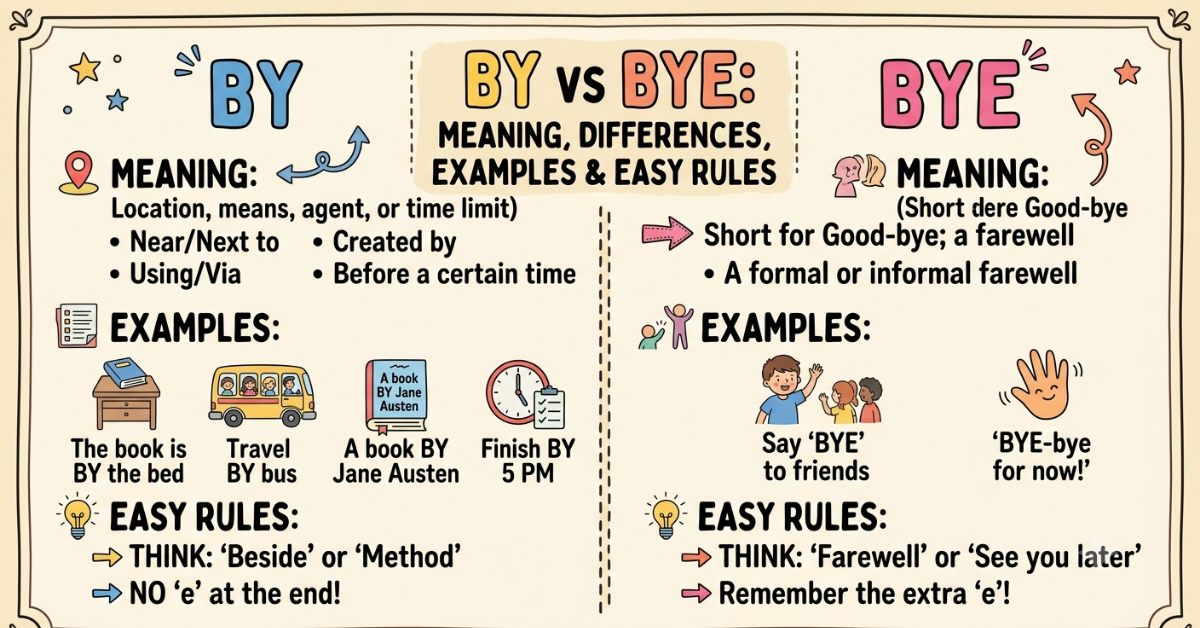
Have you ever typed “See you by!” instead of “See you bye!” or wondered whether by and bye mean the same thing? You’re not alone. These two words sound identical, making them easy to mix up, especially in texting, emails, and everyday writing.
Understanding by vs bye is essential because although they share the same pronunciation, they have completely different meanings and grammatical roles. In this guide, you’ll learn what each word means, when to use it, common mistakes to avoid, memory tricks, and plenty of real-life examples to help you remember the difference with confidence.
What Is the Difference Between By and Bye?
The biggest difference is simple:
- By is usually a preposition or adverb that indicates location, method, time, or the person responsible for something.
- Bye is an interjection or shortened form of goodbye, used when leaving or ending a conversation.
Although they sound exactly the same (they’re homophones), they serve entirely different purposes.
| Word | Part of Speech | Meaning | Example |
| By | Preposition, Adverb | Near, through, before, according to, created by | The book was written by Sarah. |
| Bye | Interjection | A farewell or goodbye | Bye! See you tomorrow. |
Understanding “By”
What Does “By” Mean?
The word by is one of the most frequently used words in English. It has several meanings depending on the sentence.
It can indicate:
- Who performed an action
- How something happens
- A location
- A deadline
- A measurement
- Passing near something
Examples
- The painting was created by Leonardo.
- Please finish your homework by Friday.
- She walked by the river.
- Travel by train is usually comfortable.
- Stand by me.
Notice how none of these examples involve saying goodbye.
Common Uses of “By”
1. Showing the Person Who Did Something
When using the passive voice, by tells us who performed the action.
Examples:
- The cake was baked by my grandmother.
- The movie was directed by Christopher Nolan.
2. Indicating Time
By often means “before” or “no later than.”
Examples:
- Submit the report by Monday.
- I’ll be home by 7 p.m.
3. Showing Method or Means
Examples:
- We traveled by bus.
- She paid by credit card.
- He contacted me by email.
4. Indicating Location
Examples:
- Sit by the window.
- There’s a coffee shop by the station.
5. Expressing Measurement
Examples:
- The room measures 12 feet by 15 feet.
- Increase production by 10%.
Understanding “Bye”
What Does “Bye” Mean?
Bye is simply a casual way of saying goodbye.
People use it when:
- Ending conversations
- Leaving a place
- Finishing a phone call
- Ending emails or text messages informally
Examples:
- Bye!
- Bye for now.
- Bye everyone!
- Okay, bye.
- Bye, see you later.
Unlike by, bye almost always relates to leaving or ending communication.
Different Ways “Bye” Is Used
Casual Farewell
- Bye!
- Bye, Mom!
- Bye everyone!
Friendly Goodbye
- Bye for now.
- Bye, take care.
- Bye! Have a great weekend.
In Text Messages
People often write:
- Byee
- Byeee
- Bye!!
- Okay bye
These are simply more expressive versions of bye.
By vs Bye: Side-by-Side Comparison
| Feature | By | Bye |
| Meaning | Near, through, before, according to | Goodbye |
| Part of Speech | Preposition, Adverb | Interjection |
| Used For | Time, place, method, agent | Farewell |
| Formal Writing | Yes | Mostly informal |
| Sounds Like | Bye | By |
By vs Bye in Sentences
Here are examples showing how different they are.
Using “By”
- The package arrived by courier.
- Finish your assignment by tomorrow.
- She lives by the beach.
- The novel was written by an award-winning author.
- We traveled by plane.
Using “Bye”
- Bye! I’ll call you later.
- She smiled and said, “Bye!”
- Bye everyone, have fun!
- Time to go—bye!
- Bye, see you next week.
Common Mistakes People Make
Because these words sound identical, they’re often confused in writing.
Incorrect
See you by tomorrow!
Correct
See you tomorrow. Bye!
Incorrect
Bye bus.
Correct
By bus.
Incorrect
Written bye Shakespeare.
Correct
Written by Shakespeare.
Incorrect
Walk bye the river.
Correct
Walk by the river.
Easy Memory Trick
One of the easiest ways to remember the difference is this:
Remember “Bye” = Goodbye
The word bye is actually part of the word goodbye.
If you’re ending a conversation, choose bye.
Remember “By” = Beside, Before, Through
If the sentence talks about:
- location
- time
- method
- authorship
then use by.
This simple trick helps avoid most mistakes.
Why People Confuse By and Bye
There are several reasons.
They’re Homophones
Both words are pronounced exactly the same.
Spell Check Doesn’t Catch It
If you write:
- “See you by.”
It’s spelled correctly—even though it’s the wrong word.
Fast Typing
People often type quickly on phones and don’t notice the mistake.
Learning English
English has many homophones, making spelling confusing even for native speakers.
Real-Life Examples
At School
Teacher:
“Please submit your project by Friday.”
Student:
“Okay. Bye!”
On the Phone
Friend:
“I’ll call you later.”
You:
“Bye!”
During Travel
“We’re going by train.”
At Work
“The report was prepared by the finance department.”
Other Homophones Similar to By vs Bye
English contains many words that sound alike but have different meanings.
Examples include:
- Their, There, They’re
- To, Too, Two
- Your, You’re
- Here, Hear
- Flour, Flower
- Right, Write
- Sea, See
- One, Won
Learning these pairs improves both writing and communication.
Practical Tips to Avoid Confusing Them
Here are some habits that make a big difference:
- Ask yourself whether you’re saying goodbye.
- If yes, write bye.
- If you’re talking about time, location, method, or authorship, use by.
- Read your sentence aloud and think about its meaning.
- Proofread text messages and emails before sending them.
- Practice using both words in everyday writing.
Key Takeaways
- By refers to time, place, method, measurement, or the person performing an action.
- Bye is a farewell meaning goodbye.
- Both words sound identical but have different spellings and meanings.
- Context always determines the correct choice.
- Remember: Goodbye contains “bye.”
Frequently Asked Questions
Is it “by” or “bye”?
It depends on the meaning. Use by for location, time, method, or authorship, and use bye when saying goodbye.
Is “bye” short for “goodbye”?
Yes. Bye is an informal shortened version of goodbye and is commonly used in conversations, texts, and emails.
Why do “by” and “bye” sound the same?
They are homophones, which are words that share the same pronunciation but have different spellings and meanings.
Can I use “bye” in formal writing?
Generally, no. In formal writing, it’s better to use goodbye, farewell, or another appropriate closing unless the context is conversational.
How can I remember the difference between by vs bye?
Think of goodbye. If the sentence involves leaving or ending a conversation, use bye. If it refers to time, place, method, or who performed an action, use by.
Is “by and by” related to “bye”?
No. The expression “by and by” is an old English phrase meaning “before long” or “eventually.” It uses by, not bye, because it relates to time rather than saying goodbye.
Conclusion
Knowing the difference between by vs bye is easier than it first appears. While they may sound exactly alike, their meanings are entirely different. By is a versatile word used to describe time, place, method, measurement, or authorship, whereas bye is simply a friendly way to say goodbye.
The next time you’re writing a message, email, or school assignment, pause for a second and consider what you’re trying to express. If you’re ending a conversation, choose bye. If you’re describing how, when, where, or by whom something happened, use by. Mastering this simple distinction will make your writing clearer, more accurate, and more professional.